

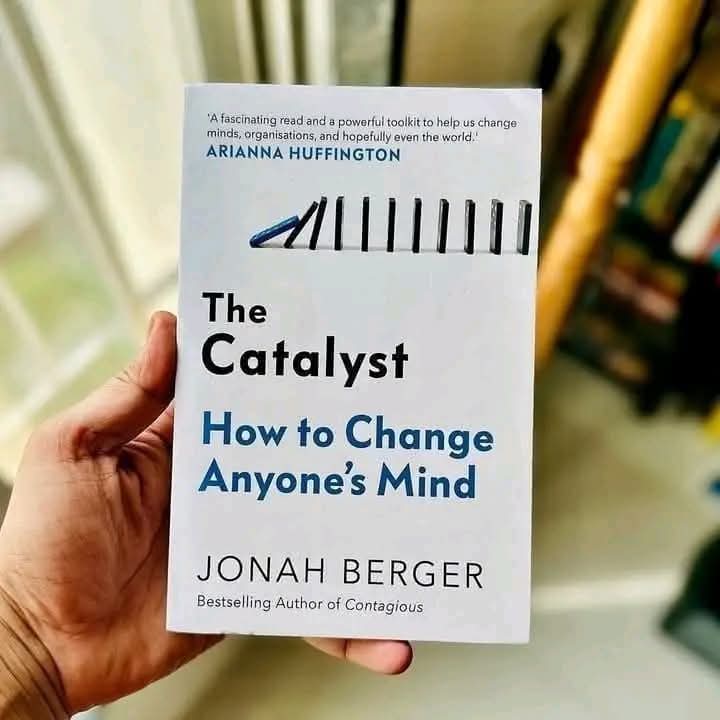
Here are 7 wonderful lessons from The Catalyst: How to Change Anyone's Mind by Jonah Berger:
1. Reduce Reactance, Don’t Trigger Resistance
People resist being pushed. Instead of forcing change, encourage autonomy and let others feel they’re choosing freely. Ask questions rather than giving commands.
2. Shrink the Distance
Too much change feels overwhelming. Break your message into smaller, relatable steps. Meet people where they are and move them gradually toward change.
3. Highlight the Costs of Inaction
People often stick to the status quo. Instead of only promoting benefits, make the cost of doing nothing visible—what they lose by staying the same.
4. Remove Uncertainty
Uncertainty kills action. Provide social proof, guarantees, or trial opportunities to reduce fear and make taking the first step easier.
5. Find the Movable Middle
Not everyone is ready to change. Focus your efforts on those who are open but undecided, rather than trying to convert the extremes.
6. Let People Own the Idea
Change is more effective when people feel ownership over the decision. Guide them to discover insights themselves instead of telling them what to think.
7. Empathy is More Persuasive Than Argument
Understanding people’s true barriers—emotional, social, practical—allows you to remove friction rather than just adding more facts or pressure.
https://amzn.to/3YEWIq8
Click on the link and GET ON AMAZON
People resist being pushed. Instead of forcing change, encourage autonomy and let others feel they’re choosing freely. Ask questions rather than giving commands.
2. Shrink the Distance
Too much change feels overwhelming. Break your message into smaller, relatable steps. Meet people where they are and move them gradually toward change.
3. Highlight the Costs of Inaction
People often stick to the status quo. Instead of only promoting benefits, make the cost of doing nothing visible—what they lose by staying the same.
4. Remove Uncertainty
Uncertainty kills action. Provide social proof, guarantees, or trial opportunities to reduce fear and make taking the first step easier.
5. Find the Movable Middle
Not everyone is ready to change. Focus your efforts on those who are open but undecided, rather than trying to convert the extremes.
6. Let People Own the Idea
Change is more effective when people feel ownership over the decision. Guide them to discover insights themselves instead of telling them what to think.
7. Empathy is More Persuasive Than Argument
Understanding people’s true barriers—emotional, social, practical—allows you to remove friction rather than just adding more facts or pressure.
https://amzn.to/3YEWIq8
Click on the link and GET ON AMAZON
No comments yet — be the first!