
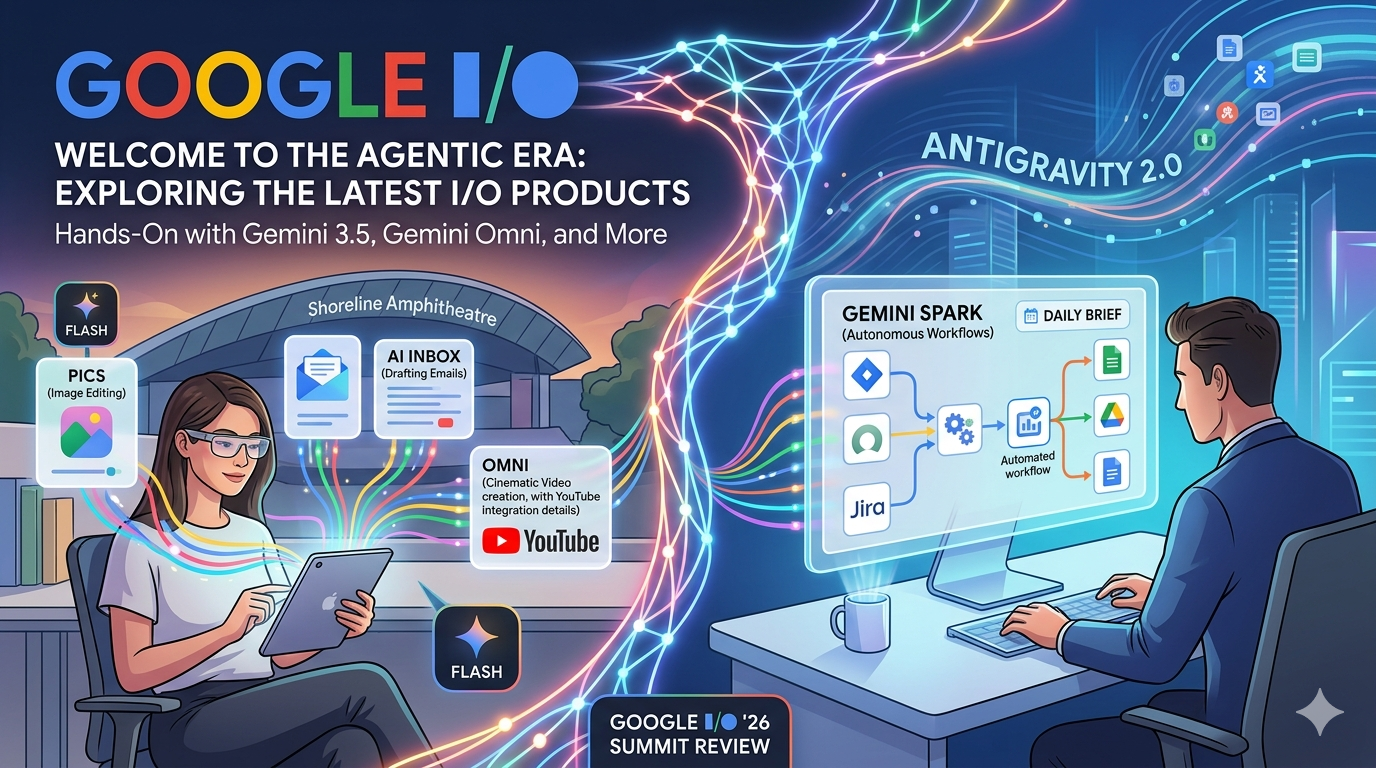
Welcome to the Agentic Era: A Deep Dive Into the Groundbreaking Google I/O Products of 2026
I just got back from sorting through the mountain of announcements at the Shoreline Amphitheatre, and let me tell you—the atmosphere at Google I/O this year was electric. Sundar Pichai stood on stage and dropped a number that blew my mind: Google is now processing 3.2 quadrillion tokens a month. "I never imagined I'd say the word 'Quadrillion' in an I/O keynote," he laughed. But that massive data power isn't just an abstract stat anymore. It is actively fueling a brand-new wave of Google I/O products that are shifting us from basic chatbots into the era of the autonomous "AI agent."
If you felt like last year was all about AI answering your questions, this year is about AI actually doing your chores. Let’s break down the most exciting hardware, software, and underlying frameworks that rolled out of the summit.
Meeting the New Software Suite: The Standout Google I/O Products
The biggest buzz in the developer sandboxes and consumer demos centered on how our daily apps are transforming. Google isn't just adding smart features; they are rolling out entirely new, standalone Google I/O products that fundamentally change how we create, search, and work.
Gemini 3.5 Flash and the Neural Expressive Design
First up is the engine under the hood. Google launched Gemini 3.5 Flash, and it is remarkably fast. It’s the new default model globally for the consumer Gemini app and Google Search. Sitting in the demo booth, I watched it spit out complex code blocks and heavy data analysis four times faster than previous frontier models.
What makes it feel alive, though, is what Google calls the "Neural Expressive" design language. The UI doesn't just display static text responses anymore; it uses fluid animations and conversational voice interactions that adapt to the rhythm of your natural speech. It feels less like executing a machine command and more like having a fluid, real-time brainstorm with a colleague.
Gemini Omni: True Multimodal Generation
We’ve heard the word "multimodal" a lot, but Gemini Omni pushes it to its logical conclusion. It’s a world model capable of generating high-fidelity outputs from absolutely any input modality. The initial rollout, Gemini Omni Flash, focuses heavily on cinematic video.
During a live demonstration, a creator typed a quick text prompt, uploaded a single still photo, and asked the model to turn it into a shifting video scene. The continuity was staggering—the physics of moving water and character clothing held perfectly consistent across multiple conversational edit prompts. It's rolling out to YouTube Shorts Remix right away, allowing creators to seamlessly remix existing content with automated safety labels attached.
Google Pics and the AI Inbox
For everyday office workflows, Google Pics is going to be a lifesaver. Integrated directly into Docs, Slides, and Drive, this tool gives you granular, pixel-level control over image editing via natural language. You can point to a product photo, say "move this coffee mug to the left and translate the label text to Spanish," and it happens dynamically on a collaborative canvas.
Paired with the wider release of the AI Inbox—which features personalized draft replies and one-click task management—the sheer volume of administrative friction being removed from the average workday is immense.
From Assistance to Action: The Frameworks and Wearables
It’s one thing to have an app edit a photo, but it’s another to have a system run workflows in the background while your laptop is completely closed. That is where the architectural updates and hardware partnerships come into play, anchoring the most ambitious Google I/O products of the summit.
Gemini Spark and the Antigravity Engine
The true showstopper of the keynote was Gemini Spark. Powered by Gemini 3.5 and the newly upgraded Antigravity 2.0 framework, Spark is a 24/7 cloud-based agent designed to handle long-horizon tasks autonomously.
I asked one of the project engineers how it handles cross-platform confusion. "Spark doesn't just wait for you to prompt it," they told me. "It actively monitors your connected streams. If a critical system alert triggers in ServiceNow, Spark can autonomously draft an incident report in Docs, loop in developers via Jira, and ping a manager on Chat for final approval." Later this year, you'll be able to track Spark's background progress directly on your phone through a dedicated interface called Android Halo, or let it browse the web for you as an agentic assistant inside Chrome.
Intelligent Eyewear: The Android XR Glasses
On the physical hardware front, Google chose style over bulky tech. They officially unveiled their intelligent eyewear platform built on Android XR. Developed in close partnership with Samsung, Warby Parker, and Gentle Monster, these look and feel like high-end, everyday glasses rather than a tech gadget.
Leaning heavily into spatial AI audio and contextual visual cues, these smart glasses act as a subtle, hands-free viewport for your Gemini agents. While pricing details are still under wraps, they are slated to arrive later this year, presenting a direct, style-first challenge to the wearable market.
Comments
0