
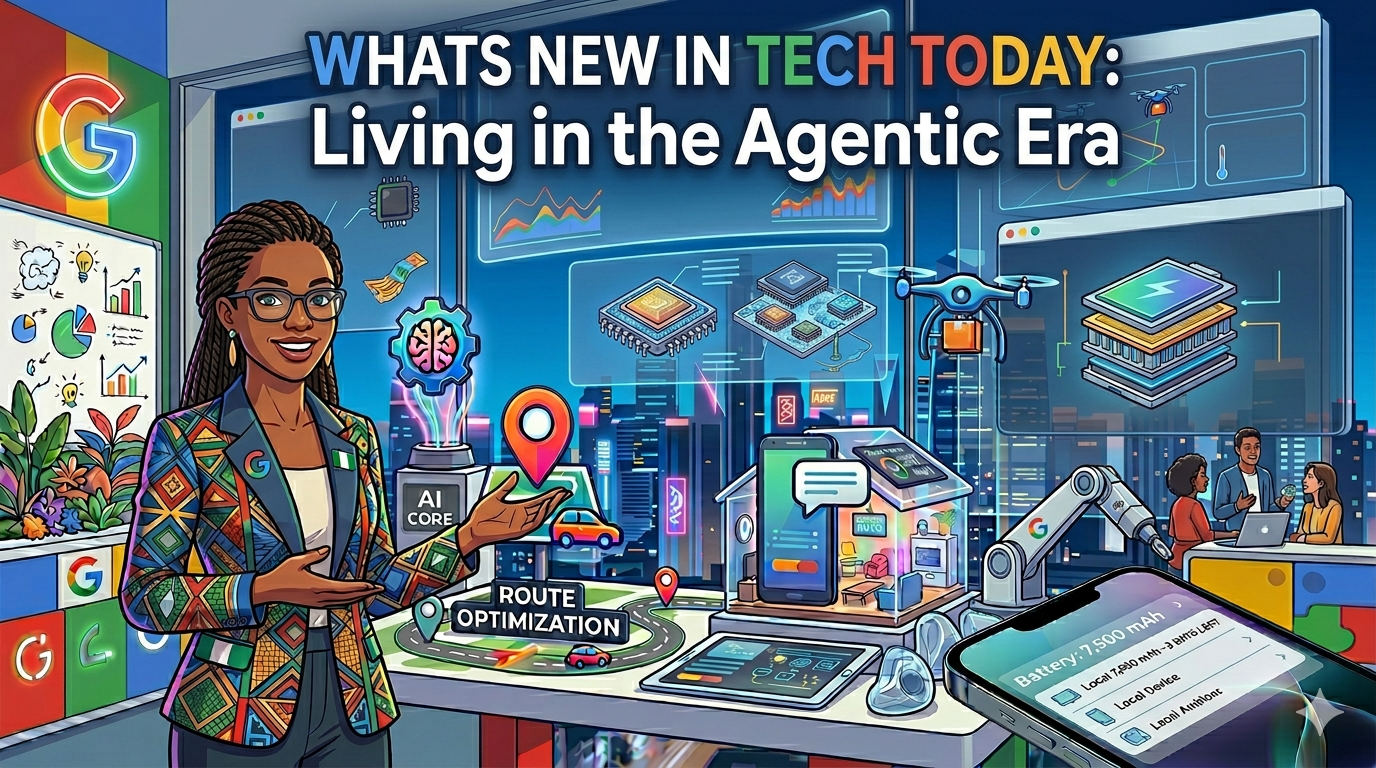
Whats new in tech today: Living in the Agentic Era
If you woke up this morning thinking the tech industry is still just about downloading apps, mindless scrolling, and tapping screens, it is time for a serious reality check. The digital world did not just get a standard software upgrade overnight; it completely rewrote its own playbook. We have officially crossed the invisible line separating simple tools that wait for your commands from autonomous systems that think, predict, and act on your behalf.
Let us dive right into the heart of the latest shifts and look at exactly whats new in tech today.
The Birth of 24/7 Autonomous AI Agents

The single most disruptive shift happening right now is the death of the traditional search box and the birth of "agentic" software. We are no longer just chatting with AI models to get quick text summaries; we are giving them job descriptions, setting permissions, and letting them run in the background. Technology is transitioning from a passive dashboard into a proactive digital workforce.
During a recent tech strategy huddle discussing this massive architectural pivot, a veteran product engineer summarized the industry's new North Star:
"We are entirely moving away from assistant apps that tell you how to do something. The new goal is to build software that simply goes out and executes the task for you while you sleep."
Look at the massive overhauls rolling out from the industry's biggest players. Google completely transformed its core ecosystem by introducing a universal AI layer. It isn't just about an AI answering questions anymore; it is about an AI that orchestrates your digital life across Search, Android, Chrome, and Workspace. If you are tracking chaotic market shifts or hunting for real estate, you do not manually open multiple tabs and refresh pages anymore. You deploy an active AI agent. It monitors data streams 24/7 and coordinates complex workflows without you ever lifting a finger.
?OpenAI is chasing the exact same horizon by extending its advanced coding and automation workflows directly into mobile environments. Developers and everyday users can now monitor active AI workflows, approve background commands, and launch multi-step tasks remotely from their smartphones. This means your software keeps working, problem-solving, and building even when you are completely away from your computer.
?Ambient Gear: What’s New in Tech Today Regarding Hardware

While the software layer becomes profoundly smarter, the physical gadgets we carry are undergoing an equally dramatic hardware evolution. If you look at whats new in tech today regarding consumer gear, the tech industry is finally moving past the era of the flat, glowing glass brick.
We are seeing a major push toward ambient computing—bringing artificial intelligence directly into the physical world through voice, audio, and advanced gesture recognition. The biggest indicator of this trend is the rapid resurgence of smart glasses running sophisticated operating systems like Android XR. These devices don't isolate you from reality like a heavy virtual reality headset; they layer contextual information directly over your physical environment.
A retail specialist testing the latest iteration of AI-powered smart eyewear shared their firsthand experience:
"I wore them through a crowded morning market, and the lenses highlighted exactly which local vendors had the specific organic ingredients I needed, while calculating the total cost in real time. It didn't feel like using a computer at all. It felt like having a photographic memory and an expert guide built right into my own eyes."
Even the classic smartphone interface is beginning to fragment. Major tech brands and boutique design firms are actively developing dedicated "AI agent phones." These pocket-sized devices bypass traditional app stores completely. Instead of opening a travel app to book a flight, a banking app to transfer funds, and a messaging app to update your family, you just speak to the device. The core operating system handles the cross-platform logistics natively.
The Power Bottleneck and the Reality of Tokenmaxxing
All this breathtaking, rapid innovation sounds like a flawless victory for Silicon Valley, but it is hitting a massive physical wall: energy consumption. The sheer computational capacity required to run millions of persistent, always-on AI agents simultaneously is putting unprecedented strain on global infrastructure.
Because of this constant, heavy usage, tech developers have entered an era of "tokenmaxxing"—a industry trend where programmers focus intensely on maximizing the amount of work delegated to AI models while trying to squeeze every ounce of efficiency out of every single data token consumed.
An infrastructure analyst recently warned a global energy forum about the immediate challenges ahead:
"The absolute bottleneck for the next phase of human technology isn't our software logic or our microchip designs. It's the electrical grid. We are running out of the clean, raw power required to keep these massive server farms cool while they process trillions of autonomous background tasks."
This energy crunch is causing fascinating economic ripple effects. The surging demand for electricity has even fueled recent initial public offerings (IPOs) for alternative energy startups, as tech conglomerates scramble to secure geothermal and nuclear power sources to keep their data centers running.
Furthermore, running these elite models is becoming so operationally expensive that some enterprises are facing a strange paradox. In specific sectors, well-trained human teams are actually proving to be more cost-effective than burning endless, costly server computing power on hyper-complex tasks.
Navigating the Future Shift

The common thread tying all of today's tech news together is seamless integration. The strict boundaries that used to separate your smartphone's operating system, your web browser, your workplace software, and your physical environment are dissolving into a single, cohesive intelligence layer.
We are no longer using technology as a digital filing cabinet or a simple communication tool. We are collaborating with it as an active partner. Whether you are excited to deploy an autonomous agent to handle your routine business logistics, or you are looking forward to stepping out into the world with a pair of lightweight smart glasses, one thing is completely undeniable: the tech landscape has never moved faster than it is moving right now. Turn your back on these changes for even a couple of weeks, and you will return to an entirely different world.
Great article. Would like to know more about this topic!!