
Hybrid Fabric: What AMD’s Equity Stake in PsiQuantum Reveals About the Classical Backbone of Utility-Scale Quantum Systems
On November 12, 2026, Advanced Micro Devices and PsiQuantum announced an expanded strategic partnership that moves AMD from component supplier to equity investor and co-designer of the classical infrastructure required for utility-scale, fault-tolerant quantum computers. The companies will jointly develop systems that combine PsiQuantum’s silicon-photonics quantum platform with AMD’s EPYC CPUs, Instinct GPUs, Versal adaptive computing, and ROCm software stack. Early joint work already includes large-scale simulations of covalent inhibitors relevant to oncology drug discovery and machine-learning decoders for real-time quantum error correction. Neither side disclosed the size of AMD’s planned equity investment. The announcement arrived the same day markets digested other major computing stories, yet it points to a quieter structural shift: practical quantum advantage will not arrive as a pure quantum machine. It will arrive as a tightly integrated hybrid fabric in which classical processors handle error correction, orchestration, and hybrid workloads at a scale classical systems already understand.
From FPGA Selection to Full-Stack Co-Design
The relationship did not start with equity. PsiQuantum had already selected AMD’s Versal FPGAs for the control and decoding layers of its fault-tolerant photonic platform. Photonic quantum computers encode information in pulses of light and manipulate it on silicon-photonic chips manufactured in conventional semiconductor fabs. That approach sidesteps some of the cryogenic and interconnect constraints that limit superconducting or trapped-ion systems, yet it still requires enormous classical horsepower for real-time error correction, photon detection readout, and the orchestration of millions of physical qubits into logical ones. Versal devices provided the reconfigurable logic and high-speed I/O needed for that control plane. The November 12 expansion adds the rest of AMD’s data-center portfolio and formalizes co-design so that quantum and classical teams iterate on the same infrastructure rather than bolting classical resources on later.

This progression mirrors a broader pattern already visible in classical AI infrastructure. High-performance computing systems have long required tightly coupled CPUs and accelerators; the arrival of agentic workloads has only intensified the demand for orchestration silicon that can keep GPUs fed with data and schedule complex multi-step tasks. AMD’s own recent emphasis on high-core-count EPYC processors for agentic AI reflects the same recognition that raw accelerator flops are insufficient without a capable classical host. Extending that host role into the quantum domain is a logical next step. Official details appear in the companies’ joint announcement on the PsiQuantum site and in contemporaneous reporting from Reuters.
Why Photonics Changes the Classical Requirements
PsiQuantum’s architecture is built around silicon photonics: single-photon sources, superconducting detectors, optical switches, and chip-to-chip interconnects that can be produced at volume in existing fabs. Because photons are relatively immune to thermal noise, control electronics can sit closer to the quantum plane than is typical for superconducting systems that demand dilution refrigerators. The company has already demonstrated high-fidelity single-qubit operations, two-qubit fusion, and long-range interconnects on its Omega chipset, published earlier in Nature. Those component-level results matter, yet they do not eliminate the classical load. Error correction for a fault-tolerant machine still demands continuous, low-latency decoding of syndromes. Hybrid applications—quantum chemistry simulations that hand intermediate results to classical optimizers or machine-learning models—require high-bandwidth data movement between the photonic fabric and GPU clusters.
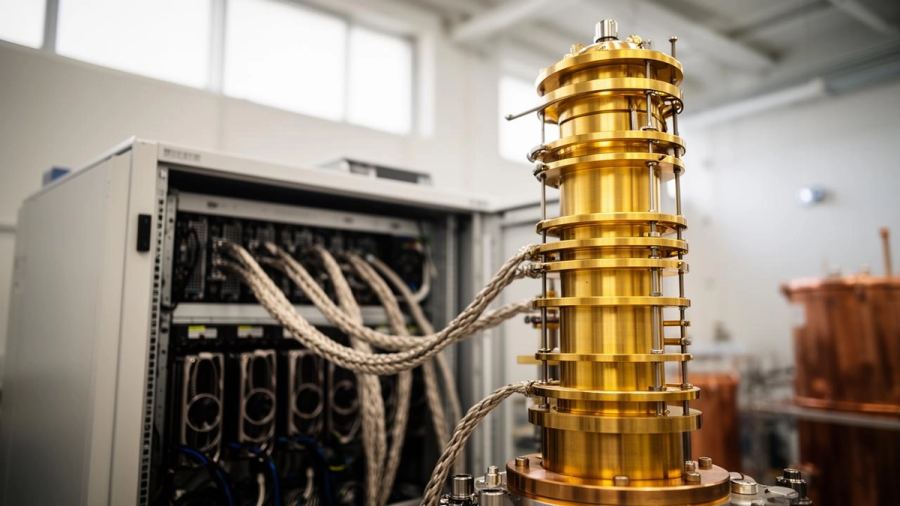
The partnership therefore focuses on co-designing the entire classical envelope: the CPUs that run the control software and hybrid orchestration layers, the GPUs that accelerate simulation and decoding, the adaptive FPGAs that provide deterministic low-latency paths, and the ROCm software stack that lets developers target the heterogeneous platform without rewriting every kernel. Early results on covalent-inhibitor simulations already show that combining PsiQuantum’s chemistry workflow with AMD GPU scale produces more accurate molecular models than prior classical-only methods. That is not yet quantum advantage in the strict sense, but it is evidence that the hybrid loop can be closed today on commercially relevant chemistry problems. Drug discovery is the first commercial target; the companies also noted alignment with U.S. Quantum Genesis priority applications in biological modeling.
Equity Investment and the Broader Capital Pattern
AMD’s decision to take an equity stake, rather than remain a pure vendor, signals longer-term alignment. The size remains undisclosed, so the financial magnitude is unknown. The move fits a pattern in which classical semiconductor firms are buying seats at the quantum table without building their own qubits. In May 2026 the U.S. Department of Commerce outlined plans to take minority stakes in nine quantum companies under a roughly $2 billion CHIPS Act program; PsiQuantum was among those slated for a $100 million commitment. Private capital and strategic corporate investment are therefore reinforcing public support. For AMD the upside is not primarily quantum revenue in the near term. It is the opportunity to supply the classical processors, interconnect, and software that every utility-scale photonic system will need, plus potential pull-through for its data-center GPUs on the hybrid workloads that will run alongside the quantum machines.

This capital logic echoes other recent moves in the AI and computing stack. Frontier labs have moved from pure software companies into direct ownership of power generation capacity and long-term chip commitments. Semiconductor suppliers have taken stakes or formed deep co-design partnerships with AI laboratories. Optical interconnect specialists have consolidated to capture the shift from copper to photonics inside AI data centers. The PsiQuantum-AMD relationship sits at the intersection of those trends: a photonic quantum company whose manufacturing base is already semiconductor-native, paired with a classical chipmaker that can supply both the control plane and the high-performance accelerators required for hybrid applications. Further details are expected at SC26 in Chicago, November 15–20, and the companies are exploring a joint footprint at the Illinois Quantum and Microelectronics Park, where PsiQuantum is already the anchor tenant.
What It Means for Quantum Timelines and Competitive Position
Utility-scale fault-tolerant quantum computers remain years away. PsiQuantum has targeted large-scale systems in Brisbane and Chicago; IBM continues to advance modular superconducting processors with higher operation rates and chip-to-chip interconnects. The AMD partnership does not change the fundamental physics timeline, yet it changes the engineering one. By embedding classical co-design from the outset, the companies reduce the risk that a working quantum core arrives without a matched classical envelope capable of correcting errors in real time or running useful hybrid algorithms. Photonic approaches also offer a potential side benefit for classical AI infrastructure: PsiQuantum has already demonstrated low-loss optical circuit switches on the same silicon-photonics platform, with insertion loss and reconfiguration times competitive for GPU-network scale-out. The quantum work therefore doubles as a technology platform for the optical interconnects that AI data centers increasingly require.
Competitive implications are straightforward. AMD gains a differentiated path into quantum infrastructure that does not require it to invent a qubit. PsiQuantum gains assured access to leading-edge CPUs, GPUs, and software at a moment when every serious quantum effort is competing for classical control resources. Other quantum modalities—superconducting, trapped ion, neutral atom—will still need their own classical partners; the photonic route simply has a particularly clean manufacturing and thermal story that aligns well with existing semiconductor supply chains. Markets reacted positively: AMD shares rose nearly 3 percent on the day of the announcement, aided by the quantum news and a separate price-target increase. Longer-term valuation will depend on whether the hybrid systems deliver measurable improvements in drug-discovery workflows or other priority applications before larger fault-tolerant machines arrive.
What to Watch Next
Several concrete milestones will clarify whether the partnership is producing more than press releases. First, the companies have promised additional technical detail at SC26. Second, progress on the covalent-inhibitor simulations and the machine-learning error-correction decoder will show whether the hybrid loop is tightening. Third, any announcement of a joint physical footprint at the Illinois park or of specific hardware orders will convert the equity commitment into tangible supply. Fourth, PsiQuantum’s optical-switch work for classical AI networks offers a nearer-term commercial path that can fund the longer quantum roadmap. Finally, the undisclosed investment size and any subsequent funding rounds will indicate how much capital both sides are willing to commit while utility-scale systems are still under construction.
Related TechMash analysis of adjacent developments includes the modular speed focus of IBM’s latest quantum processors, the memory-bound constraints now shaping AI inference silicon, the optical interconnect consolidation occurring inside classical AI infrastructure, the wafer-economics pressures that govern advanced node supply, and the shift by frontier labs toward direct control of power and capacity. Those stories share a common theme: scaling compute—classical or quantum—now depends as much on the surrounding classical fabric, power, and packaging as on the core computational element itself.
The AMD-PsiQuantum announcement is therefore less a quantum-computing headline than a statement about systems integration. Utility-scale machines will be hybrid by necessity. The classical processors that already dominate data centers will become the indispensable control and acceleration layer for the photonic or superconducting cores that eventually deliver advantage. By taking equity and committing to co-design, AMD is positioning itself to supply that layer rather than waiting to sell components after the fact. The size of the bet remains unknown, and the timeline to practical advantage remains long. What is clear is that the classical backbone is no longer an afterthought. It is the fabric that will determine whether the first useful quantum computers can actually run the workloads for which they were built.
External sources: PsiQuantum and AMD partnership announcement and Reuters coverage of the investment.
Internal related reading: IBM’s modular quantum speed focus, memory-first inference architectures, optical interconnect consolidation, TSMC wafer economics for AI, and AI labs securing power capacity.
Comments
0