
Owning the Queue: Why Anthropic’s $3.4 Billion Generator Takeover Signals AI’s Shift to Direct Power Control
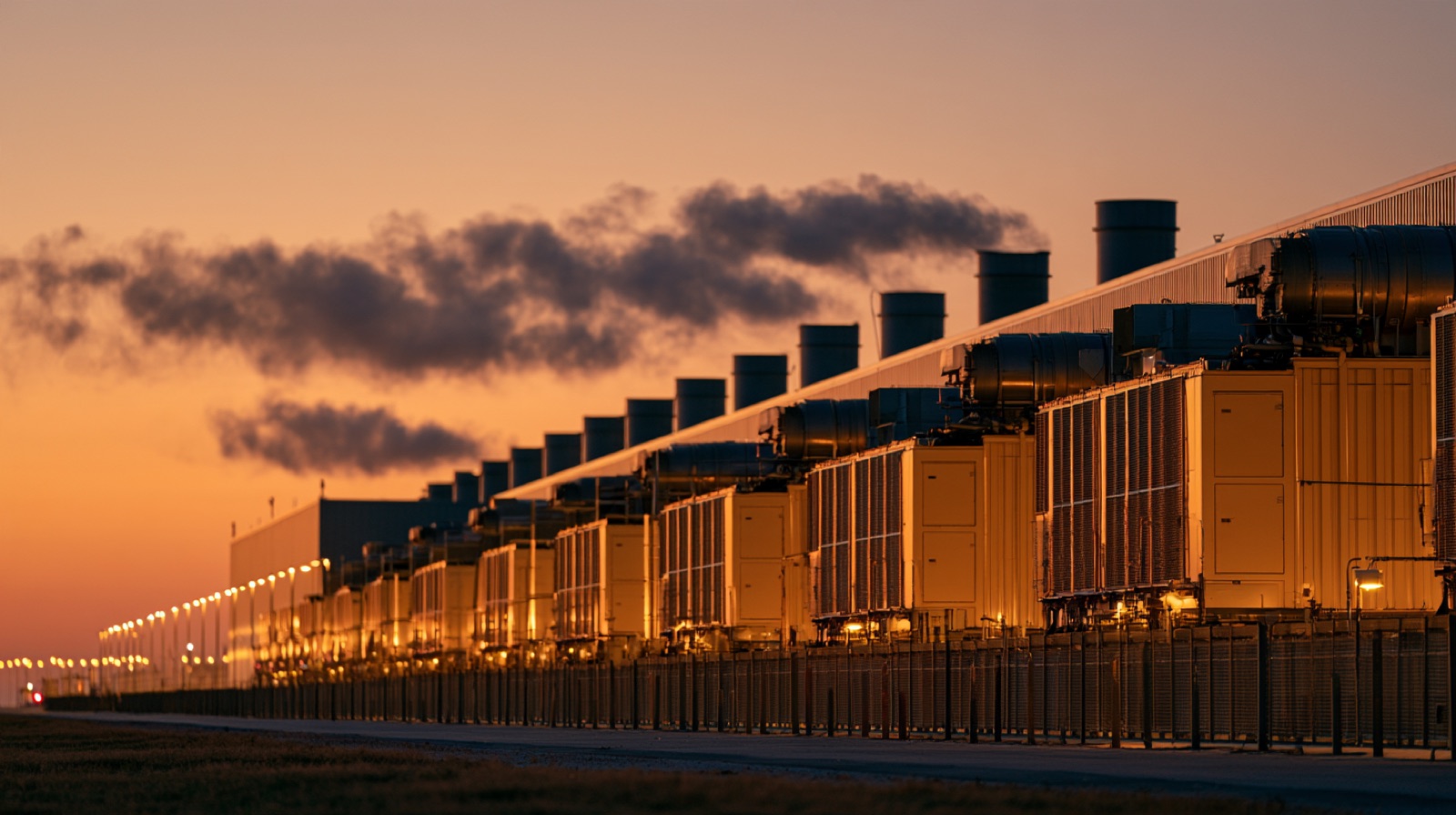
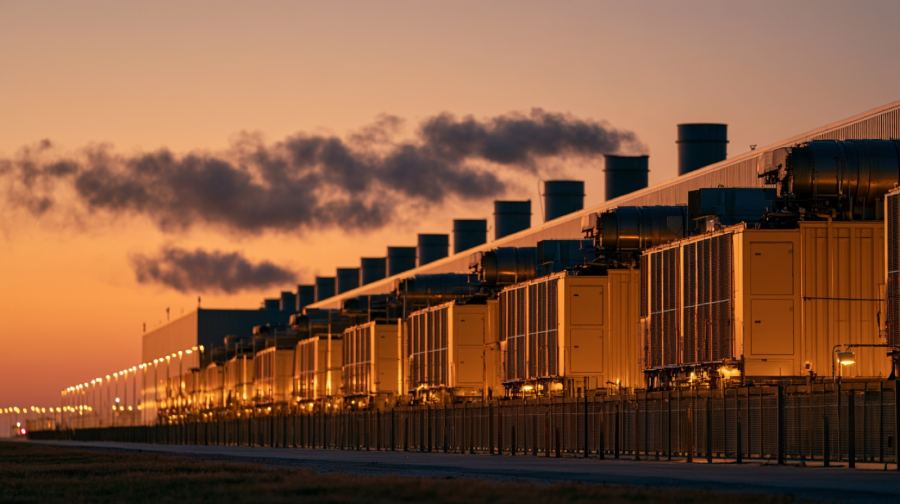
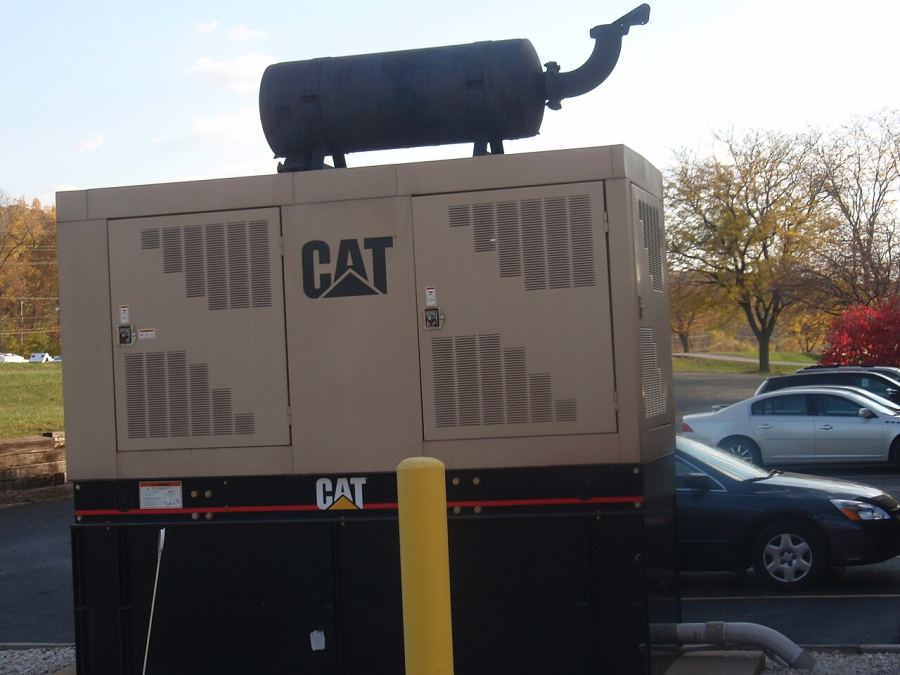
On November 8, 2026, the Financial Times reported that Anthropic had agreed to pay roughly $3.4 billion for commitments covering 1.7 gigawatts of heavy-duty gas-fired generators. The units were originally ordered from Caterpillar by San Antonio-based OnePWR Solutions about two years earlier. Rather than simply becoming a power customer, Anthropic assumed the existing queue position along with the engineering and construction capacity needed to install the equipment. The company did not acquire OnePWR itself, and no staff transferred.
The transaction is the largest known single purchase of power-generation hardware by an AI laboratory. It arrives as Anthropic continues marketing its initial public offering, with revenue already reaching $16.3 billion in the first half of 2026. The deal illustrates a structural change: frontier labs are no longer content to wait for utility interconnection queues that can stretch into the 2030s. They are buying the machines that turn fuel into electrons.
Key Facts from the Reported Transaction
According to people familiar with the matter cited by the Financial Times and subsequently covered by Reuters and Bloomberg, the agreement was signed in late September. OnePWR had placed the Caterpillar orders earlier but needed capital to complete them. Anthropic initially considered buying power from the supplier, then pivoted to taking over the equipment commitments. The $3.4 billion figure covers both the generators and the installation expertise. At face value that equates to roughly $2,000 per kilowatt of nameplate capacity.
Neither Anthropic nor OnePWR has publicly confirmed the details, and Reuters noted it could not immediately verify the report. Still, the scale matches Anthropic’s own earlier statements about infrastructure spending. In September the company indicated it expected to invest more than $500 billion over the next decade building AI capacity. Its amended S-1 filing has also flagged risks tied to on-site natural-gas generation, including fuel-price volatility and supply disruptions outside its control.
The generators are expected to become available in the near term and over the following two years because the original orders predated the recent surge in demand and lengthening manufacturing lead times. Locations for deployment have not been disclosed. The absence of a specific site is itself informative: the scarce asset is the manufacturing slot and the ability to install quickly, not yet a particular plot of land.
Why the Energy Constraint Has Become Binding
For most of 2025 and 2026 the industry conversation focused on chip supply, high-bandwidth memory, and advanced packaging. Those bottlenecks remain real, yet they are no longer the only gates. Multiple projects have stalled or been restructured because local grids cannot deliver the required megawatts on acceptable timelines. Microsoft’s earlier withdrawal as anchor tenant from an Nscale campus in the United Kingdom, analyzed previously on TechMash, showed how even well-capitalized neoclouds can fail when interconnection dates slip into the next decade. The same physical limit now appears inside Anthropic’s own planning documents.
Owning generation equipment changes the economics. Instead of negotiating a power-purchase agreement that depends on someone else’s substation and transmission upgrades, a laboratory can place modular gas units on or near its data-center campus and begin drawing load as soon as the engines are commissioned. The trade-off is explicit: exposure to natural-gas prices and a higher carbon intensity than grid power in many regions, offset by schedule certainty. At current Claude inference volumes, that certainty has a measurable dollar value.
What Direct Ownership Changes for the Industry
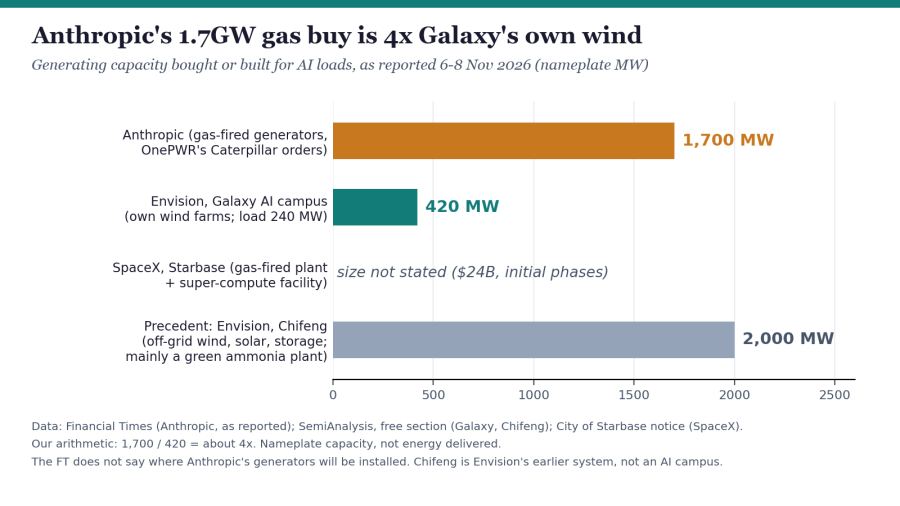
The move from power customer to equipment owner is not unique to Anthropic, but the size of the commitment is. Other laboratories and cloud providers have signed long-term offtake agreements, invested in nuclear restarts, or explored behind-the-meter renewables. Few have written checks of this magnitude simply to jump a Caterpillar manufacturing queue. The transaction therefore sets a reference price for time-to-power. Future deals will be measured against the roughly $2,000-per-kilowatt figure implied here.
It also shifts risk allocation. Utilities and independent power producers traditionally absorb development, permitting, and fuel risks in exchange for long-term contracts. By taking the generators themselves, Anthropic internalizes those risks while capturing the optionality of placing the capacity where its own models create the highest marginal return. That optionality is valuable while inference demand continues to grow faster than most forecasts made twelve months ago. Related TechMash coverage of Anthropic’s internal productivity shift, where agent hours already outnumber human hours by a wide margin, helps explain why the company is willing to lock in physical capacity now rather than wait for cleaner but slower alternatives.
For suppliers the signal is equally clear. Caterpillar and peers that can deliver large reciprocating or turbine packages on compressed schedules gain pricing power. Equipment that was once viewed as a commodity backup asset becomes a strategic input on the same order as leading-edge GPUs. Companies that can offer both the hardware and the engineering teams required to install and interconnect it at data-center scale will see their order books lengthen further.
Implications for Valuation, Regulation, and Competition
Anthropic’s IPO process has already encountered a more cautious market. Prospective investors have discussed ranges below the $1.5 trillion to $2 trillion figures floated earlier in the year. Securing 1.7 GW of near-term generation capacity is one concrete response to the question of how the company will support continued revenue growth once public-market scrutiny intensifies. The same filing that discloses the gas-generation risk also highlights the scale of contracted demand. Demonstrating physical control over a large block of power reduces one source of execution uncertainty for underwriters and long-only funds.
Regulators will take note as well. Midterm election results in the United States and local protests against data-center expansion in Europe have already slowed some permitting processes. On-site gas generation does not eliminate environmental review, air-quality permits, or community opposition, but it can decouple a project from the longest utility interconnection queues. Expect greater scrutiny of fuel sourcing, methane leakage, and the interaction between private generation and wholesale power markets. The same political environment that has slowed pure grid-connected campuses may now accelerate hybrid designs in which laboratories own or control a portion of their supply.
Competition among the frontier labs is also affected. OpenAI, Google, Meta, and xAI face analogous constraints. Any laboratory that can credibly show it has locked in multi-gigawatt capacity on a two-year horizon gains an advantage in customer conversations that involve multi-year capacity reservations. The advantage is temporary—other players will copy the tactic—but in a market where model capability gaps are measured in months, temporary schedule advantages matter. Earlier TechMash analysis of open-weight progress, including Kimi K3.1 Pro’s narrowing of the closed-model gap, shows that capability leadership remains contested; power availability is one of the few remaining durable differentiators.
What to Watch in the Coming Months
First, confirmation or further detail from the parties themselves. Anthropic’s next S-1 amendment or investor presentation may quantify the power commitment or identify regions. Second, delivery schedules. The original orders were placed roughly two years ago; the actual commissioning dates will reveal how much of the reported “near-term” availability is realistic once installation, fuel infrastructure, and interconnection work are complete. Third, copycat transactions. If other laboratories announce similar takeovers of existing equipment orders, the $2,000-per-kilowatt reference will harden into an industry benchmark. Fourth, the interaction with Anthropic’s public-market timeline. A successful listing would give the company additional balance-sheet capacity to finance further power assets; a delayed or downsized offering would force prioritization among competing capital uses.
Investors and operators should also monitor fuel-price sensitivity. Anthropic has already disclosed the risk. A sustained rise in Henry Hub or European gas benchmarks would flow through to inference costs faster for operators that own the generators than for those still buying from the grid under fixed contracts. The same ownership that buys schedule certainty also imports commodity volatility.
Conclusion: Electrons as the Next Strategic Input
The $3.4 billion generator transaction is not merely a procurement story. It marks the moment when a leading AI laboratory decided that the most reliable way to obtain the next 1.7 gigawatts was to own the machines that produce them. Chip shortages and memory tightness remain important, yet they are now accompanied by an equally binding constraint measured in turbines, reciprocating engines, and the skilled crews that install them. Laboratories that treat power as a commodity they can purchase on the spot market will continue to discover that the spot market has long lead times. Those that treat it as a strategic asset they can acquire, site, and operate will set the pace of capacity expansion through 2027 and 2028.
Anthropic’s move is consistent with its earlier internal shifts toward agentic workflows and with the broader industry pattern documented across TechMash coverage of energy walls, orbital compute experiments, and humanoid manufacturing ramps. In each case the limiting factor migrates from pure algorithmic progress to the physical systems required to run those algorithms at scale. Owning the queue for 1.7 gigawatts of gas generation is one concrete expression of that migration. The next expression will be visible in the commissioning dates, the fuel contracts, and the competitive responses that follow.
Related reading on TechMash includes analysis of the energy wall facing AI data centers, Anthropic’s IPO path and valuation recalibration, Claude’s growing share of internal research work, open-weight progress narrowing the capability gap, and the physical constraints of scaling robotics and AI systems.
Official reporting on the transaction appears at Reuters and Bloomberg.
Comments
0