
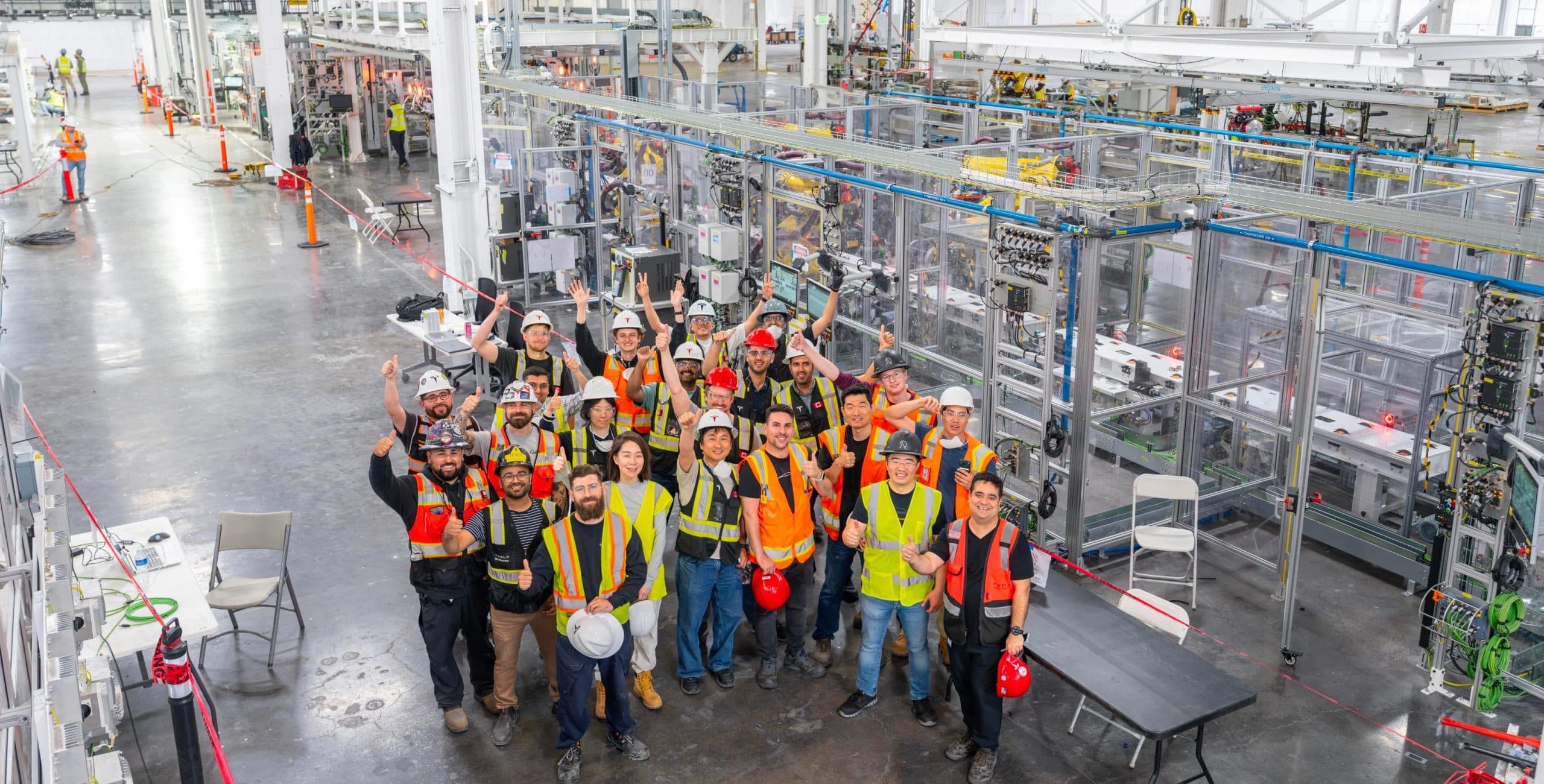
Fremont’s Flagship Floor Turns to Humanoids: What Tesla’s Early Optimus Ramp Reveals About the Physical AI Timeline
On 21 October 2026 Tesla told shareholders that Optimus production had begun on high-volume lines at its Fremont factory. The robots coming off that line, the company wrote in its Q3 update, are “the first production-quality bots that we have manufactured.” The process, it added, has been shown suitable for a commercial product even as hardware and manufacturing continue to iterate. Elon Musk called the start “early production” on the earnings call and said reaching an annualized rate of roughly 20,000 units a week would take at least a year, possibly longer, because Optimus is a radically new product with thousands of unique parts.
The floor space itself is the same one that built every Model S and Model X for more than a decade. Tesla dismantled that assembly line in 46 days earlier in 2026 after ending production of the two flagships in May. The long-term capacity target for the Fremont Optimus line is one million units a year; a larger site under construction in Texas is planned for even higher volume. Outside deliveries are expected around the end of 2027, initially for industrial tasks. No unit count, price, or exact version was disclosed. California is listed as “Early Ramp” in the capacity table; Texas is “Construction.” Both rows lack the numerical installed-capacity figures that appear for vehicle and energy lines.
This is a manufacturing milestone, not yet a commercial product at scale. It is also the clearest industrial signal so far that Tesla is reallocating a proven high-volume factory toward general-purpose humanoids. The implications extend well beyond one company: power density, actuator reliability, data collection for training, and the economics of physical AI all become more concrete once a line designed for cars is running robots.
The Floor That Built the Model S
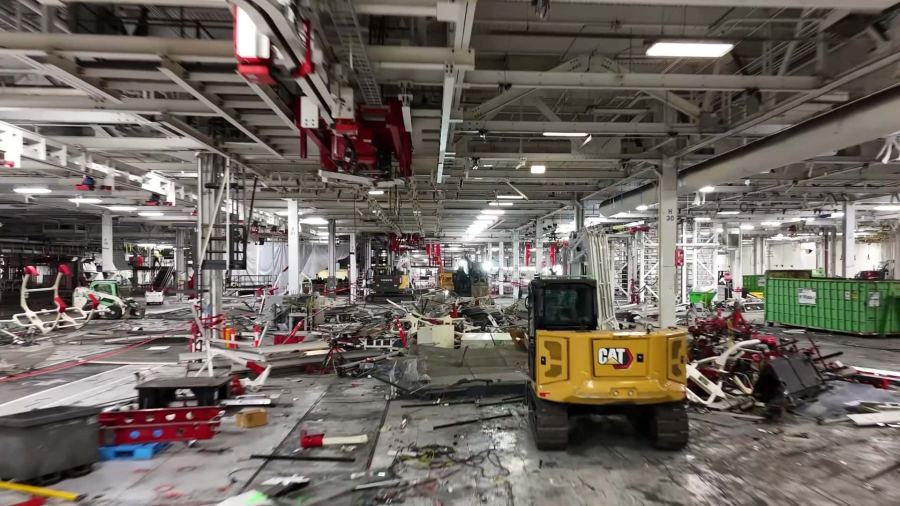
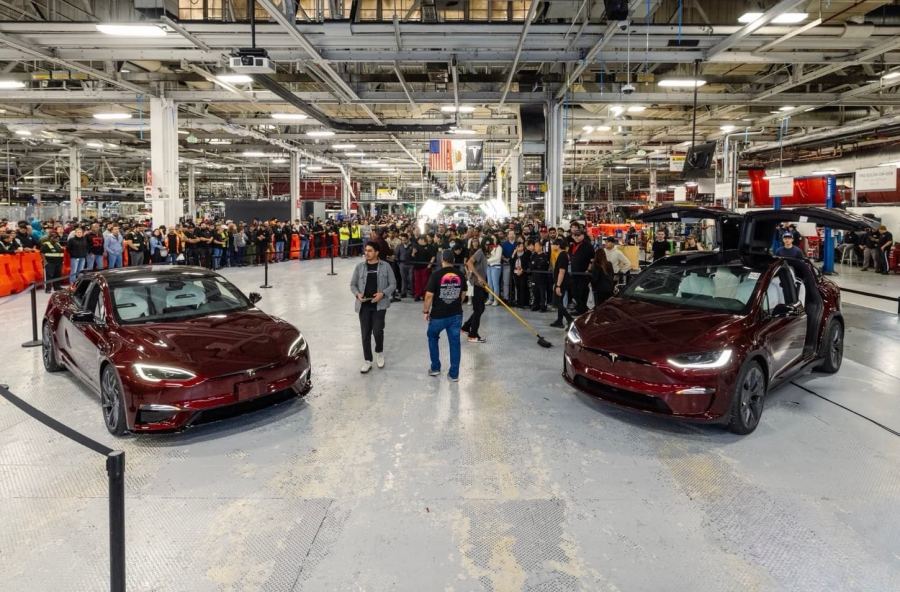
The Model S began production at the former GM-Toyota plant in Fremont in 2012. The Model X joined in 2015. Together they defined Tesla’s early reputation for range, performance, and technology before the Model 3 and Model Y took the volume lead. Combined lifetime output was roughly three-quarters of a million units. By late January 2026 Musk described ending the programs as an “honorable discharge” so the space could be used for robots. Final units left the line in early May. The subsequent teardown was completed in 46 days, a pace Tesla highlighted with time-lapse imagery from its manufacturing account.
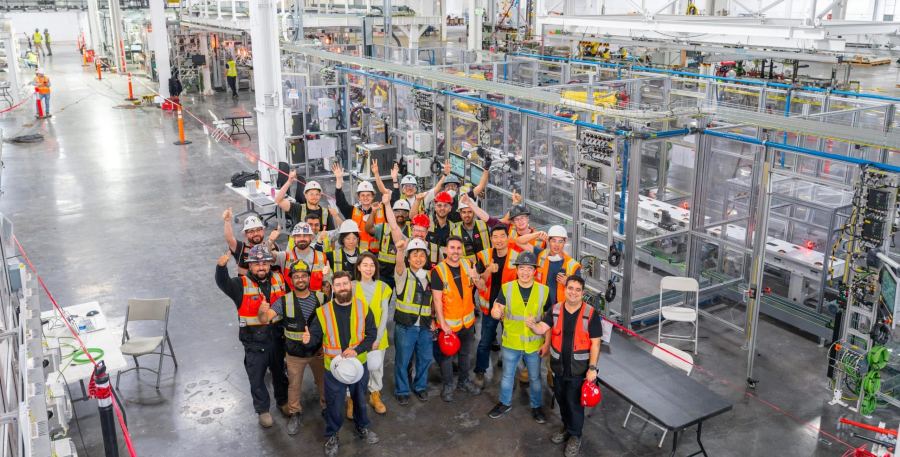
What replaced the fixed automotive line is a modular cell layout intended for a product with more than 10,000 unique components. Early robots are expected to spend time inside Tesla’s own operations—an internal “Optimus Academy” for data collection and simple factory tasks—before any external shipment. Hands remain a acknowledged challenge; rare-earth magnet supply constraints have also been noted. The Q3 materials emphasize that the current process is suitable for a commercial product while refinements continue. That distinction matters: production-quality hardware can exist without yet demonstrating open-ended, unsupervised usefulness at volume.
The same vertical integration that let Tesla scale vehicle and battery production is now being applied to a bipedal form factor. Whether that muscle transfers cleanly is one of the open questions the early ramp is designed to answer.
Why the Timeline and the Numbers Matter
Musk’s one-year-plus estimate to 20,000 units per week is an S-curve description rather than a firm schedule. The early portion of any new-product ramp is shallow and bumpy; ten thousand things must go right. The Q3 deck does not list a current weekly rate or cumulative output. That absence is deliberate. A manufacturing start is easier to document than sustained throughput, yield, or field reliability.
Compare the resource intensity with digital AI. Training a frontier model requires massive clusters and power measured in tens or hundreds of megawatts. Running inference at scale still demands dense, liquid-cooled racks. A humanoid, by contrast, must carry its own actuators, sensors, and compute while operating for hours on a battery, under variable lighting and temperature, and around people. The energy wall that has already delayed or cancelled terrestrial data-center projects appears in different form here: every joint motor, every thermal path, and every safety interlock multiplies cost and complexity. Tesla’s earlier analysis of power constraints in other domains, including the orbital TPU experiments, shows how physical limits reshape deployment economics; the same logic applies to a robot that must move and manipulate rather than simply generate tokens. See related coverage of the energy wall and orbital compute limits.
Related coverage of inference-stack efficiency and agentic systems underscores the software side of the same problem. DeepSeek’s open production engine and Meta’s Muse Wonder releases both emphasize memory, focus, and cost per useful action. Physical AI adds the requirement that those actions succeed in the real world without constant teleoperation. Early Fremont units will generate the real-world data that simulation alone cannot supply. That data loop is the practical bridge between today’s early ramp and any later claim of broad usefulness. Further context appears in analysis of inference economics and agent memory, as well as the wafer constraints that affect every accelerator used in robotics.
What to Watch Next
Several concrete markers will clarify whether the early ramp is progressing. First is any disclosure of weekly or monthly output, even a range. Second is the appearance of external pilot customers or named industrial use cases before the end-of-2027 window. Third is progress on the Texas site and any statement about Gen 3 versus later hardware. Fourth is evidence that the internal Academy is producing measurable capability gains—longer task sequences, higher success rates on factory chores, or reduced human intervention.
Supply-chain signals matter as well. Actuator magnets, specialized gearing, and high-reliability sensors are not yet commodities at the volumes Tesla is targeting. Any sustained constraint there will show up in the slope of the ramp. Safety and regulatory pathways for workplace deployment will also become visible once units leave Tesla’s own walls.
On the broader industry side, watch how other humanoid programs respond. Several competitors are already running limited factory pilots. Tesla’s advantage, if it materializes, will be manufacturing volume and the data flywheel from its vehicle autonomy work. Its risk is the same one that has historically slowed robotics: the gap between a robot that can perform scripted tasks in a controlled environment and one that can handle open-ended variation at acceptable cost and reliability.
Conclusion: A Structural Reallocation, Not Yet a Product
Tesla’s decision to clear the Model S and Model X floor and stand up an Optimus line in its place is a structural statement. Floor space, capital equipment, and engineering attention have been reallocated from a low-volume luxury EV program to a humanoid whose long-term addressable market the company describes in millions of units. The Q3 materials correctly describe the current stage as early ramp and production-quality hardware. They do not claim commercial volume or demonstrated general usefulness. That honesty is useful. The next twelve to eighteen months will show whether the same organization that scaled electric vehicles can also scale a bipedal machine whose every subsystem must survive real physics, real safety requirements, and real economic scrutiny.
Physical AI will be won or lost on the factory floor as much as in the model weights. Fremont’s early Optimus line is the first large-scale test of that proposition from a company that already knows how to run high-volume production. The results will be measured in units that work, not in units that are merely built.
Official sources: Tesla Q3 2026 Update (PDF) and Tesla Investor Relations.
Comments
0