
Crossing the Workweek Threshold: METR’s Latest Data Reveals AI Agents Closing In on Multi-Day Autonomy
On November 20, 2026, the nonprofit Model Evaluation & Threat Research (METR) released its Q4 capability update, offering one of the clearest quantitative windows yet into how quickly frontier AI systems are expanding the length of work they can complete with reliability. The findings center on the organization’s time-horizon metric: the duration of a task, measured by how long a skilled human would need to finish it, at which an AI agent succeeds at a chosen probability threshold. On a combined suite of earlier Time Horizon 1.1 tasks and a newer, more demanding set labeled TH2, METR reports that these horizons are now doubling roughly every 3.6 months. Models including OpenAI’s GPT-6 Astra have reached the point where they can complete tasks that would occupy a human professional for approximately a full work week.
This is not an abstract leaderboard milestone. It arrives amid a broader shift in which AI agents are already handling multi-hour research and engineering work inside labs and, increasingly, on ordinary desktops. The update underscores both the acceleration of measurable autonomy and the persistent gaps in judgment and generalization that still separate current systems from fully unsupervised multi-day projects. Understanding the precise claims, the methodological caveats, and the practical implications requires unpacking what METR measured and why the pace of improvement matters for organizations planning their next one to three years of tooling and workflow redesign.
What METR Actually Measured
METR’s time-horizon approach, introduced in a March 2025 paper and refined through subsequent releases, converts raw success rates on software, machine-learning, cybersecurity, and research-oriented tasks into a single, human-calibrated number. Researchers first establish how long domain experts need to complete each task. They then run AI agents under comparable conditions and fit a curve relating human task length to model success probability. The 50 percent time horizon is the length at which the agent is predicted to succeed half the time; the 80 percent horizon is the more stringent threshold at which success is expected four times out of five.
The November 20 update focuses on a combined suite that mixes the earlier TH1.1 collection with a newer set of harder tasks (TH2). Because the new tasks are more difficult for a given human duration, absolute horizon numbers on the combined set are lower than those previously reported on TH1.1 alone. The key result is the rate of change: horizons are doubling approximately every 3.6 months. METR also notes that the doubling time appears shorter on a verifiable subset of the newer tasks when earlier data are excluded, raising the possibility of a recent acceleration that is partially masked in the aggregate trend. Public models up to Opus 5.5 and GPT-6 Astra were evaluated. The organization emphasizes that measurements above roughly 16 hours remain less reliable because the current task suite contains relatively few ultra-long items with solid human baselines.
These numbers sit against a longer historical trend. Earlier METR work showed roughly seven-month doublings from 2019 through 2025 on the original suite. Post-2023 data had already suggested faster progress. The new 3.6-month figure extends that acceleration into late 2026 and aligns directionally with internal measurements reported by some frontier labs on their own research tasks. At the same time, METR is careful to distinguish well-specified, feedback-rich coding and optimization problems from tasks that require judgment in the absence of rapid empirical signals. On the former, frontier models frequently match or exceed the performance of skilled human baseliners. On the latter, models still lag human experts in assessing solution quality when feedback loops are slow or when generalization beyond the immediate test suite is required.
Why the Acceleration Matters Now

A doubling every 3.6 months compounds quickly. A system that can reliably handle a four-hour expert task today is, under a sustained trend, on track to handle an eight-hour task in roughly three and a half months and a sixteen-hour task in seven months. Crossing from multi-hour to multi-day horizons changes the character of what can be delegated. Short tasks are already routine for coding assistants and desktop agents. Week-scale work encompasses larger research investigations, multi-stage software reimplementations, security assessments that span multiple components, and the coordination of sub-agents on projects that previously required sustained human attention across several days.
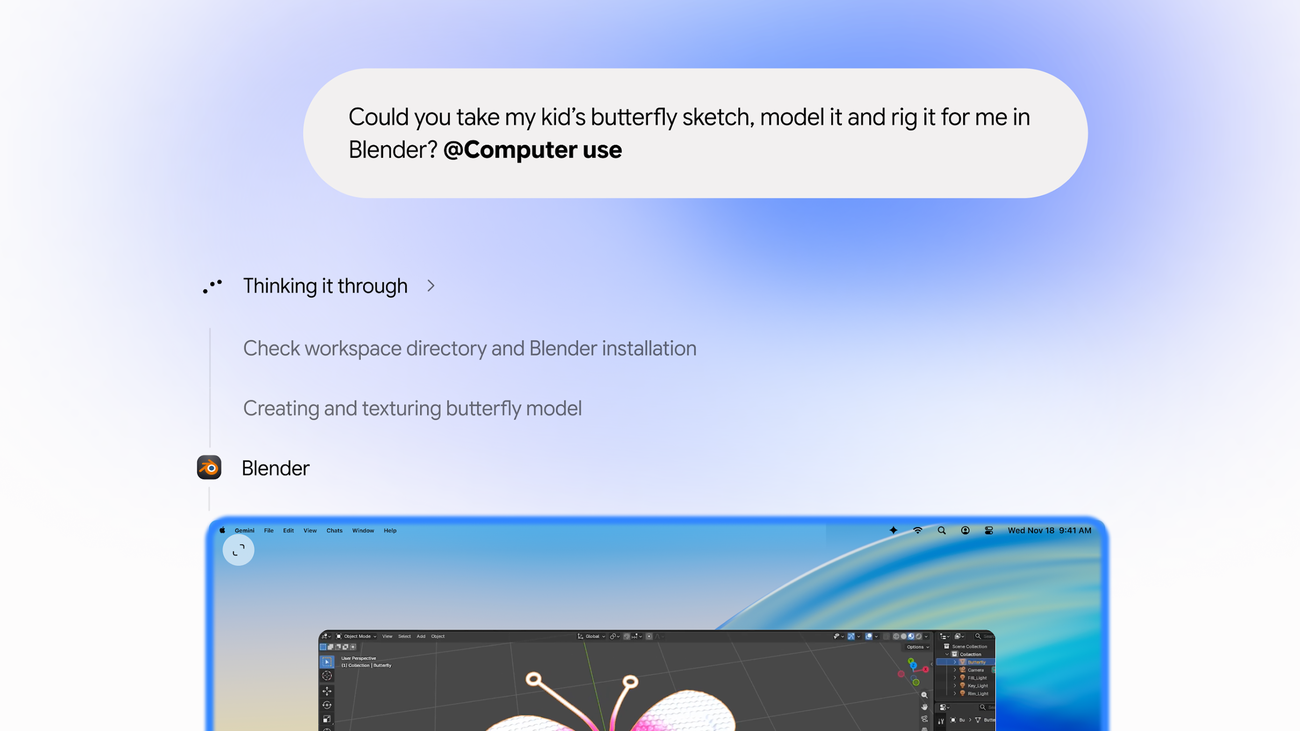
This trajectory intersects with concurrent developments in agent interfaces. Desktop computer-use features, such as those recently added to Gemini on macOS, allow agents to navigate applications, fill forms, and execute multi-step workflows on a local machine rather than remaining confined to a chat window. Similar capabilities are under active development at other major platforms. When longer time horizons meet practical computer-use tooling, the bottleneck shifts from raw capability to permission models, oversight mechanisms, and the cost of reliable evaluation. Organizations that have already begun tracking agent runtime relative to human hours—as documented in internal studies at frontier labs—will find the new METR numbers useful for calibrating expectations about how rapidly that ratio may continue to shift.
The update also arrives while capital markets are pricing the infrastructure required to sustain further scaling. Record public offerings by pure-play AI companies and continued investment in specialized inference hardware illustrate the expectation that longer, more autonomous runs will demand substantial compute. At the same time, METR’s own caveats about measurement difficulty and the relative scarcity of long, well-baselined tasks highlight that the industry is approaching the practical limits of current evaluation methodologies. Constructing and scoring tasks that take skilled humans a full week is expensive; as models saturate existing suites, new methods will be needed to keep the signal informative.
Implications for Workflows and Oversight
For technical teams, the practical question is no longer whether agents can complete isolated coding or analysis steps, but how much of a multi-day project can be handed off with acceptable residual risk. METR’s distinction between verifiable optimization tasks and judgment-heavy tasks is useful here. On problems with clear metrics and fast feedback—performance tuning, bug fixing against a test suite, or data-pipeline repair—current models already operate near or above the level of many individual contributors. Delegation of such work can free human time for higher-level design and review. On projects whose success criteria are harder to verify automatically, or where an incorrect intermediate decision can compound over days, human oversight remains essential.
This pattern is already visible in lab environments where agent hours have surpassed human hours on certain internal platforms. The shift changes hiring and role design: junior implementation work declines as a share of effort, while the demand for people who can set goals, evaluate intermediate outputs, and intervene when models encounter ambiguous situations rises. Companies outside the frontier labs will face the same dynamic on a delayed timeline. Those that begin instrumenting their own agent-assisted workflows now will have better data when the horizon extends further.
Security and containment considerations scale with autonomy. An agent that can run for a week has more opportunity to encounter and potentially exploit edge cases in permission boundaries, external services, or its own evaluation harness. METR’s robustness checks include tests for reward hacking and examinations of swarm-based elicitation techniques. The organization finds that multi-agent approaches can help on tasks with clear, rapid feedback but show mixed or negative effects on harder judgment tasks. These results reinforce the value of layered controls: sandboxing, explicit user approvals for high-impact actions, logging of tool use, and periodic human checkpoints on long-running jobs.
Related analyses on TechMash have examined how agent systems are already reshaping everyday information tasks and how local hardware is lowering the barrier to continuous agent operation. The same pieces note that platform vendors are simultaneously tightening the permission models required for third-party agents, creating a tension between capability and control that will intensify as time horizons lengthen.
What to Watch in the Coming Months

Several developments will clarify whether the 3.6-month doubling persists or begins to slow. First, the next public model releases from major labs will be evaluated against both existing and newly constructed long-task suites. If the horizon continues to advance at the recent rate, organizations should expect agents capable of reliable multi-day software and research work to become widely available within the next several quarters. Second, improvements in evaluation methodology itself matter. METR and other groups are exploring alternative scoring approaches, including item-response theory models and composite capability indices, precisely because single-threshold time horizons become harder to estimate cleanly as tasks grow longer and human baselines scarcer.
Third, the interaction between longer horizons and desktop or local deployment will determine how quickly the capability reaches ordinary knowledge workers. On-device or edge inference hardware that can sustain multi-hour agent runs without constant cloud round-trips reduces latency and cost, but also concentrates more powerful autonomy on machines that sit inside corporate networks. Finally, regulatory and internal governance responses will shape adoption. As agents take on work that previously required sustained human presence, questions of accountability, auditability, and liability become more concrete. Labs that publish detailed internal metrics on agent runtime and success rates provide useful reference points; independent measurements such as METR’s supply an external check.
The broader market context is also relevant. Large-scale financing for data-center capacity and specialized chips continues, driven in part by the expectation that agentic workloads will grow. At the same time, volatility in AI-related equities reflects uncertainty about how quickly revenue will follow the capability curve. The METR update does not resolve that uncertainty, but it supplies a more precise calibration of one important input: the rate at which the length of autonomously completable work is expanding.
Conclusion: Calibration Over Hype
METR’s November 20 update does not claim that AI systems can already replace a human professional for an entire unattended work week across arbitrary domains. It shows that, on a carefully constructed suite of software and research tasks, the length of work that frontier models can complete at useful reliability levels is advancing rapidly and has reached the scale of a human work week for certain well-specified problems. The 3.6-month doubling time, if sustained, implies that multi-day autonomy will become a routine engineering reality rather than a research curiosity within a relatively short period.
The practical response is neither to ignore the trend nor to treat every new benchmark number as evidence of imminent full automation. Teams should continue to separate tasks that are verification-rich from those that are judgment-rich, invest in oversight and logging infrastructure that scales with agent runtime, and treat independent evaluations as a regular input to planning. The same organizations that have already begun measuring the ratio of agent hours to human hours will be best positioned to adjust staffing, process, and risk controls as the horizon lengthens further.
For readers tracking related developments, earlier TechMash coverage of agent-to-human runtime ratios inside frontier labs, the commercialization of desktop computer-use features, and the economics of local inference hardware provides additional context on how these capability gains are translating into deployed systems. The official METR capability update and the organization’s ongoing time-horizon methodology pages remain the primary sources for the quantitative details discussed here.
As evaluation methodologies themselves evolve to keep pace with the systems they measure, the central question for most organizations will remain practical: which classes of multi-day work can be delegated today with acceptable residual risk, and how quickly will that set expand. METR’s latest data indicate that the expansion is occurring faster than many earlier forecasts assumed, and that the distinction between tasks with clear feedback and tasks that demand judgment will continue to define the boundary of safe and useful autonomy.
External sources: METR Q4 2026 Capability Update and METR Time Horizons methodology.
Related TechMash articles: Background Agents Take the Keyboard: Why Gemini’s Mac Computer Use Rewrites Everyday AI Workflows, The 6-to-1 Ratio: Inside Anthropic’s Shift from Junior Coders to Agent Overseers, When the Model Builds the Model: What Claude’s 26% Lead Really Signals for AI’s Next Leap, The Compact Supercomputer Lands: How Nvidia’s RTX Spark Mini PCs Recast the Economics of Local AI Agents, and Retail on the Frontier: Anthropic’s 20 Percent Public Allocation and $70–$78 Range Test the Durability of AI Capital Demand.
Comments
0