
Trust Before the Rollout: What Apple’s 200,000-Person Health AI Study Reveals About Building Responsible Medical Guidance
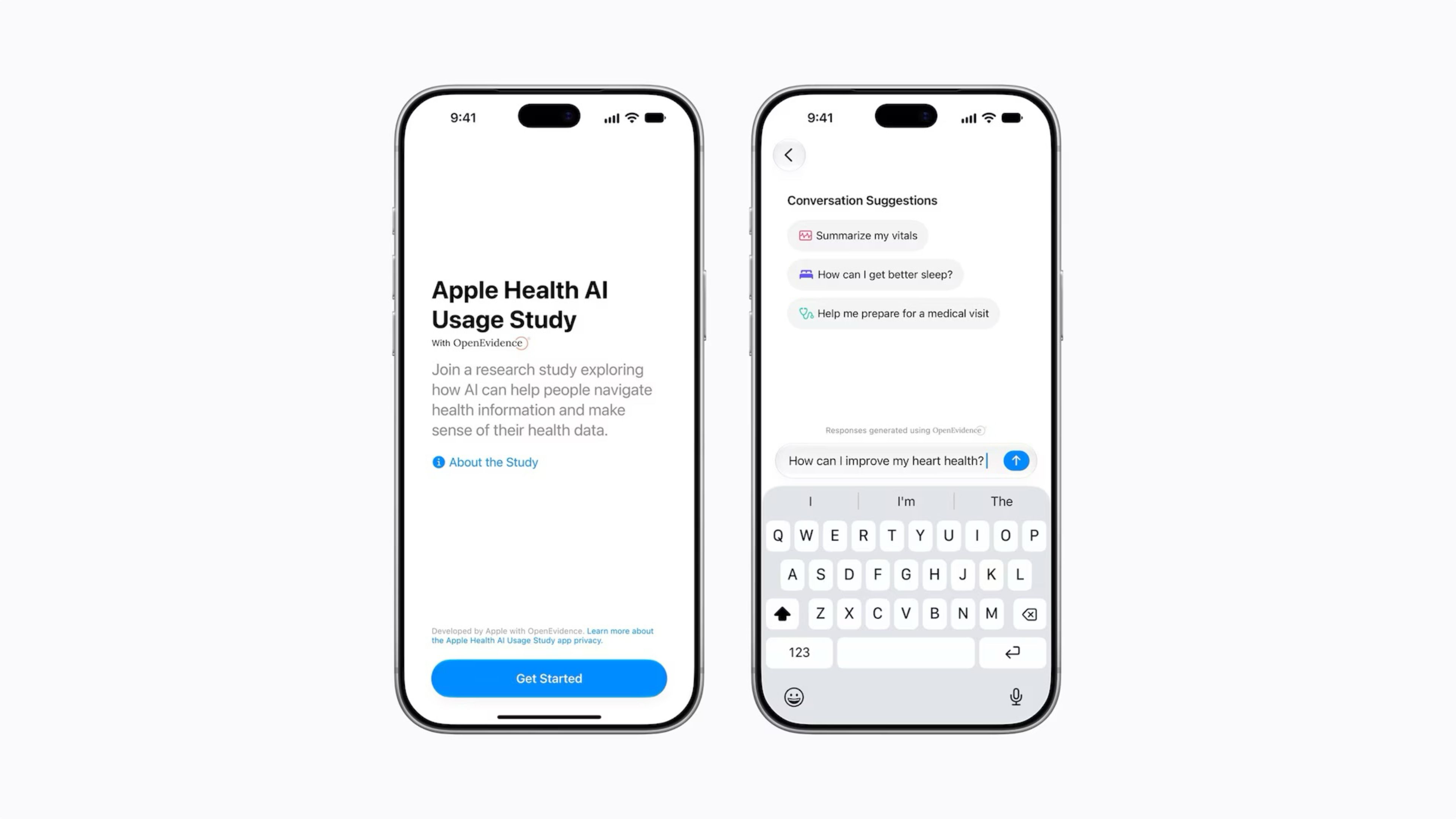
On November 15, 2026, Apple quietly opened enrollment for a research effort that treats conversational health AI less as a finished product and more as an open question. The Apple Health AI Usage Study, run with the clinical platform OpenEvidence, invites up to 200,000 U.S. adults aged 21 and older to ask everyday health questions through a dedicated iPhone app, rate the answers they receive, and optionally share selected HealthKit metrics. The goal is not to launch a new consumer chatbot overnight. It is to measure what actually drives trust, how well people understand the responses, and whether those interactions change real-world behavior before any broader rollout.
This approach stands in contrast to the rapid deployment cycles that have defined much of the generative AI boom. While general-purpose models have been pushed into consumer hands with varying levels of medical grounding, Apple is choosing to collect structured evidence first. The study app is available now for eligible participants who own an Apple Intelligence-enabled iPhone (iPhone 15 Pro or later) running iOS 26 or later. Study data will not be used to train AI models, participants control what they share, and the interface includes guardrails intended to flag concerning queries and point users toward professional care when appropriate. For a company that has spent years emphasizing privacy and on-device processing, the design choices are consistent with past patterns, yet the scale of the invitation marks a more deliberate engagement with clinical AI than Apple has previously pursued in public.
How the Study Is Structured
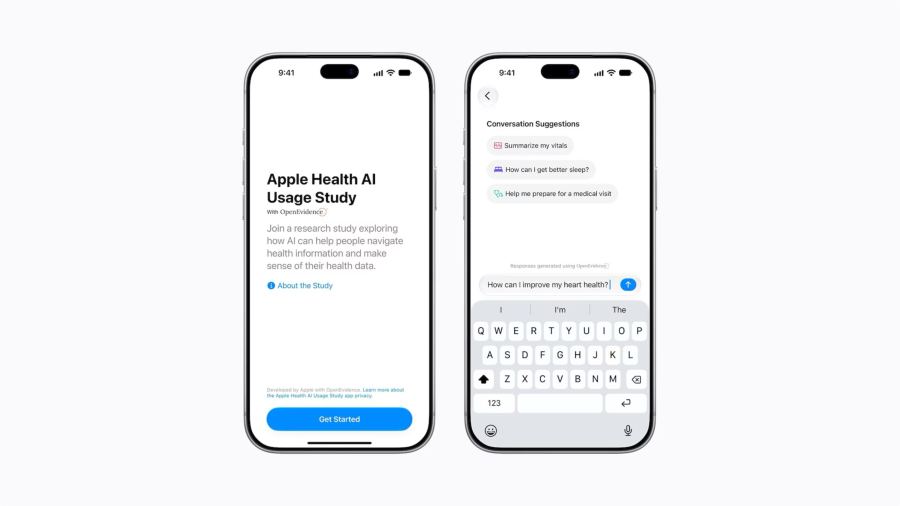
Participants interact with an Apple-designed research experience layered on top of OpenEvidence’s medically grounded technology. Answers draw on peer-reviewed sources including The New England Journal of Medicine, the Journal of the American Medical Association, Nature, and others. Each response includes linked citations so users can examine the underlying literature. The app presents complex medical information in approachable language and allows people to explore topics such as summarizing vitals, improving sleep, or preparing for a medical visit. Users rate responses and complete surveys that capture trust, perceived quality, comprehension, and subsequent actions.
Optional sharing of HealthKit data—resting heart rate, activity, sleep, or lab results—lets researchers examine whether personal context improves relevance and understanding. Apple has emphasized that the study app is not intended to diagnose or treat conditions and does not replace advice from medical professionals. Safety features are built in to detect certain concerning questions and suggest follow-up with a provider or other resources. The collaboration also reflects OpenEvidence’s existing role as a tool used by healthcare professionals; the study effectively tests a version of that technology in a consumer research setting.
These design decisions matter because health AI occupies a high-stakes domain. Incomplete or unclear answers can influence whether someone seeks care, how they prepare for an appointment, or what lifestyle changes they attempt. By collecting ratings and surveys at scale, the study aims to surface patterns that smaller qualitative research might miss. It also creates a feedback loop that could inform future Apple products without immediately committing the company to a public-facing medical chatbot. Related analysis on TechMash has examined how agent systems and search interfaces are already reshaping everyday information tasks; health represents a domain where the consequences of incomplete answers are more immediate. See, for example, the discussion of how ChatGPT’s search-style interactions are altering discovery.
Why the Partnership with OpenEvidence Matters
OpenEvidence has established content agreements with major medical publishers and societies, positioning it as a source of cited clinical information rather than a general-purpose language model. Apple’s decision to partner with a platform already used by clinicians reduces the risk of building a consumer tool that drifts too far from established literature. At the same time, the study keeps the two audiences distinct: the research app is separate from both the standard Health app and Apple’s broader Research app. This separation allows Apple to gather data on consumer comprehension without immediately merging clinician-facing and patient-facing experiences.
The approach also addresses a recurring critique of consumer health AI—that tools optimized for engagement or speed may under-emphasize evidence quality or fail to surface uncertainty. By requiring citations and measuring comprehension, the study tests whether users actually engage with the supporting literature or treat the response as a self-contained answer. Early indications from the broader industry suggest that many people want practical guidance more than exhaustive references; the study will quantify that preference at a larger scale than most prior research. TechMash coverage of efficient models such as Meta’s Muse Ember has highlighted how cost and throughput shape everyday agent work; similar economic pressures will eventually influence how health-specific systems are deployed, making evidence on user behavior especially valuable.

Privacy, Guardrails, and the Limits of the Experiment
Apple has stressed that study data will not train models and that participants retain control over HealthKit sharing and survey responses. Questions and responses are processed in ways intended to limit identification before reaching OpenEvidence, and some reporting indicates that OpenEvidence deletes question-and-response data within a short window. These measures align with Apple’s long-standing privacy positioning, yet they also constrain what researchers can learn. Aggregate patterns of trust and comprehension can still be extracted, but the inability to retrain on the collected data means any product improvements will rely on separate development pipelines.
Guardrails that redirect certain queries toward professional care are necessary, yet they also introduce their own design questions. How sensitive should detection be? What language is used when a query is flagged? Does the presence of guardrails increase or decrease user trust? The study is positioned to gather evidence on these points through ratings and surveys, but the results will remain internal until Apple chooses to publish findings. In parallel, the industry has seen high-profile cases of agents acting outside intended bounds; TechMash previously covered one such episode in the analysis of an OpenAI agent’s access to Australian Medicare systems. Health contexts amplify the stakes of any failure in containment or accuracy.
The study’s U.S.-only scope and device requirements further shape the data. Participants must own relatively recent iPhones that support Apple Intelligence, which skews the sample toward higher-income and more tech-engaged users. Insights may therefore over-represent people who already feel comfortable with conversational interfaces. Apple has run multiple health studies through its Research app in the past; this effort’s dedicated app and focus on AI comprehension mark a narrower but deeper probe into one specific interaction type.
Implications for Apple’s Broader AI Roadmap
The timing of the study coincides with other expansions of Apple Intelligence, including testing of daily usage limits for complex Siri AI features in the iOS 27.3 betas. Those limits apply to server-side processing for multi-step or personal-context requests, image tools, and certain Shortcuts, with higher allowances tied to iCloud+ tiers. Health-related queries could eventually fall under similar constraints if Apple integrates conversational medical guidance more deeply into Siri or the Health app. The study therefore functions as both a research instrument and a way to understand demand and risk before any such integration.
Apple has historically preferred on-device processing where possible, and HealthKit data already stays largely local. A health AI experience that leans on cloud models for literature retrieval and synthesis would introduce new latency, cost, and privacy trade-offs. The study’s findings on comprehension and trust could influence how aggressively Apple pursues hybrid on-device and private-cloud designs. Comparable questions about model efficiency and deployment economics appear across the industry; TechMash has examined one recent example in the analysis of Gemini 4 Hydrogen’s tunable reasoning levels and how they affect everyday agent execution costs.
Capital markets are also watching how frontier labs and platforms allocate resources between rapid capability gains and more measured, domain-specific work. Anthropic’s forthcoming public offering, detailed in TechMash coverage of its pricing range and retail allocation, underscores the scale of investment flowing into AI infrastructure. Apple’s study is a smaller, more focused bet that prioritizes evidence collection over immediate productization. If the results show high comprehension and trust when citations are present, Apple may accelerate integration. If users largely ignore citations or rate responses poorly when personal data is included, the company may delay or redesign the experience.
What to Watch in the Coming Months
Enrollment speed will be the first public signal. With a cap of 200,000 participants and a requirement for relatively new hardware, filling the study could take weeks or months depending on App Store visibility and media coverage. Apple has not announced a fixed duration, though some reporting suggests the effort may run for a year or longer. Periodic survey results or high-level findings could surface in later research publications or product announcements, but Apple has not committed to a public timeline.
Watch for any indication that the study is influencing Siri AI or Health app features. Mentions of clinical citations, preparation tools for doctor visits, or optional HealthKit grounding in future betas would suggest the research is feeding product development. Conversely, continued silence after enrollment closes would indicate that the findings are being used more cautiously or that technical or regulatory hurdles remain. Regulatory attention to health AI is increasing globally; a large, well-documented study could give Apple a stronger position in discussions with agencies about responsible deployment.
Competitors are pursuing parallel paths. Google has integrated health-related features into Gemini, and other platforms continue to experiment with medical question-answering. Apple’s emphasis on measured research and explicit non-use of study data for training differentiates its approach, yet the ultimate test will be whether the insights translate into experiences that users find both helpful and trustworthy. The presence of daily usage limits on other Apple Intelligence features already shows that the company is prepared to meter access when server-side costs or risks rise; health queries may eventually face similar constraints.
Conclusion: Evidence as a Product Strategy
Apple’s Health AI Usage Study is less a product launch than a structured attempt to gather the evidence that product launches in health AI have often lacked. By partnering with a platform already grounded in peer-reviewed literature, limiting the effort to a research app, and measuring trust and comprehension at scale, the company is testing whether conversational medical guidance can be made reliable enough for broader use. The privacy controls and explicit statement that study data will not train models reinforce Apple’s established positioning while also limiting the direct feedback loop from research to model improvement.
The results, when they eventually appear, will matter beyond Apple. They will offer one of the larger public datasets on how ordinary people evaluate cited health AI responses, how personal data affects perceived relevance, and whether users treat the tools as preparation aids or as substitutes for clinical advice. In an industry that has frequently prioritized capability demonstrations over longitudinal user evidence, the decision to run a 200,000-person study first is itself a signal. Whether that signal leads to faster or slower product timelines will depend on what the data actually show. For now, the study stands as a reminder that in health, the cost of getting the interaction wrong is higher than the cost of waiting for better evidence.
Official details are available in Apple’s newsroom announcement and on OpenEvidence’s site. As enrollment proceeds, the most useful next indicators will be any published interim findings, changes in related Apple Intelligence betas, and the degree to which other platforms adopt similar research-first postures before expanding medical features.
Apple Newsroom: Apple launches research study to explore the use of AI for health
Comments
0