
DeepSeek Opens the Production Engine: How DeepInfer’s Release Rewrites the Cost Equation for Frontier Inference
On October 20, 2026, DeepSeek open-sourced DeepInfer, the high-performance inference framework that powers its large-scale production services for DeepSeek-V4.1-Flash. Released under the Apache 2.0 license on GitHub, the stack arrives alongside deepseek-recipe, an MIT-licensed token encoding and decoding layer aligned with the official API. The timing is striking: days after the U.S. Department of Homeland Security ordered civilian federal agencies to remove DeepSeek products and any third-party services built on its models from government systems, citing multiple threat vectors and the risk of sensitive data reaching China.
This is not another model-weight drop. It is the serving layer—the kernels, parallelism strategies, speculative decoding, and scheduling that turn trained parameters into usable throughput. DeepSeek’s own announcement on X framed the goal plainly: help the community lower compute costs, reduce energy use, and make AI more affordable. For developers and operators who already run open weights, the missing piece has often been the production-grade engine that keeps latency low and utilization high at scale.
What DeepInfer Actually Ships
DeepInfer currently supports offline inference for DeepSeek-V4.1-Flash (default checkpoint deepseek-ai/DeepSeek-V4.1-Flash-1017). It runs on NVIDIA SM100 (Blackwell-generation) GPUs and Huawei Ascend 950 NPUs. The feature set includes optimized kernels (FlashMLA, DeepGEMM, DeepEP, TileKernels, DeepSelect, and custom TileLang operators), attention data parallelism with balanced context parallelism, mixture-of-experts expert parallelism with expert-parallel load balancing, DSpark speculative decoding with confidence-scheduled verification, SWA bounded replay, zero-overhead asynchronous scheduling, batch-invariant inference, deterministic sampling, and structured outputs via regex, JSON Schema, or EBNF.
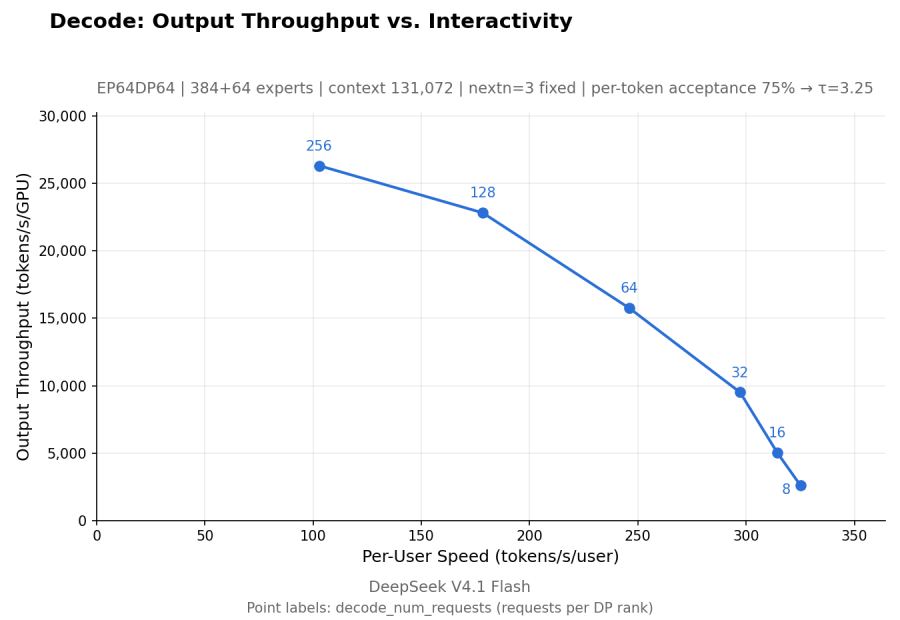
DeepSeek reports that a single production cluster serves 155 trillion tokens per day with a 96 percent input-cache hit rate. Self-published Pareto curves for 131,072-token context show decode throughput above 25,000 tokens per second per GPU at 256 requests per rank (with next-n=3 and 75 percent acceptance), while per-user speeds exceed 300 tokens per second at lighter loads. Prefill benchmarks used 4 GPUs; decode used 64, each within one scale-up domain. The framework was originally built primarily on vLLM, with ideas drawn from SGLang and TensorRT-LLM; the vLLM project has already noted the contribution and plans to incorporate relevant techniques.
The release is deliberately incomplete. It omits the KV-cache system, prefill/decode disaggregation, and cross-machine load balancing. Those pieces remain internal for now. The practical result is a high-quality offline engine that operators can study, adapt, and extend, rather than a turnkey cloud service.
Why the Timing and the Dual Hardware Matter
Support for both NVIDIA Blackwell-class GPUs and Huawei Ascend 950 NPUs is not incidental. DeepSeek has previously indicated plans to train on Ascend silicon by the end of 2026. Publishing a production stack that already targets both platforms gives the Chinese NPU its clearest first-party endorsement from a frontier lab to date. At the same moment, Chinese internet giants have placed large orders for remaining export-compliant NVIDIA accelerators, and Western providers continue to invest in proprietary serving stacks.
The U.S. ban, detailed in a Federal Register notice and a July order signed by Homeland Security Secretary Markwayne Mullin, applies to civilian agencies and covers not only DeepSeek’s own products but third-party services “developed using DeepSeek implementations.” Defense and intelligence systems are outside its scope. The stated concerns include data-transfer risk under Chinese law, potential generation of actionable intelligence on U.S. persons and agencies, and the possibility of malware or vulnerabilities in the models themselves. Private-sector and consumer use remains unrestricted.
Open-sourcing the inference layer does not reverse the ban. It does, however, lower the barrier for non-U.S.-government operators—enterprises, cloud providers outside restricted jurisdictions, and research groups—to run the models more efficiently on whatever compliant hardware they can obtain. Related TechMash coverage of open silicon challengers such as Tenstorrent’s Galaxy platforms shows how alternative architectures are already targeting the same inference economics. See Open Silicon’s $6.2 Billion Moment.

The Broader Cost Curve
Inference, not training, has become the dominant operational expense for most organizations deploying large models. Token prices have fallen sharply, yet absolute spend continues to rise because usage volume grows faster. DeepSeek’s earlier model releases already undercut many Western API rates. Adding an open, high-throughput serving stack compresses the remaining margin that proprietary engines and managed providers have enjoyed.
This pressure arrives while wafer economics remain tight. TSMC’s recent record quarters illustrate sustained demand for advanced nodes, yet capacity for the highest-bandwidth memory and leading-edge logic is still allocated under long-term agreements. Any technique that extracts more useful tokens per watt or per GPU directly improves the return on those scarce resources. DeepInfer’s emphasis on speculative decoding, bounded replay, and expert-parallel load balancing is aimed precisely at that extraction. Coverage of wafer-level constraints and agent-driven demand shows why incremental serving efficiency now moves the overall economics more than another parameter-count headline. See Wafer Economics in the Age of Agents.
Local and edge deployment is another beneficiary. Meta’s Muse Spark Open demonstrated that carefully engineered open-weight models can run on high-end desktop silicon. A production-grade inference framework that already supports long context and structured outputs makes similar deployments more practical for DeepSeek’s Flash models, provided the hardware is available. The same logic that favors local frontier models on Apple silicon applies here: once the serving stack is inspectable, operators can trade peak cloud throughput for predictable cost and data residency. See The Quiet Migration.
Geopolitics and the Open-Source Asymmetry
The dual release—model weights earlier, production inference now—amplifies an asymmetry that has defined the last two years of the AI race. U.S. frontier labs have largely kept both weights and serving stacks closed or tightly licensed. Chinese labs have released competitive open weights and, increasingly, the systems software that makes them practical. The U.S. government response has focused on procurement and agency systems rather than a comprehensive private-sector restriction, leaving commercial and open-source channels intact.
DeepSeek’s stated hope, articulated by engineers involved in the release, is that more organizations will deploy the models and profit from doing so. Whether that profit accrues primarily inside or outside China will depend on export-control enforcement, cloud-provider policies, and the speed with which Western open-source communities absorb and improve the code. Google’s recent open-source TorchTPU effort and other infrastructure open-sourcing moves show that the U.S. side is not entirely static, but the pace and completeness differ.
Energy considerations cut both ways. DeepSeek highlights reduced energy use as a benefit of the open stack. At the same time, the sheer scale of production clusters—155 trillion tokens per day per cluster in the company’s figures—still requires substantial power and cooling. Google’s orbital TPU experiments test whether specialized accelerators can operate under extreme thermal and power constraints; ground-based serving stacks like DeepInfer remain the nearer-term lever for efficiency. See A Kilowatt in Orbit.
What Operators and Policymakers Should Watch
First, independent benchmarks. DeepSeek’s throughput numbers are self-reported. Community replications on both SM100 and Ascend hardware will determine how transferable the gains are outside DeepSeek’s own clusters and whether the omitted components (cache, disaggregation, load balancing) limit real-world deployments.
Second, downstream integration. vLLM and other popular engines have already signaled interest. Rapid upstreaming of DSpark-style speculative decoding, the kernel set, or the expert-parallel load balancer would diffuse the gains beyond DeepSeek models.
Third, the regulatory perimeter. The DHS order’s language on “third-party products and services developed using DeepSeek implementations” is broad. Vendors that route traffic to DeepSeek endpoints or fine-tune on its weights for government customers must map their exposure. The same wording does not automatically constrain private commercial use, but enterprise risk committees will notice the federal precedent.
Fourth, hardware substitution. Ascend 950 support, if it performs as claimed, gives operators an alternative path when NVIDIA supply is constrained by export rules or allocation. Combined with the large recent orders from ByteDance, Alibaba, and Tencent for remaining compliant NVIDIA parts, the picture is one of parallel tracks rather than a clean break. Related agent workforce shifts at labs such as Anthropic further illustrate how inference efficiency reshapes operational models. See The 6-to-1 Ratio.
Conclusion
DeepInfer is a concrete reduction in the information asymmetry that has surrounded production inference. By publishing the engine that already serves its own high-volume traffic, DeepSeek has given the community a working reference for high-throughput, long-context serving on current data-center GPUs and emerging NPUs. The simultaneous U.S. agency ban underscores that technical openness and geopolitical restriction can coexist; the former does not cancel the latter.
For organizations outside the restricted perimeter, the practical question is narrower: does the open stack deliver enough of the claimed efficiency to change deployment economics on the hardware they can actually procure? Early indicators from the code and the company’s own figures suggest the answer is yes for offline and high-batch workloads, with the usual caveats about missing production components. The broader implication is that the cost of frontier inference continues to fall fastest where the serving layer is shared rather than siloed.
Official sources include the DeepInfer GitHub repository and DeepSeek’s announcement. The Federal Register notice details the agency exclusion. Related analysis of open hardware challengers, wafer economics, local model deployment, and agent workforce shifts continues on TechMash.
Comments
0