

The Basket and the DM: Meta’s Muse Turns Saved Posts into Action as It Lands in the UK
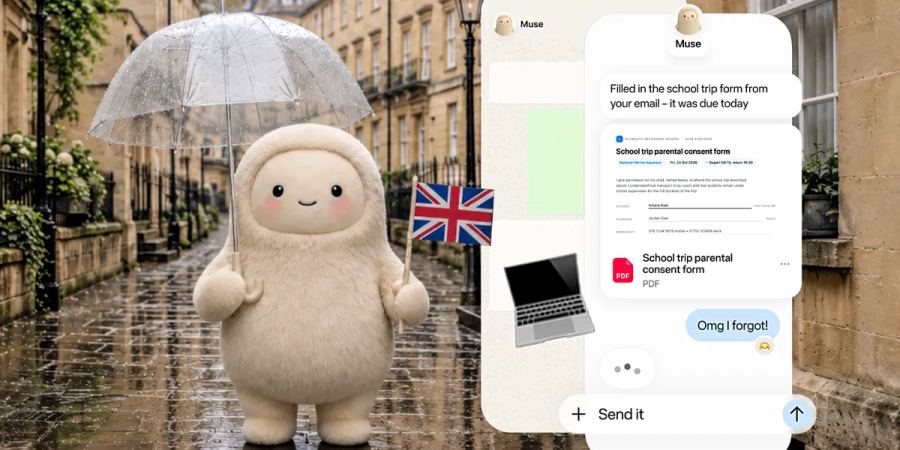
On a damp November street somewhere in a British city, a rounded, furry figure holding an umbrella and a Union Jack now stands as the public face of a shift that has been building for months. Meta’s Muse, the personal AI agent that already climbed app-store charts in the United States, arrived for adults in the United Kingdom this week. At the same moment, the company began embedding the same agent directly into Instagram direct messages for users in several markets, including the US, Canada, Mexico, Japan, and Singapore. Together the two moves mark a practical expansion of what “personal agent” means: not another chat window, but a system that can turn a saved Reel into a shopping list, fill a school-trip form, or prepare a basket at Marks & Spencer or Sainsbury’s while waiting for explicit human approval.
The timing is deliberate. Earlier TechMash coverage of Meta’s model stack—particularly the efficiency-focused Muse Ember and the memory-and-focus capabilities in Muse Wonder—showed the company building the underlying pieces for long-horizon work. The UK launch and the Instagram DM integration are the consumer-facing test of whether those pieces can survive contact with real retail sites, real calendars, and real users who expect the agent to do something rather than merely discuss it.
What Actually Launched
Meta’s official announcement states that Muse is available from 24 November 2026 to anyone aged 18 and over in the UK via the dedicated app, WhatsApp, muse.ai, and, for a growing set of users, Instagram DMs. The agent is described as free for most everyday use, with subscription tiers for heavier workloads. It arrives with connectors to a roster of British brands that includes Marks & Spencer, Sainsbury’s, Ocado, ASOS, Currys, Trainline, easyJet, Jet2, Argos, and others. Global partners such as Spotify and OpenTable are also in the mix. The explicit promise is that Muse can plan a weekly shop within a budget, turn a saved recipe Reel into ingredients, or book travel while keeping payment credentials and passwords out of its direct view.
The Instagram integration is more than a convenience feature. Users can now message Muse inside a DM thread, share a post, and ask it to act—add a coffee shop to an itinerary, find a Black Friday deal, or organize a collection of saved items. Conversations appear as side chats in the main Muse app. Meta emphasizes that nothing is published or purchased without approval. This places the agent inside a surface where discovery already happens, rather than forcing users to switch to a separate application.
Why the Approval Layer Is the Real Product
Most public discussion of AI agents still centers on capability—how well a model can browse, fill forms, or reason. The more consequential design choice Meta is making is the persistent approval step. Muse is built so that it asks before sending an email or completing a purchase. It runs inside its own virtual machine, isolated from Meta’s other services and from other users’ agents. Conversations are not fed into the advertising system. Users can instruct it to forget information and can revoke connector access at any time. Two defaults that matter for UK regulators start in more open positions (using interactions to improve models, and automatic linking of Meta accounts), but both can be changed.
This architecture is a direct response to the practical failure modes that have slowed agent adoption. Earlier experiments with fully autonomous shopping or booking often produced either excessive caution that rendered the agent useless or over-eager actions that eroded trust. By making the approval gate visible and mandatory for high-stakes steps, Meta is treating user control as a feature rather than a compliance afterthought. That choice aligns with the broader pattern TechMash has tracked in agentic systems: the shift from “can the model do it?” to “will a person still be willing to let it act when the cost of a mistake is real?” Related analysis of how labs are already reorganizing work around agents appears in our piece on Anthropic’s internal 6-to-1 ratio of agent hours to human hours.

Connectors Turn Discovery into Fulfillment
The retail and travel partners are not decorative. When a user saves an Instagram Reel of a meal or a destination, Muse can, with permission, turn that into a concrete basket or itinerary that already knows how to navigate the partner site. Sainsbury’s and Ocado have spoken about budget-aware shopping and dietary-aware meal planning. Trainline and easyJet connectors lower the friction of multi-step booking. This is the difference between an agent that can describe a process and one that can complete it on the sites people already use.
The same pattern appears in Meta’s earlier model work. Muse Spark Open demonstrated that carefully engineered open-weight models can run locally on high-end Apple Silicon; Muse Ember was positioned for high-volume, lower-cost agentic subtasks. The UK consumer launch is the place where those efficiency and memory investments meet ordinary shopping and scheduling. Without reliable connectors, the agent remains a sophisticated chatbot. With them, it becomes infrastructure that sits between discovery surfaces (Instagram) and fulfillment surfaces (supermarket and travel sites).
External reporting and Meta’s own posts confirm the dual rollout: the UK availability announcement and the simultaneous expansion of Muse into Instagram DMs. Both are live as of 24 November 2026.
What Changes for Users and for Competitors
For a UK user the immediate experience is straightforward. They can open the Muse app or WhatsApp, name and style their agent, connect a subset of accounts, and begin assigning tasks. When they save something on Instagram, a prompt may appear offering to let Muse organize it. The agent can continue working after the user closes the app and will surface results or approval requests later. Payment can route through Stripe’s Link or Shopify’s Shop Pay without exposing raw card details to the agent itself.
Competitors face a different problem. OpenAI, Anthropic, Google, and others already offer strong reasoning and tool use. Meta’s advantage in this specific moment is distribution: Instagram and WhatsApp are surfaces where hundreds of millions of people already spend time and already save content they intend to act on. Embedding the agent there reduces the activation energy that has kept many personal agents in the “interesting demo” category. The same distribution logic appears in earlier TechMash analysis of how local inference hardware such as Nvidia’s RTX Spark systems is lowering the cost of always-on agents; Meta is attacking the problem from the opposite direction—ubiquitous consumer surfaces rather than dedicated local hardware.
Regulators are watching. The UK’s Information Commissioner’s Office and Competition and Markets Authority have already engaged with Meta on the launch. The company’s emphasis on approval gates, isolated virtual machines, and opt-out training controls is clearly shaped by that scrutiny. Whether those controls remain robust once millions of users begin connecting email, calendars, and shopping accounts is an open empirical question.

What to Watch Next
Several concrete signals will show whether the UK launch is a durable expansion or a limited test. First is retention: do users who connect a supermarket or travel account continue to assign tasks after the novelty of the mascot fades? Second is error rate and recovery: when the agent misreads a dietary requirement or a train time, how quickly and transparently can the user correct it? Third is the expansion of connectors and the behavior of the Instagram DM channel. If a material share of saved posts begin routing through Muse into completed purchases or bookings, the economic relationship between Meta’s discovery surfaces and retail partners will have shifted.
Longer-term questions concern the boundary between assistance and autonomy. Meta has chosen a conservative default on high-stakes actions. Other labs are experimenting with more aggressive automation in coding and internal workflows. The consumer retail setting is less forgiving of mistakes than an internal code review. The outcome of that tension will shape how quickly personal agents move from “optional helper” to “default layer for everyday digital work.”
Related reading on the model and infrastructure side includes our earlier pieces on Muse Wonder’s memory and focus mechanisms, Muse Spark Open’s local execution path, and the broader economics of agent execution. Those technical foundations are now being tested in the messier environment of British high-street retail and Instagram inboxes.
Conclusion: Action Is the New Interface
The arrival of Muse in the UK and its embedding inside Instagram DMs is less about a new model release and more about a change in the default expectation of what an AI agent should do. The system is designed to start from something a person has already saved or said they want, move through the sites and apps they already use, and stop for explicit approval before irreversible steps. That loop—discovery, planning, controlled action—is the practical definition of a personal agent that Meta is now offering to a large new market.
Whether the loop holds under real volume, real partner complexity, and real regulatory attention will be visible in the coming months. For now the company has placed a concrete, controllable agent on the same surfaces where people already decide what they want to buy, book, or organize. The empty chat window is no longer the only interface. The basket and the DM are becoming part of it.
Official details are in Meta’s UK launch post and the accompanying controls announcement. Independent coverage of the Instagram DM rollout appears in TechCrunch. Prior TechMash analysis of the underlying models and agent workforce shifts provides additional context on why the timing of this consumer expansion matters.
Internal links: Muse Ember economics, Muse Wonder memory and focus, Muse Spark Open local execution, Anthropic agent workforce shift, Nvidia RTX Spark local agents.
External links: Meta official UK Muse announcement and TechCrunch on Instagram DMs integration.
Comments
0