
Speed Over Size: How IBM’s 520-Qubit Nighthawk r3 and 2027 Dual-Chip Plan Reset the Quantum Advantage Clock
On November 11, 2026, IBM announced that its next quantum processor, Nighthawk r3, is designed to execute 10,000 quantum operations accurately across 520 programmable qubits. In 2027 the company plans to link two of those processors into a single system exceeding 1,000 qubits. The announcement is not another abstract qubit-count headline. It is a concrete statement about speed, modularity, and the hybrid classical-quantum workflows that determine whether useful work can finish in hours instead of months.
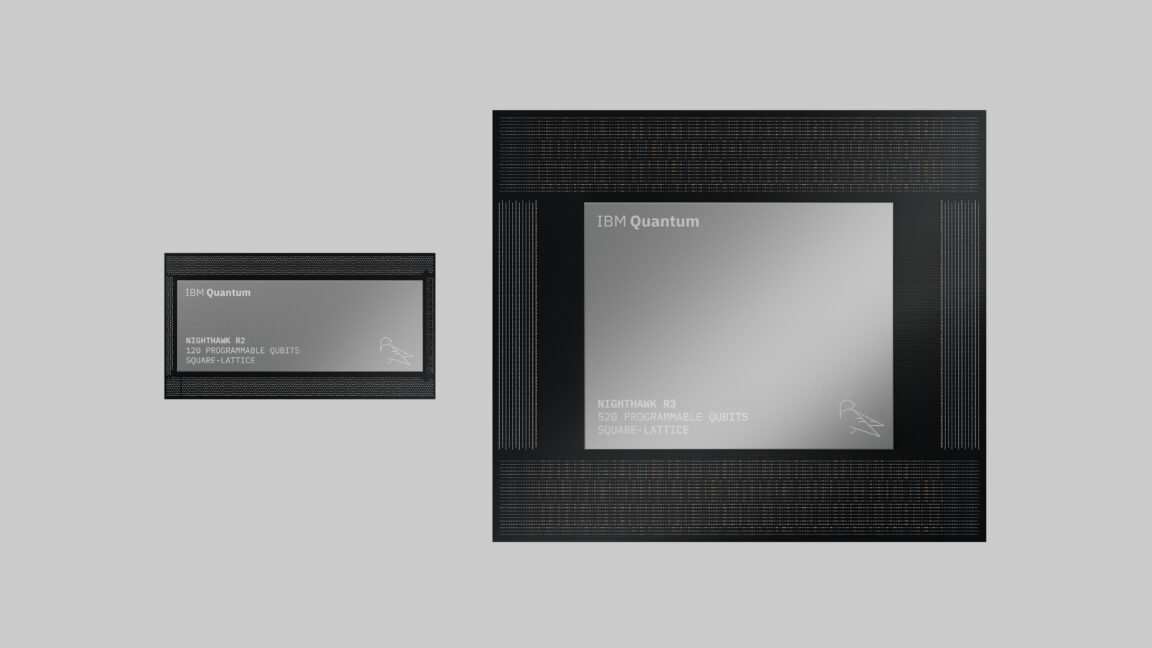
Useful quantum computing, IBM argues, depends on both accuracy and throughput. Each run of a quantum circuit returns one sample. Complex applications need millions or billions of samples. Circuits that require thousands of operations on roughly 100 or more qubits quickly become impractical if the machine is slow. Nighthawk r3 keeps the high-speed architecture already demonstrated by the current r2 generation while scaling the programmable qubit count from 120 to 520 and adding chip-to-chip interconnects. The result is a roadmap that prioritizes practical circuit volume over pure device size.
What Nighthawk r2 Already Shows
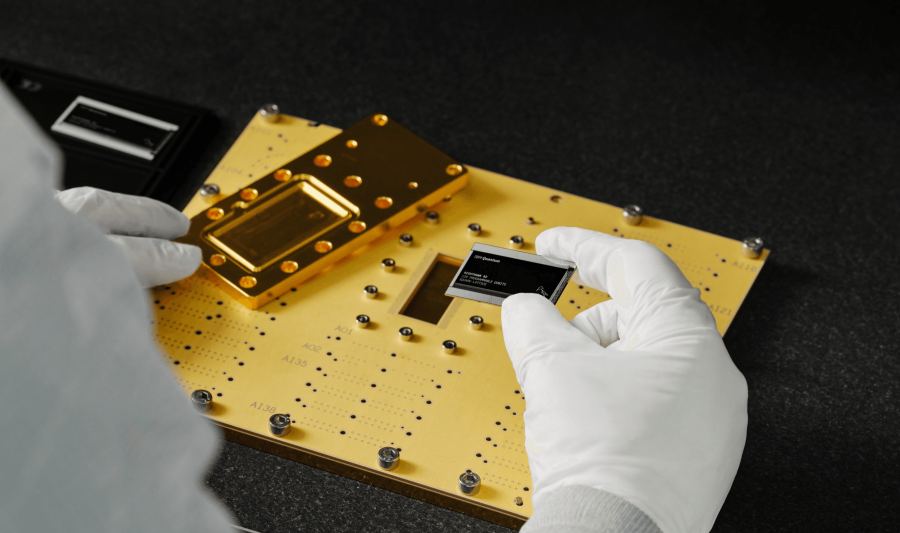
Introduced earlier in 2026, Nighthawk r2 delivers up to 100,000 samples per second while supporting accurate computations with more than 7,500 quantum operations on 120 programmable qubits. High-speed independent qubit reset cuts the idle time between circuit executions. Clients and partners including E.ON, Algorithmiq, and Q-CTRL have run more than 34 billion circuits on the processor. Reported performance improvements reach 19x relative to earlier IBM Heron systems while maintaining the quality needed for scientific work.
Concrete examples already exist. E.ON reported a 15x speedup on quantum machine-learning tasks for energy-grid optimization. An earlier materials-simulation experiment with Oak Ridge National Laboratory saw a 12x improvement when moved to r2. An Algorithmiq quantum-advantage experiment that originally ran on Heron now executes circuits eight times faster on r2; the new circuits are also substantially harder for classical tensor-network methods to simulate, requiring an estimated 240 times more memory for comparable accuracy. These are not laboratory curiosities. They are production-style workloads that benefit directly from higher sample rates.
The same emphasis on practical throughput appears across the broader computing landscape. Classical AI labs continue to confront wafer allocation, memory bandwidth, and power delivery constraints; our earlier analysis of TSMC’s record wafer economics and the energy wall that blocked a major UK AI campus shows how physical limits shape every scaling story. Quantum systems face analogous bottlenecks: coherence, gate fidelity, and the classical resources needed for error mitigation and post-processing.
The Scale Jump to 520 Qubits and Modular Interconnects
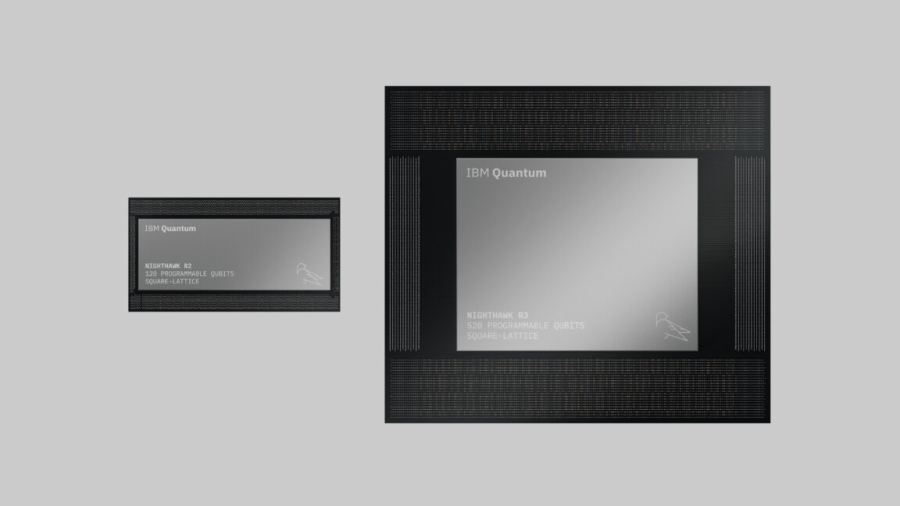
Nighthawk r3 is designed for 10,000 quantum operations on 520 programmable qubits out of a total of 2,034 physical qubits. It retains the square-lattice connectivity and fast operations of r2 while introducing ten chip-to-chip interconnects called l-couplers. Those links are the architectural feature that makes a multi-processor system feasible.
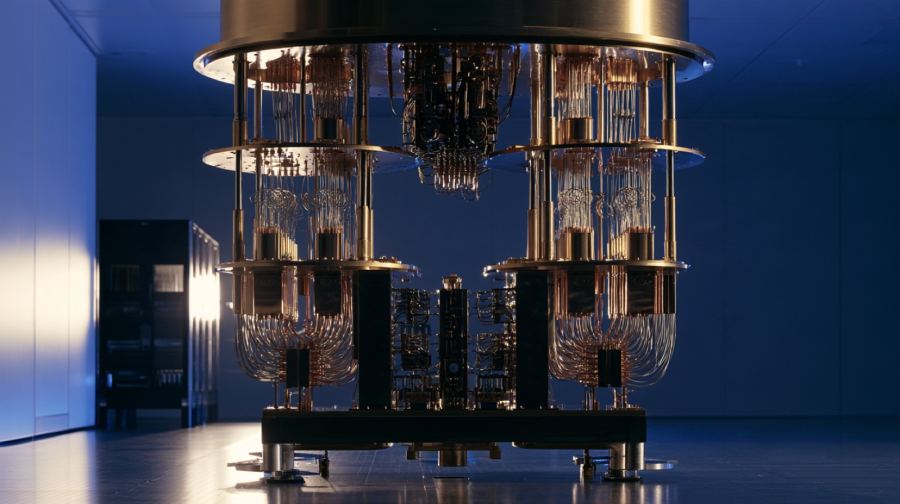
IBM has already demonstrated the two enabling technologies. Earlier this year it connected Nighthawk r1 processors with four l-couplers and achieved 99.3 percent quantum-state-transfer fidelity, moving toward a 99.9 percent target. Separately, the company joined two cryogenic modules into one system for the first time; the combined system reached operating temperature in under five days and cooled below 15 millikelvin. Together these results give confidence that the modular approach can scale beyond a single chip without starting from scratch on fabrication or packaging.
The 2027 plan is therefore specific: link two r3 processors into a single 1,040-qubit system. That configuration is smaller than some earlier multi-chip visions that contemplated linking nine smaller processors, but it is also more conservative and higher-performance. Each r3 chip already carries the high-speed reset architecture that produced the 19x-class speedups. Linking two of them multiplies both qubit count and the practical circuit volume that can be executed in a given wall-clock time.
This modular strategy has parallels in classical AI hardware. Companies pursuing alternatives to dominant GPU architectures, such as the open RISC-V approach detailed in our coverage of Tenstorrent’s Galaxy platforms, also emphasize interconnect flexibility and the ability to scale systems without proprietary fabrics. Optical interconnect work, including the large-scale integration discussed in the Marvell-Lumentum combination, further underscores that moving data between chips and modules is becoming as important as the compute elements themselves.
Hybrid Classical Resources and the Path to Fault Tolerance
Industry-relevant quantum workloads will not run in isolation. They require layers of error mitigation, noise learning, and classical post-processing. As circuit size grows, the classical resources needed to extract reliable answers grow with them. IBM Quantum Platform is therefore unifying quantum execution with high-performance classical computing in a single managed environment. Users can integrate quantum workflows with classical resources ranging from a laptop to a supercomputer, or with the HPC capacity newly available on the platform itself.
Early results illustrate the leverage. Using the new environment, IBM and RIKEN researchers executed a sample-based quantum diagonalization workflow roughly five times faster while performing 100 times more computations than in the original study. Cleveland Clinic and RIKEN processed 608 million samples for modeling biologically relevant structures 33 times faster than without workflow automation. Pulse-level control on the platform also gives researchers finer visibility into timing, reset, and measurement, which is essential for improving error correction at the hardware level.
A separate co-design platform with Oak Ridge National Laboratory and AMD physically co-locates Nighthawk processors with ORNL’s Umbra HPC system powered by AMD Instinct GPUs and EPYC CPUs. The combination is intended to accelerate research on quantum error correction by letting quantum and classical teams iterate together rather than shuttling data between separate facilities. These steps sit on the longer road toward fault-tolerant systems; IBM continues to target its Starling system later in the decade as the first machine capable of large-scale error-corrected computation.
The classical side of the hybrid equation remains constrained by the same physical realities facing every AI laboratory. Power delivery, advanced packaging, and memory bandwidth limit how quickly classical pre- and post-processing can scale. Our reporting on Anthropic’s decision to lock in generator capacity and on the broader energy constraints facing data-center growth shows that electrons are not infinitely elastic. Quantum systems that can finish more useful work per sample therefore reduce pressure on both the quantum and classical sides of the stack.
Why the Timeline Matters
The difference between a 120-qubit machine that can deliver 100,000 samples per second and a 1,040-qubit modular system is not merely additive. It changes the set of problems that can be attempted inside a practical research or industrial cycle. Materials simulation, chemistry, optimization, and certain machine-learning tasks already show measurable speedups on the current generation. Extending those speedups to larger circuits and higher qubit counts in 2027 would move additional application domains from exploratory to routine.
IBM is explicit that speed and quality must advance together. A larger chip that is slower or noisier would not expand the useful frontier. By carrying the high-speed reset architecture forward and demonstrating modular interconnect fidelity, the company is attempting to avoid that trade-off. Independent verification will still be required; quantum advantage claims remain sensitive to the classical baseline and to the precise problem formulation. The open Quantum Advantage Tracker that IBM and partners have used for earlier experiments provides one mechanism for that scrutiny.
Broader industry context reinforces the point. Classical AI continues to push inference cost and latency lower through specialized silicon and open serving stacks. Quantum computing is not a direct substitute for those workloads, but it occupies a complementary niche in which certain simulations and optimizations become tractable only when both qubit connectivity and sample rate are high enough. The 2027 dual-processor target is therefore a milestone that can be measured against real application runtimes rather than against abstract qubit counts alone.
What to Watch
Several concrete checkpoints will determine whether the roadmap holds. First, delivery and early-access timelines for standalone Nighthawk r3 processors. The announcement describes a design target; availability dates and access-plan eligibility have not yet been published. Second, continued progress on l-coupler fidelity and multi-module cryogenic integration. The 99.3 percent state-transfer result is encouraging, but production systems will need higher reliability and simpler assembly. Third, the volume and diversity of hybrid workflows that customers actually run on the unified platform. Speedups of 5x to 33x on specific scientific pipelines are meaningful; broader adoption across industrial use cases will show whether the classical-quantum interface is practical at scale.
External validation matters as well. Partners such as E.ON, Cleveland Clinic, RIKEN, and Algorithmiq have already published or reported results on the current generation. Similar transparency on r3 and on the 2027 dual-chip system will allow independent groups to test both the claimed circuit depths and the end-to-end wall-clock times. Classical competitors and alternative quantum modalities will continue to advance in parallel; the relevant comparison is not qubit count in isolation but the time and cost required to obtain a verified answer on a problem of industrial interest.
Finally, the interaction with classical infrastructure remains decisive. Quantum systems that reduce the number of samples or the classical post-processing burden free capacity that can be used elsewhere. Conversely, any requirement for large-scale classical HPC co-located with the quantum hardware will inherit the same power, cooling, and interconnect constraints that already shape AI data centers. The modular cryogenic advances IBM has shown reduce one part of that problem; power and networking advances elsewhere in the industry will determine the rest.
Conclusion
IBM’s November 11 announcement reframes the near-term quantum roadmap around measurable throughput and modular scaling rather than around ever-larger single chips. Nighthawk r2 has already demonstrated that high-speed reset can deliver substantial wall-clock improvements on real workloads. Nighthawk r3 is designed to extend that architecture to 520 programmable qubits and 10,000 operations, and the 2027 plan to link two such processors into a 1,040-qubit system supplies a concrete date against which progress can be judged.
The technical ingredients—square-lattice connectivity, l-couplers with demonstrated state-transfer fidelity, modular cryogenics, and a unified classical-quantum platform—are in place or under active development. Whether they combine into practical quantum advantage for a wider set of problems will depend on continued fidelity improvements, customer results, and the classical resources that surround the quantum processors. For laboratories and enterprises already running experiments on the current generation, the announcement supplies a clearer picture of how the next increment in scale will arrive and what metrics will matter when it does.
Official details are available in the IBM newsroom release and in related technical posts on the company’s quantum blog. Independent coverage, including analysis of the modular roadmap, provides additional context on how the 2027 dual-processor target fits within the broader industry timeline.
Comments
0