
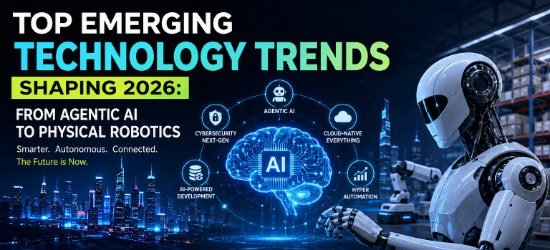
Top Emerging Technology Trends Shaping 2026: From Agentic AI to Physical Robotics
As digital transformation accelerates in 2026, technology is shifting rapidly from experimental phases to enterprise-grade execution and physical deployment. Breakthroughs across artificial intelligence, robotics, connectivity, and sustainable systems are reshaping how industries operate, innovate, and connect. Smarter. Autonomous. Connected. The Future is Now.
Agentic AI
Autonomous agents that plan, decide & execute. Artificial Intelligence has evolved far beyond simple chatbots and prompt-based tools. In 2026, agentic AI systems independently set goals, break down complex problems, coordinate with other agents, and take action across digital environments with minimal human oversight. These multi-agent networks are transforming enterprise workflows, software development, customer support, and strategic decision-making.
Cloud-Native Everything
Scalable, resilient & distributed by design. The industry continues its decisive shift toward cloud-native architectures. Microservices, containers, serverless computing, and Kubernetes-driven platforms enable organizations to build applications that scale elastically, recover automatically from failures, and run consistently across hybrid and multi-cloud environments. Cloud-native is no longer optional—it is the foundation of modern digital infrastructure.
Cybersecurity Next-Gen
AI-driven defense for a hyper-connected world. As attack surfaces expand with IoT, edge computing, and AI systems, traditional perimeter security falls short. Next-generation cybersecurity leverages artificial intelligence for real-time threat detection, autonomous response, zero-trust architectures, and adaptive defenses. AI-powered security operations centers can identify and neutralize sophisticated threats faster than human teams alone.
AI-Powered Development
Build smarter with copilots & automation. Software engineering is being redefined by AI coding assistants, automated testing, intelligent code generation, and AI-driven DevOps pipelines. Developers now work alongside copilots that understand context, suggest architecture improvements, generate tests, and even refactor entire modules. The result is dramatically higher productivity and higher-quality software delivered at unprecedented speed.
Physical Robotics
Robots that perceive, learn & work in the real world. AI is stepping out of the digital realm and into factories, warehouses, hospitals, and homes. Physical robots equipped with advanced perception, reinforcement learning, and dexterous manipulation can navigate unstructured environments, collaborate safely with humans, and perform complex tasks that were previously impossible to automate. From logistics to healthcare, physical AI is becoming a practical reality.
Connectivity Beyond 5G
6G era: ultra-fast, intelligent & ubiquitous. While 5G continues to roll out, research and early deployments of 6G technologies are already shaping the next decade of connectivity. Expect terabit speeds, sub-millisecond latency, integrated sensing and communication, AI-native networks, and seamless coverage that extends from urban centers to remote regions and even non-terrestrial networks. This ultra-reliable, intelligent fabric will power autonomous systems, holographic communications, and the Internet of Everything.
Sustainable Tech
Green innovations for a better tomorrow. Technology itself is becoming a key driver of sustainability. From energy-efficient AI chips and carbon-aware computing to smart grids, precision agriculture, and circular-economy platforms, green tech innovations are helping organizations reduce their environmental footprint while unlocking new business value. Sustainability is no longer a side initiative—it is embedded in the design of next-generation systems.
Conclusion
The technology landscape of 2026 emphasizes agility, ethical AI governance, resilient infrastructure, and responsible innovation. Organizations that embrace agentic systems, cloud-native foundations, next-gen security, AI-augmented development, physical robotics, advanced connectivity, and sustainable design will lead the next wave of transformation. The future is no longer approaching—it is already here.
Comments
0