
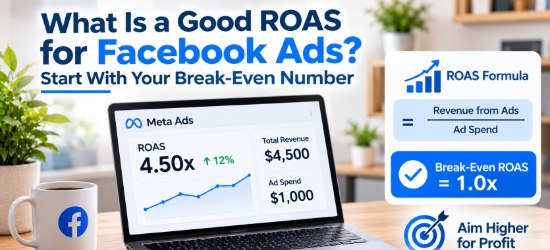
What Is a Good ROAS for Facebook Ads? Start With Your Break-Even Number
ROAS is one of the most quoted numbers in paid advertising, and one of the most misunderstood. Someone says a good ROAS is four, another says two, and a third says it depends. All of them are partly right, and none of them can tell you whether your ads are actually making money.
This guide explains what ROAS means, why a universal benchmark is unreliable and how to work out a target that fits your own business.
What ROAS Means
ROAS stands for return on ad spend. You calculate it by dividing the revenue your ads generated by the amount you spent on them. If you spend one hundred dollars and your ads bring in four hundred dollars in sales, your ROAS is four.
The number is simple, but it measures revenue, not profit. A ROAS of four can be wonderful for one business and a disaster for another, because the costs behind the sales are completely different.
Why a Single Benchmark Does Not Work
You will find plenty of articles quoting an average or a recommended figure. These numbers can be useful as rough context, but they hide enormous differences between businesses. A brand selling high-margin digital products can be profitable at a modest ROAS. A store with thin margins, high shipping costs and frequent discounts may need a much higher one just to break even.
Industry, price point, repeat purchases, tracking quality and the stage of your funnel all change what counts as good. Comparing yourself with a stranger's average is like comparing your grocery bill with someone who lives in a different country.
Find Your Break-Even ROAS First
The most useful number to know is your break-even ROAS, the point where your ads earn back exactly what they cost once product costs are covered. You can estimate it by dividing one by your profit margin before ad spend.
For example, if you keep fifty percent of each sale after product and fulfillment costs, your break-even ROAS is two. At that level, you spend a dollar on ads to earn a dollar of profit back, which means you are not losing money on the sale but not gaining either. If your margin is twenty-five percent, the break-even ROAS is four.
Anything above your break-even number generates profit from the ads themselves. Anything below it loses money, unless you are deliberately accepting a loss to win customers who will buy again.
Set a Target Above Break-Even
Break-even is the floor, not the goal. A healthy business needs room for overhead, tools, team costs and growth. Your target ROAS should sit comfortably above break-even, with the exact gap depending on how much profit you need from each sale.
Many businesses also set different targets for different campaigns. Cold prospecting often runs at a lower ROAS than retargeting, because people who already know your brand are easier to convert.
Consider Lifetime Value
If customers buy from you more than once, the first purchase may not tell the whole story. A product with strong repeat sales can justify a lower first-order ROAS, because the real return arrives over time. In that case, tracking lifetime value alongside ROAS gives a much clearer picture.
The reverse is also true. If almost nobody buys twice, you need the first order to pay for itself.
Make Sure the Number Is Trustworthy
Even a well-chosen target means little if your tracking is wrong. Reported ROAS depends on attribution settings, pixel setup and how conversions are counted, and platform numbers rarely match your store data perfectly. Compare ads reporting with your actual sales regularly, and treat large gaps as a warning sign.
What to Do If Your ROAS Is Too Low
Before changing everything, find where the weakness sits. Low ROAS can come from weak creative, a poor offer, a slow or confusing landing page, broken tracking or a campaign structure that spreads data too thin. Each needs a different fix.
If you are not sure where the problem is, a Meta ads specialist can audit the account and separate creative, funnel and tracking issues. You can also read through real case studies to see how problems like low returns were diagnosed and addressed.
Frequently Asked Questions
Is a ROAS of 4 always good?
No. It depends on your margins and costs. A ROAS of four can be very profitable for some businesses and barely break-even for others.
What is the difference between ROAS and ROI?
ROAS compares revenue with ad spend. ROI compares profit with total investment, so it includes costs beyond ads. ROAS is easier to track, while ROI shows the fuller financial picture.
Should I use different ROAS targets for different campaigns?
Often yes. Cold audiences usually return less on the first purchase than retargeting audiences, so a single target for everything can be misleading.
Why does my Facebook ROAS differ from my store data?
Differences come from attribution windows, tracking limitations and how each system counts conversions. Use platform numbers for direction and your store data for confirmation.
Final Thoughts
A good ROAS is the one that keeps your business profitable and growing, not the one quoted in someone else's article. Work out your break-even number, set a target above it, check that your tracking is reliable and look at lifetime value if customers return. Do that, and ROAS becomes a useful decision tool instead of a number to worry about.
Comments
0