
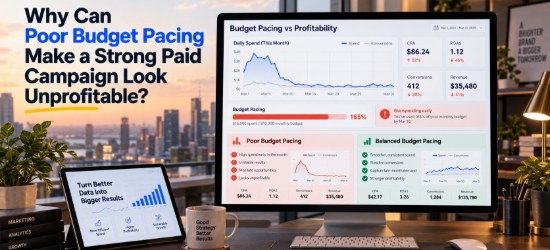
Why Can Poor Budget Pacing Make a Strong Paid Campaign Look Unprofitable?
A paid campaign can have an effective offer, relevant audience, persuasive creative, and accurate tracking but still produce disappointing results when its budget is distributed poorly.
Some campaigns spend too much too early, leaving little money available during the most valuable periods. Others spend so cautiously that they never collect enough data to identify what is working. Budgets may also be divided across too many campaigns, causing each one to operate with insufficient conversion volume.
Paid advertising budget pacing is the process of controlling how advertising spend is distributed across a day, week, month, or promotional period. It helps a business maintain delivery while adapting to customer demand, sales capacity, campaign performance, and financial limits.
A skilled performance media buyer does more than set a monthly budget. The budget must be paced according to the campaign’s objective and the way customers actually buy.
What Is Paid Advertising Budget Pacing?
Budget pacing determines how quickly or slowly an advertising budget is used during a defined period.
Suppose a company has £30,000 to spend during one month. A simple pacing plan would allow an average of approximately £1,000 per day. However, spending exactly the same amount every day may not be appropriate.
Customer demand could be stronger on certain weekdays, during payday periods, after an email promotion, or near the end of a limited offer. The business may therefore choose to spend more during high-opportunity periods and less when conversion intent is weaker.
Effective pacing balances three priorities:
- Spending enough to collect useful campaign data
- Protecting the budget from inefficient delivery
- Maintaining sufficient funds for future opportunities
The objective is not to spend the full amount as quickly as possible. It is to use the budget where it has the strongest chance of producing valuable business outcomes.
Why Do Campaigns Spend Too Quickly?
Rapid spending can happen for several reasons.
The Daily Budget Is Set Too High
A large daily budget may push the campaign to reach less suitable users after the strongest opportunities have been exhausted.
Increasing spend does not guarantee that an audience will create demand at the same rate. As delivery expands, the campaign may move beyond the easiest conversions.
The Audience Is Too Small
A high budget combined with a limited audience can increase frequency. The same users may see the advertisements repeatedly, which can reduce engagement and create creative fatigue.
Several Campaigns Target Similar Users
Audience overlap can cause budgets to compete for related groups. Instead of increasing reach effectively, additional spend may produce repeated exposure.
A Short Promotion Creates Pressure
Businesses may attempt to spend a large budget during a short sale or launch. Without preparation, this can increase acquisition costs at the exact moment profitability matters most.
Rapid spending is not always wrong. A high-value promotion may justify aggressive delivery, but the decision should be supported by demand, inventory, creative capacity, and reliable conversion data.
Why Do Some Campaigns Spend Too Slowly?
Under-spending can be equally problematic.
A campaign may struggle to deliver when:
- The audience is extremely narrow
- Bids or cost controls are too restrictive
- The budget is fragmented across many ad groups
- Advertisements have limited approval or placement eligibility
- Conversion history is insufficient
- The selected goal is difficult to achieve
- Demand is weaker than expected
Slow spending can prevent the campaign from generating enough results to evaluate performance. Marketers may then continue making decisions from small, unstable samples.
Before increasing bids or expanding audiences, the advertiser should identify why the campaign is not delivering. The solution should address the actual restriction rather than simply forcing more spend.
How Can Poor Pacing Distort Performance Reports?
Performance reports often compare one period with another. If the budget was distributed differently, the comparison may be misleading.
For example, one campaign may spend most of its monthly budget during a high-demand week, while another distributes spend evenly. The first may appear more efficient, but its advantage could come from timing rather than superior targeting or creative.
Poor pacing can also create:
- Strong early results followed by a late decline
- High acquisition costs after rapid scaling
- Insufficient data during important periods
- Uneven lead volume for the sales team
- Sudden changes in daily revenue
- Confusing comparisons between campaigns
Reports should therefore include budget changes, promotional dates, delivery patterns, and customer demand alongside conversion metrics.
How Should Businesses Set an Initial Pace?
The initial pace should begin with the total available budget and the number of days in the campaign.
However, the business must also consider:
- The normal sales cycle
- Historical conversion rates
- Average customer acquisition cost
- Audience size
- Seasonal demand
- Promotional periods
- Sales-team capacity
- Product inventory
- Creative availability
If historical data is limited, a controlled testing period can establish a baseline. The campaign should receive enough budget to generate meaningful results without exposing the business to unnecessary financial risk.
Professional paid advertising services should connect budget decisions with campaign data, customer quality, and the wider conversion journey.
Should More Budget Be Assigned to Better-Performing Days?
Historical patterns can guide budget allocation, but they should be interpreted carefully.
If customers frequently purchase on Fridays, increasing Friday delivery may seem logical. However, advertisements shown earlier in the week might have introduced the brand and influenced those purchases.
Reducing earlier activity could weaken the final conversion volume.
Businesses should examine the complete journey, including first interactions, assisted conversions, conversion delays, and repeat website visits. Day-of-week performance should support budget decisions rather than control them blindly.
The same principle applies to time-of-day scheduling. A purchase completed at 8 p.m. may have started with an advertisement seen during lunch.
How Does Scaling Affect Budget Pacing?
Scaling increases the amount spent on a campaign that has demonstrated potential. The challenge is that performance does not always increase in direct proportion to the budget.
A campaign spending £200 per day may produce customers profitably. Raising the budget to £1,000 per day does not guarantee five times as many customers at the same acquisition cost.
The larger budget may require the platform to reach less responsive users or increase frequency among the existing audience.
Scaling should normally be monitored through:
- Cost per qualified lead or customer
- Conversion rate
- Revenue
- Profit margin
- Audience frequency
- Lead quality
- Sales-team capacity
- Refund or cancellation rate
Relevant campaign results and reviews can help demonstrate why scaling decisions should be based on commercial outcomes rather than spend alone.
How Can Creative Capacity Affect Budget Pacing?
As spend increases, more people see the advertisements and existing audiences encounter them more frequently. A campaign may therefore require additional creative variations to maintain attention.
Budget growth without creative growth can produce:
- Repetitive delivery
- Falling click-through rates
- Rising acquisition costs
- Reduced message relevance
- Difficulty reaching new customer motivations
Businesses should prepare new hooks, formats, messages, demonstrations, and customer objections before increasing the budget significantly.
This does not mean replacing every advertisement quickly. Strong creative should continue running while new concepts are introduced through a controlled testing process.
What Should Happen When Results Decline?
A declining campaign should not automatically receive a lower budget. The business should first identify whether the change is temporary or structural.
Questions to ask include:
- Has the decline continued long enough to be meaningful?
- Did the budget recently increase?
- Has customer demand changed?
- Is the same audience seeing advertisements too frequently?
- Did the website or offer change?
- Are conversions being recorded correctly?
- Has lead or customer quality changed?
- Is the sales team responding effectively?
If the decline results from normal daily volatility, immediate budget cuts may create more instability. If the campaign has consistently exceeded an acceptable acquisition cost, adjusting the pace may protect profitability while the underlying problem is investigated.
How Often Should Budget Pacing Be Reviewed?
Campaigns should be monitored regularly, but major adjustments should follow a defined review process.
High-spend campaigns may require daily pacing checks because small percentage differences can represent significant amounts of money. Smaller campaigns may be evaluated over longer periods because their daily results are naturally less stable.
A useful review should compare:
- Planned spend with actual spend
- Revenue or qualified opportunities
- Current acquisition cost
- Remaining budget
- Remaining campaign days
- Upcoming promotions
- Sales and inventory capacity
This provides more useful information than checking spend in isolation.
Final Thoughts
Paid advertising budget pacing can strongly influence how a campaign collects data, reaches customers, supports sales, and protects profitability.
Spending too quickly may exhaust strong opportunities and increase acquisition costs. Spending too slowly may limit learning and cause the business to miss valuable demand. Dividing the budget across too many campaigns can create a different problem by leaving each one without enough data.
The correct pace depends on the objective, audience, sales cycle, conversion volume, and business capacity. A strong plan establishes an initial spending rate, monitors commercial outcomes, and adjusts carefully when reliable evidence supports a change.
Good budget management is not about spending every available pound or rupee. It is about using the budget at a rate the campaign and business can support profitably.
Frequently Asked Questions
What is budget pacing in paid advertising?
Budget pacing is the process of controlling how advertising spend is distributed across a particular day, week, month, or promotional period.
Should an advertising budget be divided equally every day?
Not always. Equal daily spending is a useful starting point, but customer demand, promotional dates, and conversion patterns may justify different daily allocations.
Can increasing the daily budget reduce performance?
Yes. A larger budget may force the campaign to reach less responsive users or increase frequency, which can raise the average customer acquisition cost.
Why is my campaign not spending its full budget?
Possible causes include narrow targeting, restrictive bids, insufficient conversion history, limited demand, fragmented campaign structure, or advertisement eligibility issues.
How often should a campaign budget be changed?
There is no universal schedule. Changes should be made when sufficient data reveals a meaningful pattern or when an operational issue requires immediate action.
Comments
0