
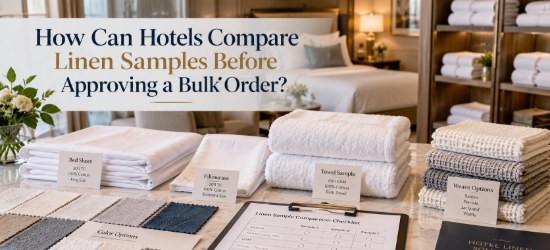
How Can Hotels Compare Linen Samples Before Approving a Bulk Order?
Choosing commercial linen from photographs or specifications alone can lead to expensive mistakes. Two sheets may have similar descriptions but behave differently after washing, while towels with comparable weights may differ in absorbency, drying time, or stitching quality. A structured hotel linen sample testing process allows hotels to compare products under realistic conditions before committing to a large order.
The aim is not to find the softest product on the first day. Hotels should assess how the textile fits, washes, dries, maintains its dimensions, and performs after several cycles of normal commercial use.
Why Should Hotels Test Samples Before Buying in Bulk?
Commercial textiles may be ordered in hundreds or thousands of pieces.
A small problem that seems unimportant in one sample can become significant when repeated across a large order.
For example, a fitted sheet that shrinks slightly too much may become difficult for housekeeping staff to use. A towel that dries slowly may increase laundry turnaround when hundreds are processed every day.
Sample testing helps identify these issues before purchasing.
It can also make supplier comparisons fairer because every product is evaluated using the same criteria.
Start With a Written Product Requirement
Before comparing samples, decide what the hotel actually needs.
For bedding, review the dimensions and type of bed linen already required by the property.
Record details such as:
- Mattress width
- Mattress length
- Mattress depth
- Sheet type
- Duvet dimensions
- Pillow dimensions
- Preferred fabric construction
Without a clear specification, staff may choose whichever sample initially feels best even if it does not fit the hotel's operational requirements.
A written requirement gives the evaluation a consistent starting point.
How Should New Linen Be Inspected?
Begin with the product before it is washed.
Lay the sample on a clean surface and check its overall construction.
For sheets and covers, look at:
- Dimensions
- Stitching
- Seams
- Fabric consistency
- Colour
- Edge finishing
For fitted sheets, inspect the elastic and corner construction.
For pillowcases and duvet covers, check closures and whether the finished size matches the inserts already in use.
Any visible construction differences should be recorded before the textile enters testing.
Why Is Linen Quality Comparison Better With Several Samples?
A single sample does not always show production consistency.
Where practical, hotels should compare several pieces of the same proposed product.
A useful linen quality comparison looks for differences between items that are supposed to have identical specifications.
Check whether their dimensions, texture, stitching, colour, and construction remain reasonably consistent.
If three towels from the same proposed order feel noticeably different or vary considerably in size, the hotel should investigate before approving a larger quantity.
Consistency is especially important when replacement products will later be mixed with existing stock.
How Should Hotels Conduct a Wash Test?
A textile wash test should reflect the process the product is likely to experience during normal hotel use.
Measure the sample before laundering and record the dimensions.
Then wash and dry it using the hotel's normal commercial process or conditions representative of the external laundry service.
After processing, measure it again.
Check for:
- Shrinkage
- Shape changes
- Stitching damage
- Texture changes
- Colour changes
- Wrinkling
- Drying behaviour
One cycle can provide useful information, but several cycles give a better picture of how the textile may perform over time.
Why Is Shrinkage Particularly Important for Fitted Products?
A small dimensional change may have little impact on an oversized flat sheet but can create problems with fitted bedding.
A fitted sheet needs to remain compatible with mattress width, length, and depth.
After testing, place the sheet back on the actual mattress.
Do not rely only on the measuring tape.
Housekeeping staff should confirm whether it still fits securely and can be installed without excessive stretching.
This practical test can identify issues that numerical measurements alone may miss.
How Should Towels Be Compared?
My Cotton's bath linen range includes several towel types, and these products need different evaluation criteria from bedding.
For towels, assess:
- Dimensions
- Weight
- Absorbency
- Drying time
- Texture
- Hem quality
- Shape after washing
Do not judge a towel only by its thickness.
A heavier towel may provide a particular feel but could also retain more water and take longer to dry.
Hotels should consider where the product will be used.
A guest-room bath towel may require a different balance from a pool, gym, or spa towel.
How Can Hotels Test Absorbency Practically?
Hotels do not need laboratory equipment for a basic operational comparison.
Samples can be washed first so any finishing treatments from manufacturing are no longer influencing the initial feel.
Then staff can compare how efficiently each towel absorbs moisture during normal use.
Laundry teams can also note whether one towel retains noticeably more water after washing or requires substantially longer drying.
The purpose is not to produce a scientific ranking.
It is to understand whether the towel suits the property's real operational environment.
Why Should Housekeeping Staff Evaluate Samples?
Purchasing teams often focus on price and written specifications.
Housekeeping staff experience the practical side of the product.
They can identify whether:
- Sheets are easy to fit
- Duvet covers take too long to change
- Pillowcases fit correctly
- Towels fold consistently
- Products take too much storage space
Their feedback is especially valuable because a small inconvenience can become a large operational issue when repeated across dozens of rooms every day.
Laundry employees should also participate when washability, drying, or finishing is being evaluated.
How Should Restaurants Test Table Linen?
Hotels with dining and banquet operations should use the same approach for table linen.
Tablecloth samples should be placed on the actual tables.
Check whether they provide the intended drop and whether dimensions remain suitable after washing.
Restaurant teams should also evaluate:
- Stain handling
- Wrinkling
- Colour stability
- Edge finishing
- Ironing requirements
- Appearance after repeated laundry cycles
Napkins should be tested for size consistency and how easily they can be folded for normal service.
A product that looks attractive before washing may create additional work if it becomes difficult to finish after every cycle.
What About Healthcare Textiles?
Healthcare facilities should follow their established hygiene, clinical, infection-control, and laundry requirements.
When evaluating hospital linen, testing should focus on the product's intended healthcare use.
Reusable sheets, pillow covers, towels, gowns, and other textiles may need evaluation for dimensions, construction, wash durability, and ease of handling.
Different hospital departments may also require different specifications.
For this reason, samples should be assessed according to the environment where they will actually be used rather than applying hotel standards directly to healthcare products.
How Can Hotels Record Sample Results?
A simple comparison sheet can prevent decisions from depending on memory.
For each sample, record:
- Product name
- Original dimensions
- Post-wash dimensions
- Fabric information
- Stitching condition
- Drying observations
- Fit
- Housekeeping feedback
- Laundry feedback
Photographs can also be useful.
When several products are being compared over multiple wash cycles, written records make it much easier to see which issues appeared and when.
Should Price Be Included in the Test?
Price matters, but it should be considered after performance requirements are understood.
A lower-priced product may not provide good value if it requires frequent replacement or creates additional laundry work.
Likewise, the most expensive sample should not automatically be assumed to perform best.
Hotels should first determine which textiles meet their operational requirements.
Cost can then be compared among products that have already demonstrated acceptable performance.
This approach provides a more meaningful purchasing decision than selecting by unit price alone.
Final Thought
Bulk textile purchasing becomes more reliable when decisions are based on actual performance rather than first impressions. Measuring products, completing realistic wash tests, checking fit, involving housekeeping and laundry teams, and recording results can reveal problems before they are multiplied across a large order.
A structured commercial textile evaluation also helps businesses understand which specifications matter most in their own environment. When hotels compare bedding, towels, table textiles, and other products under real operating conditions, future purchasing can become more consistent while the main commercial product pages remain focused on their intended search terms.
FAQs
1. How many linen samples should a hotel test?
There is no universal number, but testing several pieces where practical provides a better view of consistency than relying on one sample.
2. Why should linen be washed before approval?
Washing can reveal shrinkage, stitching problems, colour changes, texture changes, wrinkling, and drying behaviour that may not be visible when the product is new.
3. What should hotels measure before and after washing?
For sheets and covers, record length, width, and relevant depth. Towels and tablecloths should also be checked for dimensional changes.
4. Should housekeeping staff help select hotel linen?
Yes. Housekeeping staff can identify practical problems with fit, folding, changing covers, storage, and everyday room preparation.
5. Is the thickest towel always the best choice?
No. Hotels should balance absorbency, comfort, drying time, weight, laundry capacity, and the towel's intended use.
6. Should price determine which linen sample is approved?
Price should be considered together with performance. A product that costs less initially may not be economical if it wears quickly or creates additional operational work.
Comments
0