
The Energy Wall No Chip Can Bypass: Microsoft’s Nscale Withdrawal and What It Reveals About AI’s Real Scaling Limits in 2026
When Microsoft quietly ended its role as the anchor tenant for Nscale’s planned AI campus in Loughton, Essex, the headlines focused on a single cancelled contract. The deeper story is more structural. A British neocloud startup that had lined up planning permission, Nvidia backing, a £2 billion commitment, and a marquee customer still could not turn the project on because the local electricity grid will not be ready until the early to mid-2030s. That gap—between signed demand and available electrons—is now one of the clearest illustrations of the physical limits facing the global AI build-out.
Nscale had positioned Loughton as the United Kingdom’s largest sovereign AI data centre, designed for an initial 50 MW that could scale to 90 MW and house roughly 23,000 Nvidia GPUs for Azure workloads. The government had highlighted the site in its AI strategy. Microsoft had included it within a broader UK investment commitment. Then UK Power Networks indicated that the necessary grid connection would not arrive in time for a 2027 opening. Microsoft walked away. Nscale insists the relationship remains strong on other projects and that it is exploring alternative power sources, yet the site now lacks a publicly announced customer and the IPO timing has grown more complicated.
Key Facts Behind the Withdrawal

The original plan called for the Loughton facility to open in early 2027 and supply Microsoft with high-density GPU capacity close to London. Nscale, spun out of an Australian crypto-mining firm, had grown rapidly by offering full-stack AI infrastructure and had filed for a US listing with Microsoft and Anthropic expected among its largest customers. Total contracted value had been presented as rising from roughly $100 million to more than $100 billion in a short period. That metric, however, only converts into revenue once power, buildings, and servers are actually delivered.
Reporting from the Telegraph, BBC, Guardian, and Reuters consistently pointed to the same constraint: the London-area grid cannot supply the required megawatts on the original schedule. Similar delays have affected Nscale’s flagship site in Norway, where only a fraction of the intended capacity is online. The company has said it remains committed to Loughton and is examining on-site generation options, including fuel-cell approaches, while also looking at other UK locations. Microsoft has declined public comment, which is typical when a commercial agreement is terminated for operational rather than strategic reasons.
For context, 90 MW is comparable to the electricity demand of hundreds of thousands of homes. Across the UK, hundreds of data-centre projects are already queued for grid connections whose aggregate request far exceeds current peak national demand. The same pattern appears in the United States, Ireland, the Netherlands, and parts of Asia: interconnection queues measured in years, not quarters.
Why This Matters Beyond One Cancelled Deal

The AI industry has spent the past two years optimising for chips, model scale, and capital. Nvidia’s supply has been the most visible bottleneck, followed by advanced packaging, high-bandwidth memory, and leading-edge wafers from TSMC. Those constraints remain real; our earlier analysis of TSMC’s record quarters and wafer economics showed how leading-edge capacity continues to be allocated rather than freely available. Yet the Loughton episode demonstrates that even when chips can be ordered and capital can be raised, the electrons may not arrive.
Power is different from silicon. A GPU can be shipped, a wafer can be reallocated, and software can be optimised for efficiency. Building new high-voltage transmission lines, substations, and generation capacity requires multi-year permitting, public consultation, and physical construction that cannot be accelerated by a product roadmap. In the UK the issue is compounded by a network that was not designed for the sudden concentration of multi-tens-of-megawatt loads near major cities. Similar pressures appear wherever hyperscalers and neoclouds try to site large campuses close to existing fibre and talent.
This has direct consequences for sovereign AI strategies. The UK government has spoken of becoming a leader in AI and has pointed to projects such as Loughton as evidence of progress. When the flagship campus loses its anchor tenant because of grid timing, the gap between policy announcements and operational capacity becomes harder to ignore. Comparable tensions exist in the European Union’s data-centre efficiency rules and in US debates over transmission reform. The companies that can secure power early—through long-term offtake agreements, behind-the-meter generation, or locations with surplus capacity—gain a durable advantage that is difficult for competitors to close quickly.
There is also a financing angle. Neoclouds such as Nscale, CoreWeave, and others have used large contracted backlogs to support high valuations and IPO plans. When a major contract is cancelled or delayed because the underlying facility cannot be energised, the backlog number becomes less predictive. Investors are already watching AI-related debt levels and the gap between announced capacity and delivered megawatts. A single high-profile exit does not reverse the demand trend, but it does raise the discount rate applied to projects whose power timeline is uncertain.
The Broader Infrastructure Crunch

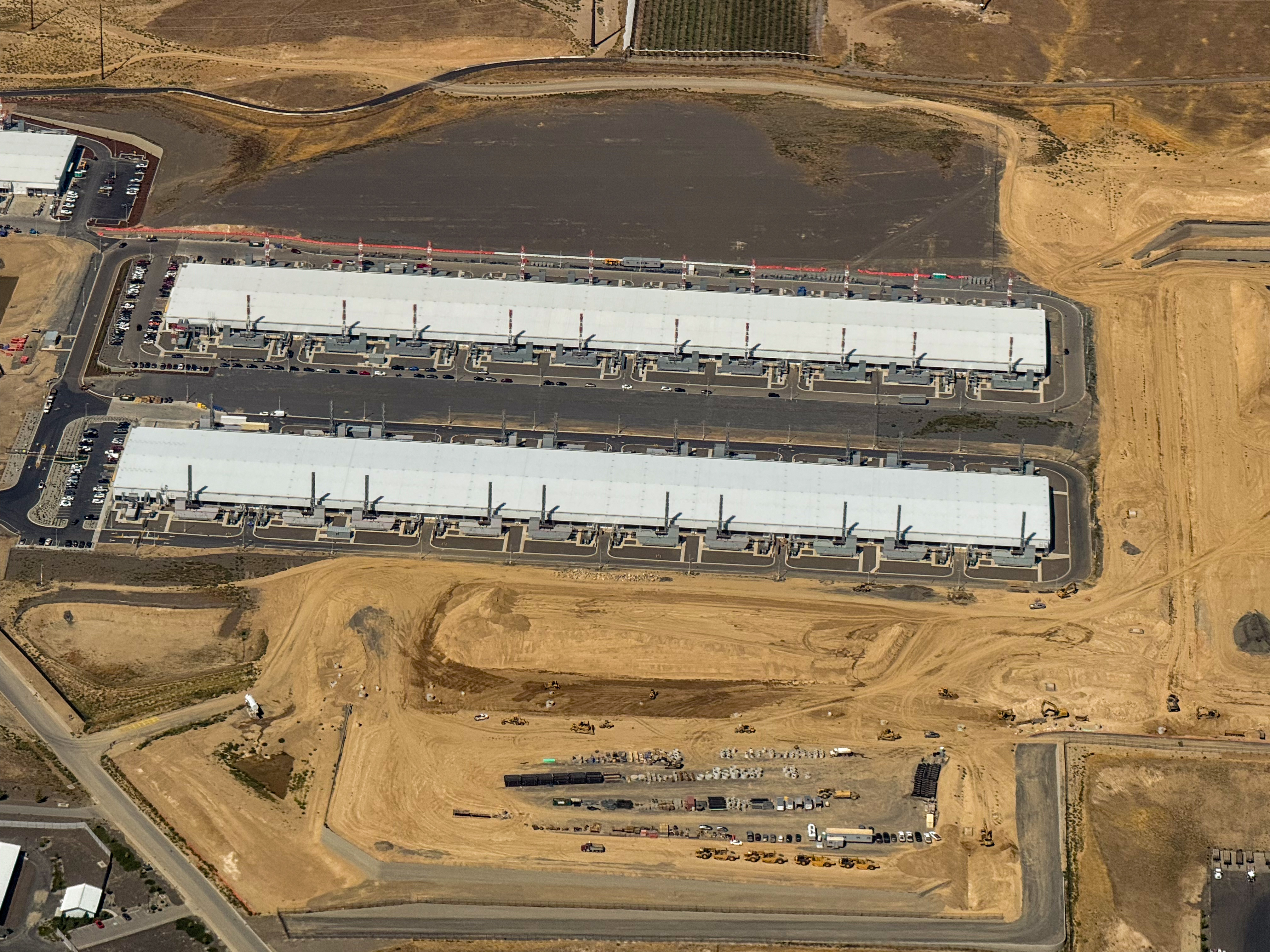
Across the industry the pattern is consistent. Data-centre operators report that the limiting factor has shifted from land or fibre to interconnection and generation. Some are turning to on-site gas turbines or solid-oxide fuel cells as bridge solutions while waiting for grid upgrades. Others are relocating projects to regions with faster interconnection queues or surplus renewable capacity. Microsoft itself has been expanding in locations where it can control more of the power stack, including large campuses in the United States that combine compute halls with substantial cooling and electrical infrastructure.
Efficiency gains help but do not eliminate the problem. Newer GPU generations and liquid cooling reduce the power per token or per training run, yet absolute demand continues to rise because model sizes, agentic workloads, and inference volumes are growing faster. The shift toward longer-context agents and continuous background work, visible in products from multiple labs, increases sustained rather than bursty load. That sustained load is exactly what stresses local grids.
Related coverage on Webypost has examined adjacent pieces of the same puzzle. The analysis of CXMT’s density claims and the AI chip cycle showed how memory and logic supply still matter. Google’s orbital TPU experiment, covered in A Kilowatt in Orbit, tests extreme power and thermal constraints in a different environment. Anthropic’s internal agent-hour data, discussed in the 6-to-1 ratio piece, illustrates why inference demand keeps expanding even as training clusters remain capital-intensive. Apple’s HomeView plans, examined in The Always-On Room, point to a future in which household devices also draw continuous AI inference. Each of these trends ultimately routes back to the same physical constraint: reliable, scalable electricity.
What to Watch Next

Several developments will clarify whether the Loughton outcome is an isolated UK-grid problem or a preview of wider friction. First, watch whether Nscale secures an alternative power solution or an alternative tenant on a timeline that supports its IPO narrative. Second, monitor UK grid-upgrade announcements and any policy moves that accelerate interconnection for strategic AI projects. Third, track similar announcements from other neoclouds and hyperscalers: any public admission that a major campus has slipped by multiple years because of power will reinforce the pattern.
On the technology side, look for measurable gains in power efficiency at the system level—not just peak FLOPS per watt, but sustained tokens per megawatt under realistic agentic workloads. Companies that can demonstrate lower energy per useful output will be better positioned when interconnection queues remain long. Finally, observe how capital markets reprice projects whose power timelines stretch into the 2030s. The difference between a contracted backlog and a deliverable backlog is becoming a material due-diligence item.
Microsoft’s other UK and European commitments remain in place, and the company continues to expand capacity elsewhere. The Loughton decision does not signal a retreat from AI infrastructure; it signals a practical refusal to commit capital and chips to a site that cannot be energised on a commercially relevant schedule. That distinction matters for every operator and every government that has treated data-centre announcements as roughly equivalent to delivered compute.
Conclusion: The Quiet Constraint That Now Shapes Strategy

The AI boom has been narrated primarily through model releases, chip generations, and valuation multiples. The Nscale episode in Essex is a reminder that the underlying physical system—generation, transmission, and local interconnection—moves on a slower clock. When that clock and the commercial clock diverge by several years, even well-funded, well-partnered projects can stall. Microsoft’s exit is not the end of Britain’s AI infrastructure story, but it is evidence that power has become a first-order strategic variable rather than a secondary operational detail.
For readers tracking the sector, the practical implication is straightforward. Chip supply, model capability, and capital availability remain essential. They are no longer sufficient. The projects that reach production at scale will be those that solve the electron problem early, whether through location choice, behind-the-meter generation, long-term grid agreements, or efficiency gains that stretch every available megawatt further. In 2026 the energy wall is no longer theoretical. It has already rewritten at least one high-profile contract, and it is likely to rewrite more.
Official reporting on the withdrawal can be found at the BBC and Reuters.
Comments
0