
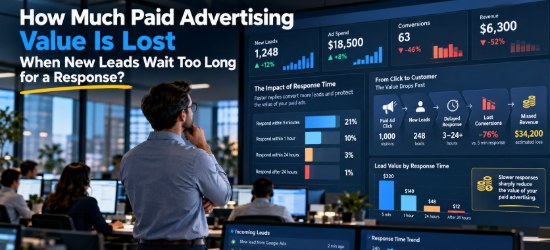
How Much Paid Advertising Value Is Lost When New Leads Wait Too Long for a Response?
A paid campaign can attract the correct audience, communicate a relevant offer, and generate qualified enquiries. Yet the campaign may still appear unsuccessful if those enquiries do not receive a timely and useful response.
Potential customers often contact several businesses while comparing their options. Their attention may be strongest immediately after completing a form, requesting a quotation, or booking a consultation. When the company waits too long to respond, that interest can decline.
Lead response time measures how quickly a business contacts a new prospect after an enquiry. Improving it can increase the value of existing advertising without requiring more clicks or a larger media budget.
What Is Lead Response Time?
Lead response time is the period between a prospect submitting an enquiry and receiving the first meaningful response from the business.
The enquiry may come through:
- A website form
- A paid social campaign
- A search advertisement
- A phone call
- A live chat
- A messaging application
- A consultation booking
- A product demonstration request
An automatic confirmation can reassure the prospect that the form was submitted successfully. However, it is not always a complete response.
A meaningful response should acknowledge the person’s request, explain the next step, and provide a realistic expectation about when further contact will occur.
Why Does Response Speed Matter?
A prospect usually submits an enquiry because a problem or need is currently important.
At that moment, the person may be actively researching, comparing options, or trying to make a decision. A fast response keeps the conversation connected to that motivation.
A delayed response creates several risks:
- The prospect contacts a competitor
- The original need becomes less urgent
- The person forgets the advertisement
- The business appears disorganized
- Important context is lost
- The prospect becomes difficult to reach
- Trust declines before the conversation begins
Fast communication cannot guarantee a sale. It simply improves the chance of engaging the prospect while the original interest is still active.
How Can Slow Follow-Up Make Advertising Look Weak?
Advertising platforms usually measure form submissions, calls, bookings, or purchases. They may not know what happens after a lead enters the sales process.
Suppose two campaigns each generate 50 leads. Leads from the first campaign receive a response within a reasonable period, while leads from the second campaign wait several days because they are assigned incorrectly.
The first campaign may produce more customers even if the quality of the original enquiries was similar.
A business reviewing only final sales might conclude that the second campaign attracted weak prospects. The real problem occurred after the conversion.
A complete lead generation strategy should therefore include both advertising performance and the process used to manage incoming enquiries.
What Prevents Businesses From Responding Quickly?
Slow response is not always caused by a lack of effort. It often results from an unclear system.
Common causes include:
No Clear Ownership
Several team members may have access to enquiries, but nobody is specifically responsible for responding.
Disconnected Systems
Leads may arrive in different inboxes, spreadsheets, dashboards, and messaging tools. Some enquiries are noticed quickly, while others are missed.
Incomplete Notifications
The sales team may not receive an immediate alert when a new lead arrives.
Limited Working Hours
Campaigns can generate enquiries outside normal business hours. Without a defined process, those leads may wait until much later.
Too Many Unqualified Leads
The team may spend time reviewing irrelevant enquiries because the advertisement or form does not qualify prospects effectively.
Insufficient Sales Capacity
Advertising volume may increase faster than the team’s ability to respond.
Understanding the operational cause is important before changing the campaign.
Should Every Lead Receive an Immediate Sales Call?
Not every enquiry needs an instant phone call.
The appropriate response depends on what the person requested and which communication method was offered.
Someone who booked a consultation may need confirmation and preparation details. A person requesting a quotation may need a short message explaining when it will be prepared. Someone downloading educational content may not expect direct sales contact immediately.
The response should match the prospect’s intention.
An aggressive call immediately after a low-intent content download may feel intrusive. A slow response to an urgent service enquiry may feel careless.
Speed matters, but relevance and context matter as well.
What Should the First Response Include?
The first response should reduce uncertainty.
It can include:
- Confirmation that the enquiry was received
- The name of the person or team responding
- A summary of what the prospect requested
- The next step
- The expected response time
- Any information the prospect should prepare
- A way to reschedule or update the request
- Contact details for urgent questions
The message should be short enough to understand quickly. It should not overwhelm a new lead with an extended sales presentation.
How Can Automation Improve Lead Response Time?
Automation can help businesses acknowledge new enquiries and route them to the correct person.
Useful automation may include:
- Instant confirmation emails
- Text or messaging notifications
- Calendar confirmations
- Lead assignment rules
- Sales-team alerts
- Follow-up reminders
- Customer relationship management updates
- Qualification sequences
Automation should support human communication rather than create a confusing or impersonal experience.
An automated message that promises a response within one hour becomes harmful if the business regularly takes two days. Expectations should be accurate.
How Can Advertising Improve the Follow-Up Process?
Advertising can help qualify prospects before they submit an enquiry.
The campaign can clearly explain:
- Who the offer is for
- The product or service provided
- Relevant locations
- Important requirements
- Starting prices when appropriate
- The expected commitment
- What happens after the form is submitted
Clear advertising may reduce the total number of enquiries while improving their quality.
A skilled performance media buyer should evaluate whether campaigns generate leads that the sales team can realistically contact, qualify, and convert.
Lead volume should not be increased beyond the team’s capacity simply because the cost per form submission appears attractive.
What Role Does the Lead Form Play?
A lead form should collect enough information to support the next conversation without creating unnecessary friction.
Useful fields may include:
- Name
- Contact information
- Service or product required
- Location
- Preferred contact method
- A short description of the need
Complex services may require additional qualification. However, asking too many questions can reduce form completion and frustrate prospects.
The form should also explain what happens next. Statements such as “Our team will contact you to discuss your requirements” are more helpful when they include a realistic timeframe.
How Should Leads Be Prioritized?
Not every lead has the same urgency or purchase intention.
Businesses can prioritize leads using factors such as:
- The action completed
- The product or service requested
- The stated timeline
- The problem’s urgency
- The budget range
- Previous website activity
- Existing customer status
- Form answers
Someone requesting emergency support may require an immediate response. A person researching a future project may be better suited to a nurturing sequence.
Lead prioritization helps the team respond quickly where speed has the greatest commercial value.
Which Metrics Should Be Tracked?
Businesses should measure both response speed and what happens afterward.
Useful metrics include:
- Average first-response time
- Percentage of leads contacted
- Contact success rate
- Qualified lead rate
- Appointment booking rate
- Appointment attendance rate
- Lead-to-customer conversion rate
- Average time to close
- Revenue by lead source
- Customer acquisition cost
The company can compare these metrics across campaigns, platforms, times of day, and team members.
Relevant case studies can also help demonstrate how advertising, qualification, follow-up, and sales performance influence one another.
How Can a Business Improve Its Response Process?
A practical improvement plan may include:
- Map every source of incoming leads.
- Assign clear ownership for each source.
- Create immediate notifications.
- Define realistic response-time standards.
- Prepare templates for common enquiry types.
- Set reminders for unanswered leads.
- Record the outcome of each conversation.
- Review response and sales data regularly.
- Adjust advertising volume to match team capacity.
The process should be tested during busy periods, outside normal hours, and when responsible staff members are unavailable.
Final Thoughts
Advertising does not finish when a lead submits a form. The speed and quality of the next interaction can determine whether that paid enquiry becomes a genuine sales opportunity.
A slow response can make strong campaigns appear weak, while an organized follow-up process can increase the value of existing media spending.
Businesses should connect lead response time with qualification, appointment, sales, and revenue data. This provides a clearer view of whether poor performance begins in the campaign or after the lead reaches the business.
Frequently Asked Questions
1. What counts as a meaningful first response?
It is a response that acknowledges the specific enquiry, explains the next step, and gives the prospect a realistic expectation.
2. Is an automated email enough?
It can confirm receipt, but high-intent enquiries usually require relevant human follow-up as well.
3. Should businesses contact leads outside working hours?
They can use accurate automated confirmations and offer scheduling options. Human contact should reflect the company’s actual availability.
4. Can faster responses improve lead quality?
Speed does not change the original lead, but it can improve contact and qualification before the prospect loses interest.
5. How can advertising reduce pressure on the sales team?
Clear targeting, qualification, offer details, and form questions can reduce unsuitable enquiries and help the team prioritize stronger leads.
Great Article!! Add images to make it more informative!!