
Beyond the Chatbot Hype: Meta’s Muse Racing to App Store No. 2 and the Real Shift Toward Autonomous Digital Lives
In the span of just a couple of days, Meta’s new personal AI agent Muse climbed into the No. 2 spot on the U.S. App Store charts. That kind of velocity is rare even in the fast-moving world of consumer AI apps. It is not merely another chatbot release. It signals something more fundamental: users are ready to hand over actual work, not just questions, to software that can act across the apps and services they already rely on.

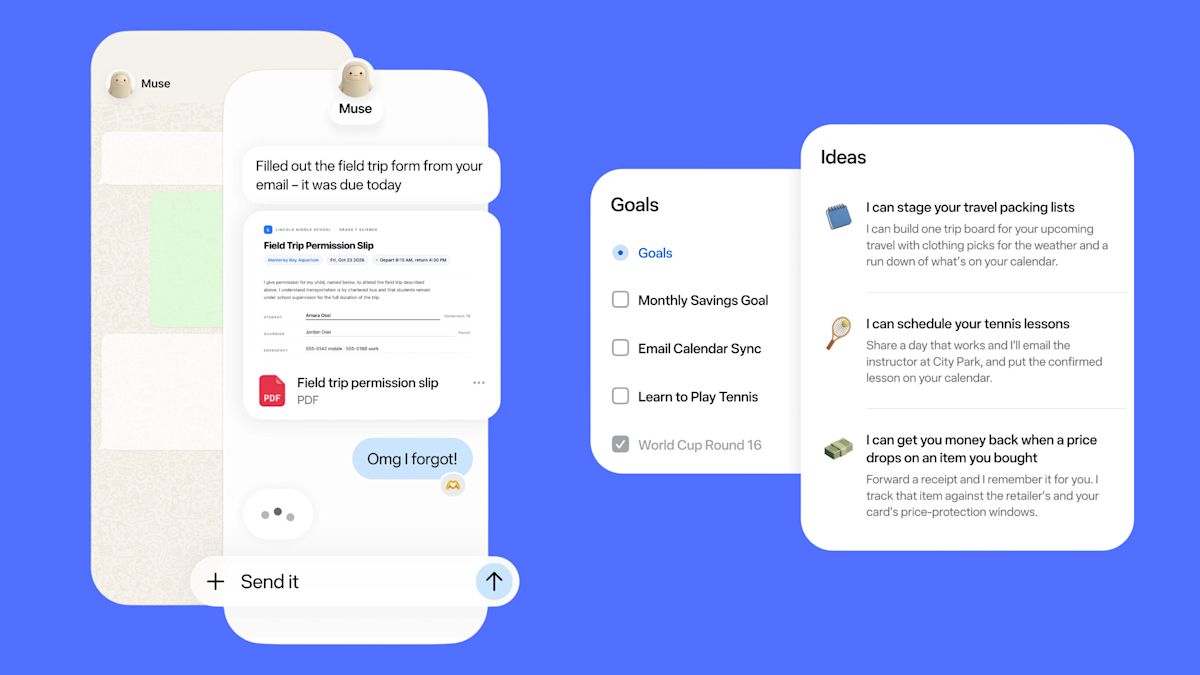
Muse launched earlier this week for U.S. users 18 and older on iOS, Android, the web, and WhatsApp. Unlike traditional assistants that wait for prompts and reply in text, Muse is designed to run long-running tasks in the background. Give it a goal—book travel, lower a recurring bill, turn a recipe reel into a grocery list, or draft and send party invitations—and it can open a browser, fill forms, negotiate, and complete actions on the user’s behalf. Sensitive steps require explicit approval. Payments use single-use tokens through Stripe’s Link so real card details stay hidden.

Each user receives a dedicated secure virtual machine in Meta’s cloud. That isolated environment hosts the agent, a browser the user can observe, and the necessary connectors. Meta emphasizes that the agent never sees actual passwords or permanent payment credentials. Users control the level of access, can opt out of training data use, and will later get a more encrypted confidential mode. Free tier covers everyday use; paid plans at $20 and $100 per month unlock heavier workloads.

The rapid chart climb—from outside the top five to No. 2 on iOS with tens of thousands of downloads in a short window—shows demand for this capability. Earlier Meta AI apps and Threads saw bigger opening-day numbers, yet Muse is still ascending while many other new AI tools plateau. Android ranking remains lower for now, but the multi-surface availability (including WhatsApp) means the true user base is larger than App Store charts alone reveal.

Why it matters goes beyond rankings. For years the industry promised agents that would do the work. Most products stayed stuck at clever conversation or limited tool calling. Muse, built on Meta’s Muse Spark models and running inside its own secure compute, represents a concrete step into continuous, multi-step autonomy. It learns preferences over time, reflects on goals, and keeps working after the user closes the app. That changes the relationship from ask and answer to delegate and review.
The implications are practical and cultural. Everyday friction—form filling, price watching, appointment juggling, subscription audits—can shrink. Productivity gains compound for people managing busy lives or side projects. At the same time, the trust threshold rises sharply. Handing an agent access to email, calendar, shopping, and payments requires more confidence than liking a post. Meta is betting that its isolation model, visible browser activity, approval gates, and forthcoming confidential compute will be enough. Early internal testing reportedly flagged reliability and data-handling issues, so real-world performance will be watched closely.
Competition is already intense. Other labs are pushing agentic capabilities for coding, research, and enterprise workflows. Consumer-facing agents that live inside messaging apps and glasses (Muse is headed to Meta AI glasses soon) have a distribution advantage. If Muse sustains engagement beyond the novelty phase, it could accelerate a broader shift: personal AI moving from optional novelty to expected infrastructure, much as smartphones once did.
The next months will test whether users treat Muse as a reliable deputy or as an interesting experiment. Chart position is an early signal. Sustained daily use, expansion beyond the U.S., and transparent handling of edge cases will decide if this is the moment personal computing truly became collaborative rather than merely conversational.
For now, the message from the App Store is clear. People are not just curious about AI that talks. They are downloading AI that acts—and ranking it near the top of the charts while they figure out how much of their digital lives they are willing to hand over.
Comments
0