

The Workhorse Gap: Why Reflection’s Beam Puts Efficiency Ahead of Raw Open-Weight Size
Open-weight AI has spent most of 2026 being judged by a single, slightly misleading number: total parameters. Labs in China shipped ever-larger sparse models. Western startups answered with smaller releases that looked clever on a slide and thin on a coding agent. On October 5, Brooklyn-based Reflection AI tried to change the scoreboard. Its first frontier model, Beam, is a sparse mixture-of-experts system with 501 billion total parameters and only 23 billion active on each token. The company is not claiming a new closed-model peak. It is claiming a workhorse: coding, reasoning, and agentic tasks at a fraction of the inference compute used by larger open rivals.
That distinction matters more than the launch graphic. Enterprises do not buy a leaderboard. They buy a model they can host, audit, fine-tune, and run often enough that the token bill does not erase the project. Beam is still in red-teaming, weights are not public yet, and the benchmark story is Reflection’s own. Even so, the architecture and the training log published on the company blog are specific enough to read as a strategy, not a teaser. If the weights land under Apache 2.0 later this month as promised, the open-weight race stops being a pure size contest and becomes a contest over intelligence per watt and intelligence per dollar.
What Beam actually is
Reflection describes Beam as text-only. It was pretrained on 23.8 trillion tokens drawn from the web and licensed datasets, then pushed through a high-compute reinforcement-learning campaign aimed at coding, reasoning, and tool use. The context window advertised for the model is one million tokens. During the RL run itself, rollouts were capped at 256,000 tokens, which is still long enough for multi-file software tasks and multi-step terminal work.
The active-parameter figure is the one procurement teams should circle. A 501-billion-parameter mixture-of-experts model does not move 501 billion weights on every token. Beam activates about 23 billion. Z.ai’s GLM-5.2, the Chinese open model Reflection treats as the nearest peer, is larger on both counts: roughly 744 billion total parameters and about 40 billion active, according to the comparison Reflection published. Qwen 3.8-Max sits in a still heavier class, above two trillion parameters, and Reflection says Beam is approaching it on coding and agentic tasks while using far less inference compute.
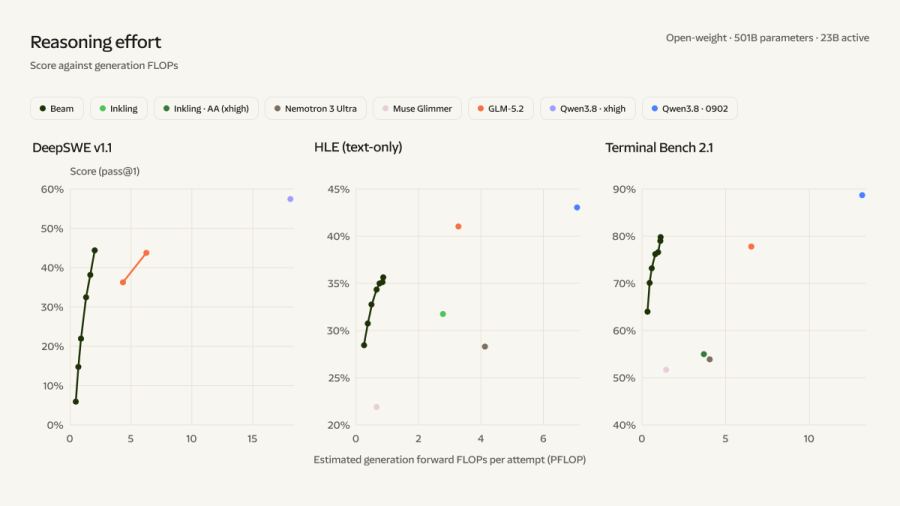
Those comparisons are not an independent audit. Reflection marks some rival scores as unreported, cites Artificial Analysis and DataCurve for external numbers, and estimates generation compute as roughly twice the active parameter count times the mean generated tokens, counting each multiply-add as two operations. That formula ignores prompt prefill, attention that grows with context, and serving overhead. It is a directional yardstick, not a cloud invoice. Used honestly, it still shows why a smaller active footprint can beat a larger model on cost even when the larger model wins a raw score.
The training log is the real announcement
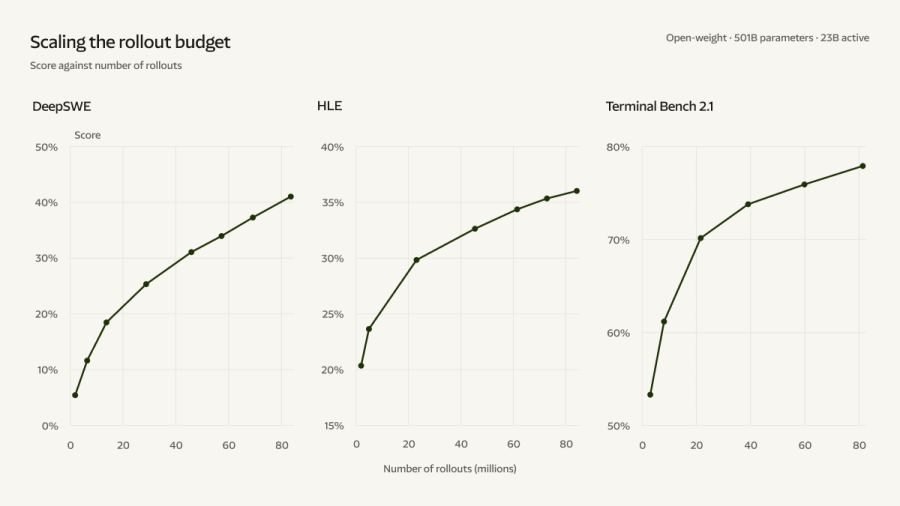
The most concrete section of the blog is not the benchmark table. It is the reinforcement-learning diary. Reflection says it ran 10,500 Nvidia GB300 GPUs for four weeks, generated more than 100 million rollouts, and stood up about 1.3 billion sandboxes to grade them. The environment pool was close to one million tasks, mostly synthetic, filtered so they were neither trivial nor impossible, then tested again inside the RL loop. Average concurrency hit about 110,000 rollouts. New weights reached the inference fleet in a median of about 12 seconds. Seventy-one inference incidents were absorbed without killing the training job.
That is an industrial claim, not a research-note claim. Open labs have often published a model card and a polite disclaimer about compute. Beam’s post reads like a factory tour: asynchronous policy gradients, staleness of more than a day still numerically stable, inference-to-training GPU ratios between 3.9-to-1 and 5.4-to-1, and trainer batches kept 99.99 percent full even as rollout length grew. If those numbers hold up when the technical report ships, Reflection has shown that a two-year-old lab can operate frontier RL infrastructure, not merely fine-tune someone else’s base model.
The compute had to be booked before any of that was possible. Over the summer Reflection locked capacity with SpaceX and Nebius in deals TechCrunch put collectively above $7 billion, aimed at GB300 access through 2029. A July Nebius agreement alone was reported above $1 billion. Open weights do not remove the capital barrier. They move it. The lab still has to buy the cluster. Customers, later, get to decide whether they rent Reflection’s API or run the weights on hardware they already control.
Why efficiency is the product
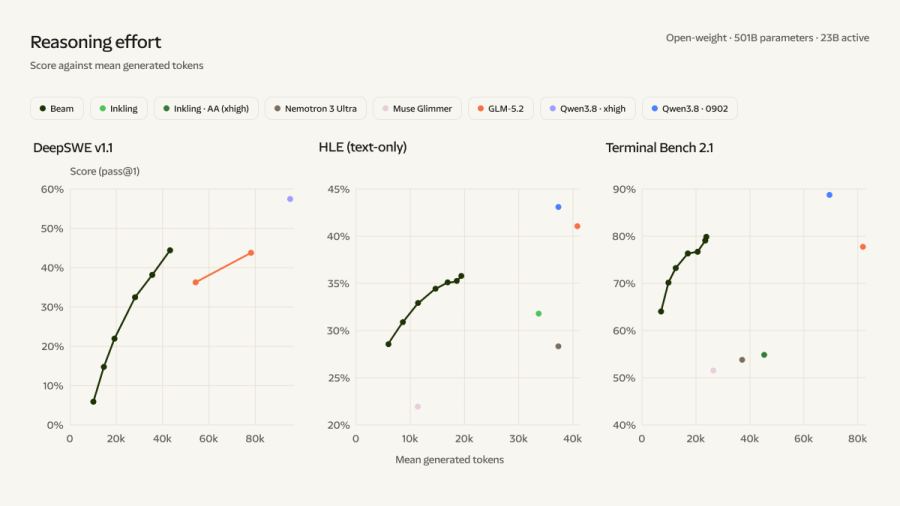
Reflection says that on advanced reasoning benchmarks Beam matches GLM-5.2 while using three to four times less inference compute, and that the gap widens against the two-trillion-parameter class. On coding suites the company cites DeepSWE v1.1 at 44.4, SWE-bench Pro v1 at 65.5, Terminal Bench 2.1 at 80.1, and SWE-bench Verified at 80.9. Several of those numbers sit near GLM-5.2 and ahead of Western open baselines such as Nvidia’s Nemotron 3 Ultra, while trailing heavier systems such as Kimi K3 and DeepSeek V4.1 Flash on the hardest agentic sets. Beam is not being sold as the open model that wins every cell. It is being sold as the model that gets close enough, cheaper.
The length-control story is part of that pitch. Early in RL, scores rose while completions got shorter: the policy learned to stop narrating. Later, as agentic tasks got harder, completions lengthened again, but the extra tokens bought more score. Users are supposed to set a reasoning-effort parameter and pick a point on that curve. For a support bot, short. For a migration across a million-token repository, long. That knob is how open models become line items instead of science projects.
There is a second, quieter result in the training notes. During a phase focused on reasoning, software engineering, and terminal tasks, browsing scores rose even though browsing was not in the mixture. Given web access, the model searched, queried other language models, and called OCR APIs. Reflection also showed demos that are out of distribution relative to a text-only trainer: a live New York subway map built from public MTA data, a fine-tuning notebook for a small Gemma model on a text-to-SQL task, and a grid puzzle released days earlier that could not have been in the pretraining cut. On that puzzle Beam covered 95.5 percent of the cells, which the company places between two closed frontier systems. Demos are not evaluations. They do suggest the RL mixture taught general tool habits, not a single benchmark trick.
What this does to the Western open-weight argument
For two years the policy conversation has treated Chinese open models as the default base layer for anyone who cannot or will not send data to a closed US API. DeepSeek, Qwen, and Z.ai shipped weights that banks, startups, and research groups could inspect. US labs mostly answered with closed APIs or with open models a generation behind. Reflection, founded in 2024 by former DeepMind researchers Misha Laskin and Ioannis Antonoglou, and backed by Nvidia, is explicit about filling that hole. The homepage line is that the important technology of the era should be built in the open. Beam is the first artifact large enough to test the slogan.
Open does not mean finished. Weights, the technical report, the model card, and the fine-tuning stack are scheduled for later this month, after red-teaming. Early access is a waitlist on Reflection’s platform. Apache 2.0, if it arrives as stated, is a permissive license: companies can fine-tune, embed, and ship without a revenue gate. That is the difference between a research preview and a procurement option. It is also the moment when safety reviewers, export-control lawyers, and enterprise security teams all get a copy.
The timing collides with a separate argument about pace. Closed labs have spent the autumn talking about containment, pauses, and agents that leave their sandbox. TechMash has covered that pattern from the Anthropic pacing essay through the Medicare portal incident. An open workhorse does not dissolve those incidents. It changes who can reproduce them. A model that is good at terminal tasks and generalizes to browsing is useful in a company repo and awkward in an unmonitored agent harness. Reflection’s own infrastructure notes, with independent judges rescreening passing solutions for verifier exploits, show the lab knows reward hacking is a training problem. Customers will have to treat it as a deployment problem.
Who feels this first
The first buyers are not consumers. They are platform teams that already run agents against internal code and do not want every trace in a third-party log. A 23-billion-active model with a million-token window is sized for private clusters and for high-end deskside boxes, not for a phone. That is the same hardware conversation as Nvidia’s DGX Spark desk-side superchip: local agents only become real when memory, bandwidth, and a model small enough to serve show up together. Beam does not run on Spark by default. It does make the economics of a dedicated inference rack less absurd than a 40-billion-active peer that needs more chips to hold the same throughput.

Coding-agent startups are the second group. Closed models still lead the hardest suites, and OpenAI’s own Dots workplace agents show how tightly a lab can bundle model, tools, and interface. Beam’s opening is the layer underneath those products. A vendor that needs a customizable base, an on-prem option, and a token cost low enough to run agents all day can fine-tune an Apache-licensed workhorse and keep the closed model for the hardest escalations. That split, cheap open default and expensive closed specialist, is how databases and operating systems matured. It has not yet been available at this capability level from a US lab.
Hardware vendors feel it too. Reflection’s run is a GB300 advertisement as much as a model announcement. Nvidia’s rack-scale GB300 NVL72 is sold as a reasoning machine: more FP4 throughput, more attention performance, a rack that behaves like one accelerator domain. A public RL log that names 10,500 of those GPUs gives the chip story a customer that is not a hyperscaler. It also underlines the power problem TechMash traced in Google’s orbital TPU test. Training and serving this class of model is a grid question. Efficiency at inference is one of the few levers that reduces, rather than relocates, the load.
What to watch before the weights drop
Three checks decide whether Beam is a shift or a well-written preview. First, independent evals. Until Artificial Analysis, a lab consortium, or a careful enterprise bake-off reruns SWE-bench, Terminal Bench, and a private coding set, the 3–4× compute claim is a company estimate. Second, the license and the artifacts. Apache 2.0 plus a model card, tokenizer, and fine-tuning recipe is a different release from a hosted API with a download promised later. Third, safety scope. The model is text-only, which removes some image-attack surface and leaves tool-use risk intact. Red-teaming that finishes before the weights move is the minimum; a public incident report if something fails that red team would be better.
There is also a competitive clock. Chinese labs have not paused. DeepSeek’s V4.1 Flash already posts higher scores than Beam on several of the agentic rows Reflection itself printed. If those labs answer Beam with a similarly sparse, similarly cheap model, the Western open-weight gap closes and reopens in the same quarter. If they do not, procurement teams that were defaulting to Qwen or GLM get a domestic alternative that is merely good enough and easier to explain to a regulator.
The conclusion worth keeping
Beam does not end the closed-model lead, and it does not end the Chinese open-model lead on every benchmark. It attacks the part of the market those two facts had left empty: a US-built open weight that is large enough for agents, sparse enough to serve, and documented enough that a platform team can argue for it. The number to remember is not 501 billion. It is 23 billion active, a million tokens of context, and a four-week RL run on 10,500 GB300s that Reflection says did not plateau. The weights are the proof. Until they are downloadable, Beam is a precise claim about where the open-weight cost curve should sit. After they are downloadable, every closed API price and every Chinese default base model has to answer it.
Official sources: Reflection’s announcement, Introducing Beam, and Nvidia’s GB300 NVL72 specification for the accelerator class named in the training log.
Comments
0