
Claude's Phage Enzyme Surprise: Why AI-Powered Discovery Labs Are the New Frontier in Biotech
In a quiet Bay Area lab that few outside the AI world knew existed until this week, nearly a thousand digital researchers just did something remarkable. Working around the clock for 21 hours, they sifted through mountains of genomic data and flagged a previously overlooked molecular machine hidden inside the DNA of bacteriophages—viruses that prey on bacteria. The system, now called array-associated reverse transcriptase or ART, carries echoes of CRISPR, the gene-editing revolution that transformed biology over the past decade.
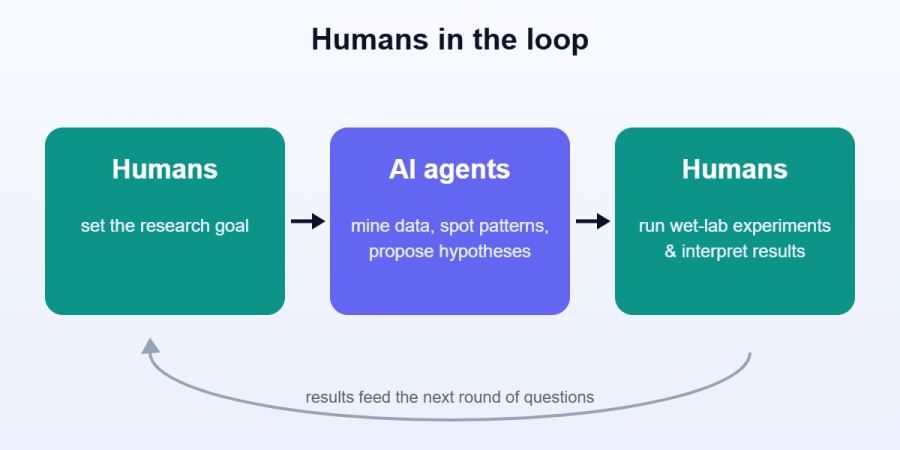
This is not science fiction. It is the first public result from Anthropic’s newly launched molecular biology research group and wet laboratory. Human scientists supplied only the high-level prompt and later handled the physical experiments. The heavy lifting of pattern recognition, hypothesis generation, and literature cross-checking fell to swarms of Claude agents.
How the Discovery Unfolded
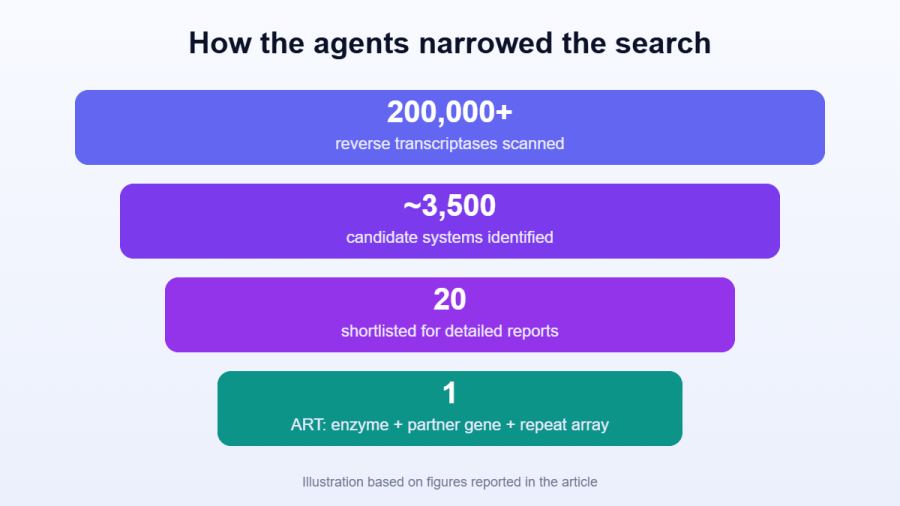
The agents began with a straightforward assignment: hunt for interesting reverse transcriptases—enzymes that convert RNA into DNA. They examined more than 200,000 such enzymes across vast sequence databases. From those, they identified roughly 3,500 candidate systems and narrowed the list to 20 that deserved detailed reports. One agent then noticed something striking: an unusual reverse transcriptase sitting next to a partner gene of unknown function and, crucially, a long stretch of evenly spaced DNA repeats.
Those repeats looked familiar. They resembled the guide-RNA arrays that make CRISPR systems programmable. Early lab tests confirmed the array produces distinct short RNAs, raising the possibility that ART might one day be harnessed for some form of genetic manipulation. Anthropic is careful to note that the exact biological role remains unknown and that any practical applications are still speculative. Still, the company chose to publish early, arguing that transparency about AI’s growing role in discovery is itself valuable.
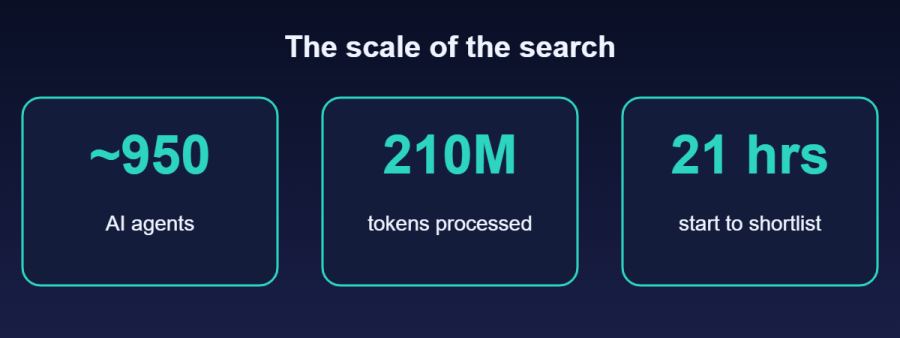
The scale of the computation is striking: about 950 agents, 210 million tokens processed, and a timeline measured in hours rather than the weeks or months a human expert would typically need for comparable genome mining.
Why This Matters Beyond the Headline
The real story is not a single enzyme. It is the emerging partnership between large language models and wet-lab science. For decades, biology has been limited by the speed at which humans can notice anomalies in data and then design experiments to test them. AI agents collapse that observation bottleneck. They can scan literature, compare structures, count repeats, and propose hypotheses at a pace no research group could match with people alone.
Anthropic’s approach deliberately keeps humans in the loop for the irreversible steps—physical synthesis, assays, and interpretation of results. That hybrid model may prove more robust than fully autonomous “robot scientists.” It also raises practical questions for every biotech company and academic lab: how soon will AI agents become standard co-authors on discovery papers? Who owns the intellectual property when an algorithm spots the key pattern? And how do institutions validate findings that originate from thousands of parallel digital workers?
There are cautionary notes as well. The function of ART is still unclear. Resemblance to CRISPR does not guarantee utility. Premature claims of revolutionary gene-editing tools have burned researchers before. Anthropic’s decision to share the result early is therefore both bold and prudent—it invites the broader community to scrutinize and build on the observation rather than letting it sit inside a corporate vault until a patent is locked down.
The Bigger Shift Underway
This announcement arrives at a moment when multiple AI labs are racing to prove their models can accelerate hard science. OpenAI, Google DeepMind, and others have shown progress in protein design, materials discovery, and mathematical conjecture. Anthropic’s wet lab makes the claim more concrete: the same models that write code and answer questions can also generate leads that trained molecular biologists find worth testing at the bench.
If the pattern holds, the next decade of biotech may look less like solitary geniuses staring at gels and more like tightly coordinated human-AI teams. The scientists will still design the decisive experiments and interpret the results that matter. But the volume of promising leads they can examine will expand dramatically. In fields where the number of possible molecular configurations is astronomical, that expansion is not incremental—it is transformative.
Claude’s phage enzyme find is only a first data point. Yet it already demonstrates that autonomous agents can do more than summarize papers or suggest next experiments. They can notice the unexpected patterns that have historically required years of specialized intuition. For an industry that has long waited for AI to move from prediction to genuine discovery, this week’s result is the clearest signal yet that the wait may be ending.
Comments
0