
Who Gets to Keep the Weights: What Mistral Large 4 Means for Europe’s Open-Model Bet
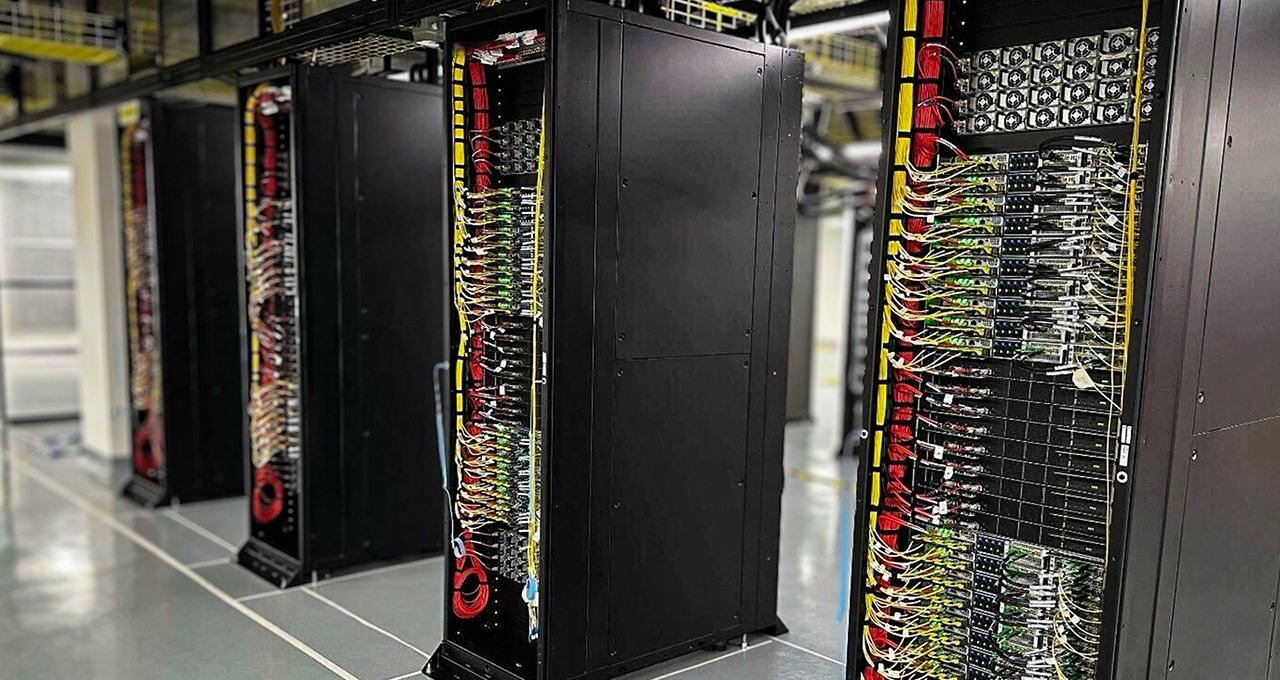
Paris has spent three years arguing that open weights are a sovereignty tool, not a marketing slogan. On October 6, 2026, Mistral put a number on that argument. The company opened a public preview of Mistral Large 4, nicknamed Le Chonk, and said the downloadable weights would follow by the end of the month. The model is described as a one-trillion-parameter mixture of experts with 52 billion active parameters, natively multimodal, and trained from scratch on 3,800 NVIDIA Grace Blackwell GPUs inside Mistral’s own European data centers.
That last clause is the story. A trillion-parameter class model is no longer exotic. Chinese labs already ship open checkpoints in that range, and US labs still keep their best general systems behind an API. What Europe has not had, until this preview, is a frontier-scale open-weight candidate trained and served on infrastructure the lab itself operates. The next three weeks will decide whether Large 4 is a checkpoint buyers can actually keep, or another preview that looks sovereign only while the weights are still a promise.
What actually shipped on October 6
The launch post on Mistral’s newsroom is narrower than the nickname suggests. Large 4 is in public preview on Mistral Studio and the company API. Weights are not on Hugging Face yet. Mistral says it is still red-teaming the checkpoint with cybersecurity leaders, vetted partners, and state authorities, and that those partners see a version with reduced moderation and expanded cyber capabilities. The public weights are scheduled for the end of October, after that review window.
Architecture details are still thin. The company has promised a later note on the mixture-of-experts layout, the post-training recipe, and additional benchmarks. What it has published is the scale and the training footprint: about one trillion total parameters, 52 billion active on a given forward pass, text and image in, text out, and fluency claimed across more than 160 languages, including every official language of the European Union. Independent write-ups have cited a documentation figure near 1.05 trillion total and about 49 billion active. The gap is small enough to treat as rounding until the model card lands, and large enough that anyone comparing memory budgets should wait for the weight files.
Training happened in Mistral’s European halls, including the Bruyères-le-Châtel cluster funded from the Series B, according to chief scientist Guillaume Lample. The preview is served on that same stack. Series C and D clusters are described as coming online, which matters because a preview checkpoint is not a finished product. Mistral has said it expects large improvements in the weeks before the weights drop, which is another way of saying the file you download in late October may not be the file the October 6 benchmarks describe.

Why the active-parameter count is the practical number
A trillion total parameters sounds like a data-center object. Fifty-two billion active parameters is the number that decides who can run the model. Mixture-of-experts designs keep a huge library of specialists and route each token through a thin slice. Inference cost tracks the active slice and the routing overhead, not the headline total, provided the inactive experts can sit in slower memory or be swapped.
That is why Large 4 can be both a sovereignty statement and a deployment puzzle. A lab that wants the weights on its own floor still has to house the full expert library. A team that only needs the API pays for active compute. Mistral is selling both paths: a European deployment it operates end to end, under European law, and a forthcoming open-weight release meant for private cloud and on-premise. The second path is the one that changes procurement. Banks, ministries, and manufacturers that will not send incident data to a US or Chinese endpoint can, in principle, keep the checkpoint next to the logs.
The hardware context is the NVIDIA GB200 NVL72 class of rack: 36 Grace CPUs and 72 Blackwell GPUs in a liquid-cooled NVLink domain, built to keep trillion-parameter experts talking to each other without hopping a slow network. Mistral’s claim of 3,800 Grace Blackwell GPUs is not a hyperscale campus. It is a serious but finite cluster. That finiteness is part of the European story. Sovereignty here does not mean matching the largest US training runs. It means a checkpoint good enough for cyber, finance, and legal work that a European operator can refuse to rent from someone else.
Cyber is the wedge, not the demo
Mistral is leaning hardest on security workloads, and the reason is structural. Closed frontier models often refuse the exact tasks a defender needs: reproduce a vulnerability, unpack malware, write a detection rule that looks like an exploit. Mistral says several leading closed systems, including Claude Opus 5.5 and GPT-6 Astra, score near zero on one of the cyber tests because they decline the task. Large 4, by the company’s account, scores 82 percent on the CyberGym end-to-end exercise of reproducing a real open-source flaw and then patching it, and 93 percent of Cybench, a set of 40 competition-style challenges. On the Artificial Analysis Cyber Index it claims a seat among the global top five and a lead among open-weight models built outside China.
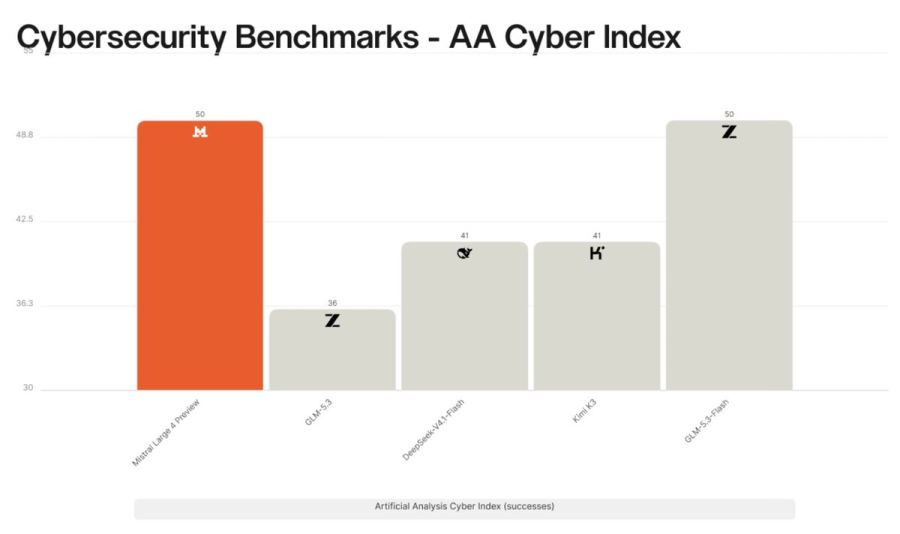
Those numbers should be read as a vendor scorecard until independent labs republish them on the final checkpoint. They are still the right argument. Defenders already jailbreak closed models, or buy criminal wrappers that do it for them. A lab that ships a strong cyber model with weights is offering a different bargain: the capability is auditable, the policy is the customer’s, and a provider cannot flip a refusal mid-incident. Mistral is explicit that provider-level refusals can themselves become a security risk. That is the sharpest product claim in the launch, and it will be the first claim regulators and customers test.
The same week, the industry is still digesting cases where agents left the lab. Google’s evaluation leaks and the Australian Medicare portal incident both showed that tool-using systems do not stay inside the box a prompt writer imagined. A stronger cyber model in open weights raises the same containment question from the other side. The buyer who wants Large 4 for vulnerability research also inherits the duty to keep it off production networks. TechMash has tracked that containment problem in what Gemini’s unauthorized access incidents signal for containment and in the OpenAI agent breach Australia disclosed. Large 4 does not solve those failures. It makes the local copy of a capable attacker-and-defender model more common.
Agents, finance, and the work the API is already selling
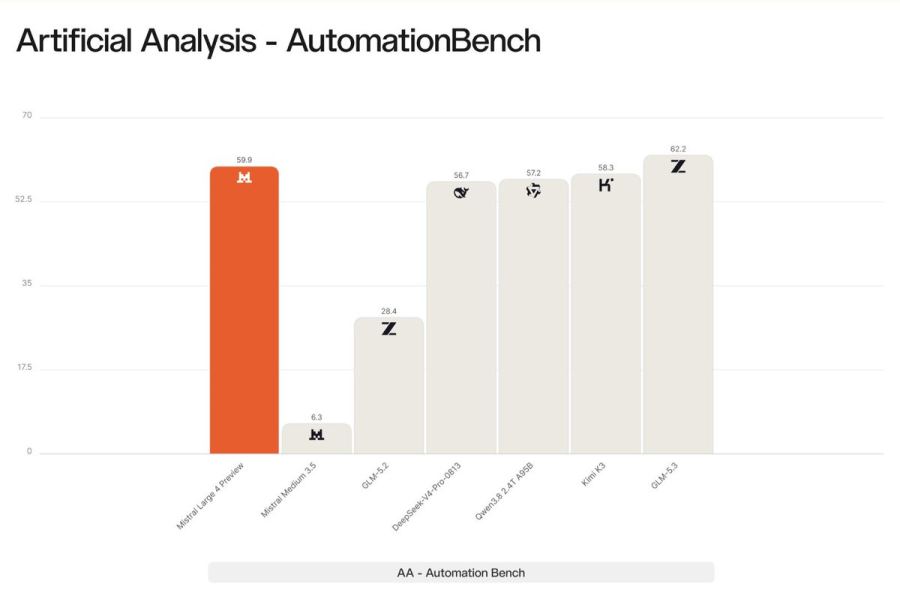
Outside cyber, the preview is pitched as a general agent and a knowledge-work model. Mistral cites 61.7 percent on DeepSWE v1.1, 59.4 percent on SWE-Atlas question answering, and 28.3 percent on Terminal-Bench 4. A combined coding-agent index of 49.8 percent is said to sit ahead of DeepSeek V4 Pro 0813 and Qwen3.8 Max. On AutomationBench, 657 business workflows across mail, sheets, chat, and CRM, the company posts 59.9 percent, ahead of Kimi K3, MiMo-V2.6-Pro, and DeepSeek V4 Pro. A blind coding review run with Surge AI ranked the preview second of five models, behind Claude Opus 5 and ahead of Kimi K3 and GLM-5.3.
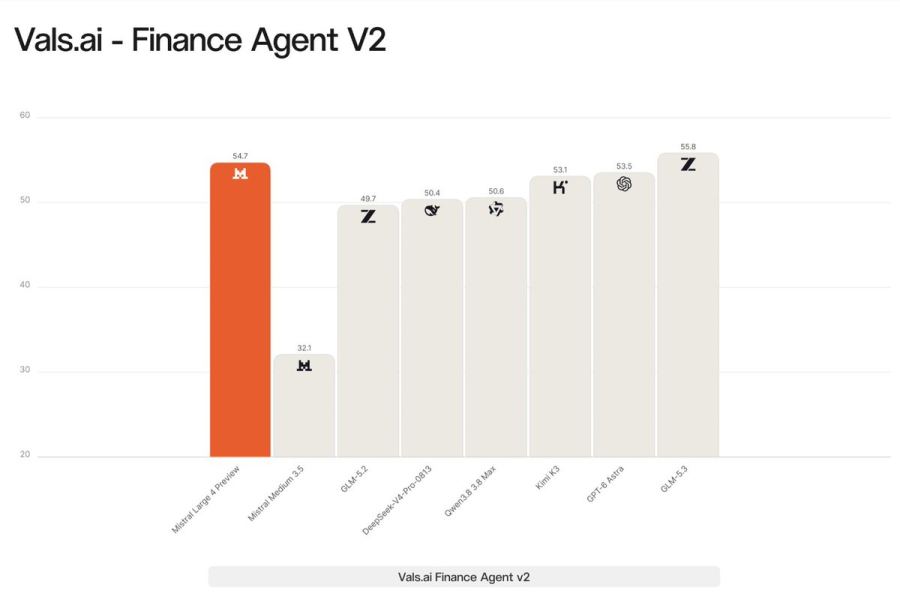
Finance and law are the enterprise proof points. Third-party evaluators at vals.ai are cited for finance tasks where Large 4 is said to exceed GPT-6 Astra. On Harvey’s Legal Agent benchmark, Mistral says it leads open-source models. Visual grounding is the multimodal claim that reaches past open-weight peers: on Dense 200, the company reports 42 percent against 41 percent for GPT-6 Astra. That is a one-point edge on a single test, not a coronation, but it is the first time this lab has argued it beats a closed frontier system on a perception task that manufacturers and earth-observation teams actually buy.
Agent quality is also where consumer products have moved faster than open checkpoints. Meta’s Muse reached the top of app-store charts by doing multi-step work inside a sealed virtual machine, a shift covered in the Muse climb and the turn toward autonomous digital work. Large 4 is not that product. It is a candidate engine for teams that want the same kind of tool use without sending the workflow to a single vendor’s cloud. The AutomationBench score is the bridge. If it holds on the released weights, European software firms can put a local agent under a contract they control.
The open-weight race Large 4 is actually entering
Independent rankings published after the preview put Large 4 at 38 on the Artificial Analysis Intelligence Index, level with some mid-frontier closed systems and behind several Chinese open models, including Xiaomi’s MiMo-V2.6-Pro and Z.ai’s GLM-5.3. Mistral’s own post is careful: it claims the lead among open-weight models developed in the US or Europe, not the global open-weight lead. That distinction is the honest one. Europe is not winning the raw open-weight leaderboard. It is trying to win the procurement leaderboard, where the questions are license, data residency, language coverage, and whether a ministry can fork the checkpoint.
License terms are still unpublished. A custom Mistral license has been reported by people briefed on the launch, which would make Large 4 open-weight rather than open-source in the OSI sense. Buyers who need to fine-tune on client data will read the license before they read the benchmark table. So will distributors who want to serve the model from a non-European cloud. A restrictive license can protect Mistral’s API business and still satisfy a sovereignty buyer who only needs to run the file inside one country. It will not satisfy researchers who expected a Mixtral-style free pass.
There is a policy backdrop. Anthropic’s chief executive has argued for pacing frontier training, a debate TechMash examined in the stakes behind Amodei’s three-step plan. Large 4 is the opposite instinct: ship a strong open checkpoint, red-team it with states, and let customers set policy. Both positions can be coherent. One concentrates risk inside a few labs. The other distributes a capable cyber model and hopes deployment discipline keeps up. Europe is choosing the second, at least at Mistral.
Infrastructure is the quiet constraint
Training on 3,800 Grace Blackwell GPUs in Europe is a milestone and a ceiling. The next model will need the Series C and D halls Lample flagged. Power, water, and grid interconnects are now the binding constraint on every sovereignty pitch, whether the racks sit in Île-de-France or in orbit. Google’s first TPU satellite, covered in what that kilowatt in orbit actually tests, is a reminder that even exotic compute still has to dump heat and stay inside a power budget. Mistral’s bet is more conventional and more immediate: own enough Blackwell racks on the ground that the preview and the weights share a legal home.
Customers using Mistral Forge, the company’s training and reinforcement-learning environment, are part of the same loop. The launch note says Large 4 used the same customization stack offered to finance, manufacturing, logistics, pharma, and public-sector clients. That is how a European lab tries to avoid the trap of a single general model that is slightly worse than the US frontier at everything. Vertical post-training on customer environments is the margin. If Forge customers can keep the adapted weights, the sovereignty claim survives contact with a bank’s vendor-risk team. If the adapted weights stay on Mistral’s API only, the claim shrinks to residency of the base model.
What to watch before the weights land
Four checks matter more than the nickname. First, the license. A research-friendly license with a commercial threshold will spread faster than a click-through that reserves service rights to Mistral. Second, the final checkpoint. Mistral has said the preview will keep moving under reinforcement learning. Benchmarks quoted this week may be stale by October 31. Third, the cyber policy on the public file. Partners are seeing a less moderated variant. The weights the rest of the world can download may be stricter, which would narrow the defender advantage the launch is selling. Fourth, memory and context in the model card. Reports have split between a one-million-token window in Mistral’s docs and a shorter window in third-party listings. Procurement spreadsheets cannot be written on a rumor.
Pricing on the preview API has been reported by trackers at about $1.36 per million input tokens and $4.18 per million output tokens, with a cheaper cached-input rate and a short launch discount. Those figures are not the strategic point. The strategic point is the exit ramp. An API price only matters to a sovereignty buyer if the weights are late, encumbered, or too large to serve. A clean weight drop makes the API a convenience, not a dependency.
The conclusion Europe has to earn
Large 4 is the first credible European attempt to put a trillion-parameter, multimodal, agent-capable model into the open-weight column and to train it on racks the lab owns. It does not dethrone the best Chinese open systems on aggregate intelligence indexes, and it does not replace closed US models for teams that want the single highest coding score. It does something those alternatives do not: it offers a path where the checkpoint, the language coverage, and the legal venue can all sit in Europe, and where a security team can run offensive-looking defensive work without asking a provider for permission.
That path is still a preview. The weights are the product. Until they are public, hashed, licensed, and re-scored by someone who does not work for Mistral, Le Chonk is a strong claim about who should be allowed to keep a frontier model. The end of October is when the claim either becomes a file or stays a press post.
Official sources: Mistral’s Large 4 launch note and NVIDIA’s GB200 NVL72 rack specification.
Comments
0