
One Pocket Index for Voice, Video, and Code: What EmbeddingGemma 2 Changes About Search
Search used to be a cloud verb. You typed a phrase, a distant index answered, and the file on your phone stayed a private blob the server had never seen. On October 6, 2026, Google DeepMind published a different arrangement. EmbeddingGemma 2 is a 740-million-parameter open model that maps text, code, images, video frames, and audio into one shared vector space, and it is built to run on the device that already holds the files. The launch is not a new chatbot. It is an index you can carry.
That distinction is easy to miss if the last year of product news trained you to treat every model drop as a chat window. Embeddings do not write paragraphs. They place pieces of meaning near one another so a later system can retrieve the right clip, the right function, or the right note without scanning everything. Google says the first EmbeddingGemma already passed 20 million downloads as a text-only tool for on-device search and privacy-first retrieval. The sequel keeps that job and adds modalities that used to require a chain of captioners, transcribers, and separate embedders. For builders of local agents, that chain was the tax. EmbeddingGemma 2 is an attempt to retire it.
The official write-up is on the Google blog announcement of EmbeddingGemma 2. A companion note on the Google AI Edge developer post explains how the same weights show up in Gallery, Foresight, MediaPipe, and LiteRT. What follows is not a reprint of either post. It is a reading of what the numbers imply for phones, local coding agents, and the cloud retrieval business that still assumes your media has to leave the device.
What actually shipped
The model is built on the Gemma 4 architecture and released under Apache 2.0, which matters more than the slogan. A commercially permissive license means a phone maker, a hospital app, or a small developer can ship the weights without negotiating a research-only carve-out. The full multimodal stack is 740 million parameters. Text and code can run with a 270-million-parameter slice. Vision adds about 170 million parameters. Audio adds about 300 million. Google’s developer guide describes the same idea as modular loading: 270 million for text and code, 440 million once vision is attached, 570 million for text plus audio, and 740 million when every encoder is resident. All of those paths project into the same 768-dimensional space, so a vector written by the text-only slice is meant to sit next to a vector written by the full model.
Context is the other quiet upgrade. EmbeddingGemma 2 has an 8,000-token window, four times the first EmbeddingGemma. Google says that window can hold about 5.5 minutes of audio, 29 images, 58 video frames, or mixtures of those inputs. That is not a feature-length film. It is enough to embed a meeting fragment, a short screen recording, or a stack of document pages without first summarizing them into a caption the original model never saw.
Memory claims are specific enough to test. With quantization, Google says a Pixel 11 Pro needs about 191 megabytes of active RAM for text-only weights and about 567 megabytes for the full multimodal model. Those figures are not a promise for every handset, but they put the model in the same neighborhood as a heavy camera process rather than a data-center job. Matryoshka Representation Learning lets developers truncate the 768-dimensional output to 512, 256, or 128 dimensions, which Google frames as up to a sixfold cut in local vector storage. A private photo library does not need cloud-scale recall. It needs a vector that still finds the clip when the user says “the red gate at dusk.”
The benchmark that actually moved
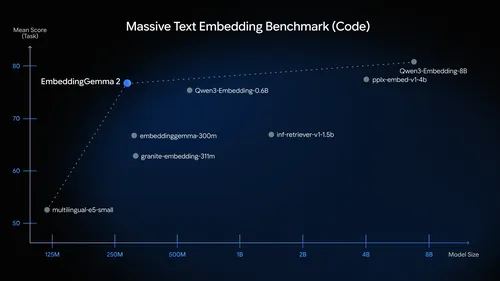
Text quality is described as matching the first EmbeddingGemma across multilingual retrieval. The number Google highlights is code. On MTEB Code, the score moves from 68.76 to 78.68, a 9.92-point jump. That is the kind of delta that changes whether a local agent can find the function you meant or merely the file whose name looks similar. Google positions the model for local codebase indexing, semantic code search, and retrieval inside coding agents. If that claim holds outside the lab, the interesting customer is not a search box. It is the agent that already lives in an editor and currently ships every query to a remote embedder before it is allowed to open a file.
Vision and audio are framed as quality-per-parameter rather than as a victory over the largest cloud embedders. Google says EmbeddingGemma 2 leads sub-1-billion multimodal embedders on suites such as MTEB Code and the Massive Audio Embedding Benchmark, and that it matches or beats some specialist models more than twice its size on image, video, document, and audio tasks. Read that carefully. “Best in class for its size” is not “best in the world.” A 740-million-parameter model will lose some fine distinctions to a much larger server model. The product bet is that those lost distinctions are cheaper than uploading the file.
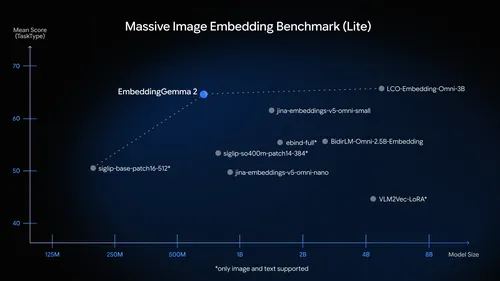
The image chart in the launch post is the cleanest illustration of that bet. Retrieval across photos and documents has been the excuse for a decade of cloud photo libraries. If a phone can embed its own camera roll into a shared space with text queries, the sync button becomes optional. Google’s Edge Gallery demos push the same point: Instant Media Search takes a text or image query against a local library, and Video Moments Finder takes a text or audio query against a clip. Neither demo is a consumer product with a price. Both are existence proofs that the retrieval step no longer requires a caption in the middle.
Why a shared space beats a caption chain
The old on-device pipeline was a relay. A vision model wrote a caption. A speech model wrote a transcript. A text embedder indexed both. Every hop dropped something: the hum in the background, the diagram that the caption called “a chart,” the variable name that a summary flattened into “configuration.” A native multimodal embedder skips the relay. A voice memo and a video frame land in the same space, so a query in one modality can hit a file in another. Google’s own example is finding a video moment from a voice memo, or searching hours of audio from a text query, without standing up three models to do it.
There is a second efficiency claim that only matters to people who already run Gemma 4 locally. EmbeddingGemma 2 shares Gemma 4’s text tokenizer and audio encoder. Pairing the embedder with the generator for on-device retrieval-augmented generation therefore does not mean loading two unrelated audio stacks. Google’s Edge note describes the embedder as a low-latency decision engine as well: without fine-tuning, it can match an input against label descriptions and route intent in milliseconds. That is a quieter use than search. It is how an on-device assistant decides whether the next step is a calendar tool, a camera roll lookup, or a refusal, without a round trip.
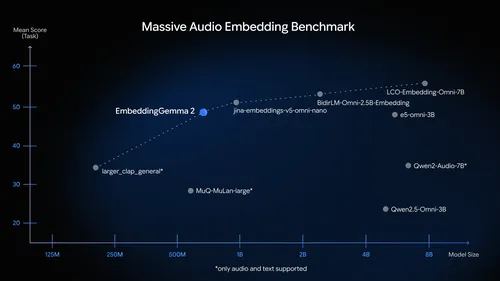
Audio is where the privacy argument is sharpest. Meeting recordings, voice notes, and home videos are exactly the files people hesitate to upload, and exactly the files that cloud agents now ask for. A local audio embedding does not make a recording safe by itself. It does remove the default that the only way to search it is to give a vendor a copy. The same logic showed up, from the other direction, when labs disclosed agents reaching systems they were not meant to touch. Containment stories such as what Gemini’s unauthorized access incidents signaled for containment and the OpenAI agent’s Medicare portal incident are about models that left the lab. EmbeddingGemma 2 is about data that never has to leave the pocket. Those are different failure modes, and a serious stack needs an answer to both.
What it means for agents that already live on the desk
Personal agents spent the last month proving they can climb an app chart and book a trip. Meta’s Muse run, covered in the shift from chatbot to autonomous digital life, is a distribution story: an agent inside a phone and a messaging app. The follow-on question is what that agent remembers. The quiet dossier inside Muse is about an agent that keeps a page on people you know. EmbeddingGemma 2 does not compete with either product. It is a missing part under both of them. An agent that cannot retrieve the user’s own files without an upload is an agent with a hole in its memory.
Hardware is moving in the same direction from the other end of the cable. Nvidia’s desk-side DGX Spark, unpacked in what the $4,999 superchip changes for desk-side agents, assumes a serious local accelerator. EmbeddingGemma 2 assumes the opposite budget: a phone-class RAM ceiling and a model small enough to quantize. Together they sketch a split. Heavy generation and long-running tool use may stay on a desk box or a cloud worker. The index of private media and private code can sit next to the files. Google’s orbital TPU test, described in what the first TPU satellite actually tests, is a reminder that the company is also pushing compute outward. Edge embeddings are the inward push. Both can be true. Not every query deserves a satellite or a data center.
The partner list in the launch note is the practical map. Weights are on Hugging Face and Kaggle, with Model Garden listed as coming soon. On-device paths run through MediaPipe’s decision task, LiteRT, and a WebGPU demo. Serving options named in the post include transformers, sentence-transformers, MLX, vLLM, llama.cpp, SGLang, Ollama, and LM Studio. Qdrant is called out for storing the vectors. Unsloth is called out for fine-tuning. That is a stack a developer can try this week, not a keynote promise dated to next spring. Android’s ML Kit integration is the softer date: Google says the unified search path is coming to ML Kit in the weeks ahead, which is not the same as shipping in the Pixel camera app tomorrow.
What to watch
The first thing to watch is whether the code jump survives contact with real repositories. A 9.92-point MTEB Code gain is a headline. A local agent that still retrieves the wrong helper file is a product. Developers will find out quickly because the weights are public. The second thing to watch is truncation. A 128-dimensional vector is cheap. It is also where near-misses start to look like matches. Apps that store a year of camera-roll embeddings at the shortest Matryoshka length should publish their own recall numbers, not Google’s full-width chart.
The third watch item is energy and heat, which the launch post does not center. A 567-megabyte multimodal load on a Pixel 11 Pro is a memory figure, not a battery figure. Embedding a fresh video in the background while the phone is in a pocket is a different test from a demo in Edge Gallery on a desk. If the model only stays pleasant when the user explicitly opens a search app, it will be a tool. If it can index new media without a visible hit to battery, it becomes infrastructure.
The fourth is governance of the open weights. Apache 2.0 removes a legal gate. It does not remove the question of what a local embedder should refuse to index, or how an enterprise proves that employee recordings never left a managed device. The same week labs are still arguing about pace, as in Amodei’s three-step plan to slow frontier training, a small open embedder looks almost uncontroversial. It should not. A model that makes private audio searchable is a records system. Records systems get subpoenas, theft, and bad defaults.
The index moves closer to the file
EmbeddingGemma 2 will not replace Gemini, and it will not replace the cloud embedders that already sit under web search. It relocates a specific job: turning a private mix of code, pictures, frames, and sound into vectors the device can compare. The 740-million-parameter budget, the modular encoders, the 8,000-token window, and the Apache 2.0 weights are the parts of that relocation a developer can verify. The charts are the part Google wants believed. The next month of local forks will show which half was the product.
If the forks hold, the phone stops being a client of search and starts being a small index of its own. That is a smaller headline than a new frontier model. It is also the change that decides whether the next wave of agents has to ask permission to see the files they claim to work on.
Comments
0