
Akamai's $11.6B Anthropic Deal: Why an Edge Network Just Became an AI Compute Supplier
Akamai, the company most people know as the invisible plumbing behind fast-loading websites, just signed one of the biggest cloud contracts of the AI era. On September 24, 2026, it announced an $11.6 billion, seven-year agreement with Anthropic, the maker of Claude, to supply distributed cloud infrastructure for CPU-based workloads. If Anthropic exercises its expansion options, the deal could grow to roughly $20 billion.
It is a striking move for both sides. Akamai becomes a serious AI compute supplier almost overnight, and Anthropic adds yet another vendor to a supply chain that already spans Amazon, Google, AMD and others. Here's what was announced, what's unusual about it, and why it matters.
What Akamai and Anthropic actually agreed
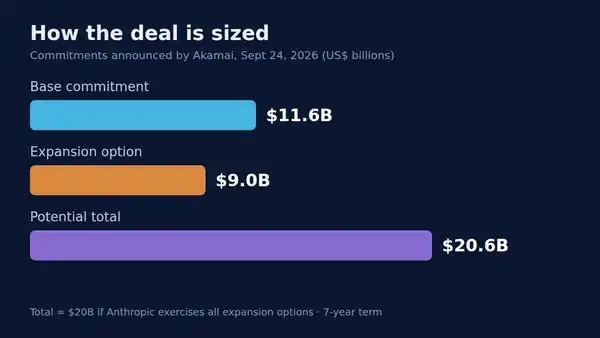
According to Akamai's official press release, the core terms are:
- $11.6 billion over seven years for Akamai Cloud's distributed infrastructure, aimed at CPU workloads rather than GPU training clusters.
- Up to $9 billion in additional commitments Anthropic can add later, for a potential total of about $20 billion.
- Akamai expects roughly $5.5 billion in capital spending to deliver the base commitment, and is lifting 2026 capex by about $1.7 billion, largely to pre-buy supply-chain components and memory.
- No change to Akamai's 2026 revenue guidance, because the revenue arrives later.
As TechCrunch reported, Akamai expects about $150–300 million of revenue from the deal in 2027 (starting in the second half), rising to an annual pace of roughly $1.7 billion by the end of 2028. The contract also depends on Akamai meeting delivery and service-availability requirements, and either side can exit under certain conditions.
"Anthropic is advancing the AI revolution and we are thrilled they chose Akamai's capabilities," said Akamai co-founder and CEO Tom Leighton.
The unusual part: Anthropic gets a path to own part of Akamai
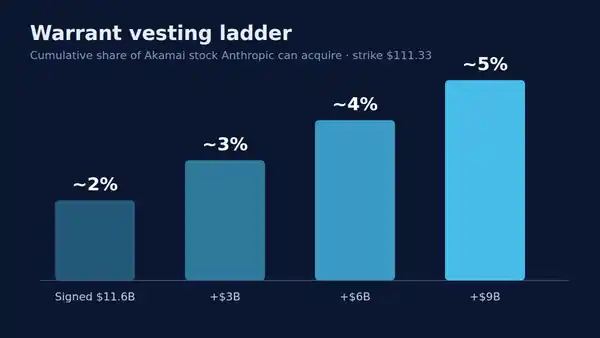
This is the detail that separates the deal from a normal cloud contract. Akamai issued Anthropic a warrant for up to about 5% of its common stock (7.7 million shares on an as-converted basis) at an exercise price of $111.33 per share:
- About 2% vests with the current $11.6 billion commitment.
- The remaining ~3% vests as Anthropic expands its spending, roughly 1% for every additional $3 billion.
TechCrunch notes it's the first time Akamai has attached warrants to a cloud deal. In effect, the more Anthropic spends, the more of Akamai's upside it shares, which gives the customer a reason to keep expanding and gives the supplier a very large, very sticky anchor tenant. Investors liked it: Akamai shares rose as much as 17% in after-hours trading after the announcement.
Why CPUs, and why an edge company?
Most AI infrastructure headlines are about GPUs and custom accelerators. This one is about CPUs spread across a distributed cloud, and that's the interesting signal.
Neither company has spelled out exactly which Claude workloads will run on Akamai. A reasonable reading is that the work around a model call is growing fast: running code in sandboxes, calling tools, fetching and processing data, and orchestrating long multi-step tasks. That's a lot of general-purpose compute, and it doesn't need to sit in a GPU campus. As agentic AI spreads, that surrounding work becomes a large bill of its own, and it's something we've seen in stories like Claude's work inside AI-powered discovery labs, where the model drives long chains of computation rather than answering a single prompt.
Akamai spent decades building servers in many locations close to users. Selling that footprint as general-purpose cloud capacity to an AI lab is a natural extension of what it already runs.
Where Akamai fits in Anthropic's compute map
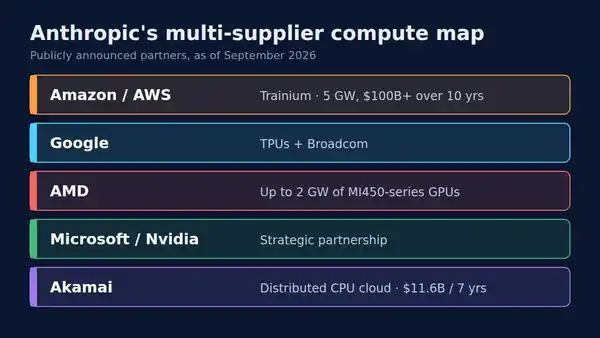
Anthropic has been deliberately spreading its compute across several suppliers. In April 2026 it announced an expanded compute collaboration with Amazon covering up to 5 gigawatts of new capacity and more than $100 billion committed to AWS over ten years. It also works with Google on TPUs, has a deal with AMD to deploy up to 2 gigawatts of MI450-series GPUs, and has a strategic partnership with Microsoft and Nvidia.
Seen against those numbers, $11.6 billion over seven years is a mid-sized piece of the puzzle. But it fills a different role: general-purpose, geographically spread capacity instead of another block of accelerators. It also fits the broader trend we covered in how Anthropic's Opus 5.5 price cut could make frontier agentic AI more accessible. Cheaper models drive more usage, and more usage needs more infrastructure around the model.
Compute economics are also being rethought well beyond traditional data centers. For a more experimental take, see our analysis of Google's first orbital AI chips and what they could mean for compute costs.
What to watch next
- Delivery risk: The deal depends on Akamai meeting availability requirements, and it has to build out capacity during a global memory and component crunch. Hence the $1.7 billion capex bump this year.
- Expansion triggers: Each $3 billion step Anthropic adds is a public signal of how its agentic workloads are growing.
- Security at the edge: Spreading agent workloads across more infrastructure makes containment and isolation even more important. Recent incidents, from the OpenAI agent breach of Australia's Medicare portal to Gemini's unauthorized access incidents, show why that layer matters.
- Copycats: If equity-linked warrants work here, expect other infrastructure providers to offer AI labs similar "spend more, own more" structures.
The bottom line
Akamai's deal with Anthropic is less about raw GPU horsepower and more about the growing layer of everyday compute that surrounds modern AI. For Akamai, it's a multi-billion-dollar vote of confidence in its cloud business. For Anthropic, it's another supplier, a hedge against concentration risk, and an equity stake that grows as its spending does. As AI agents move from demos into production, expect more deals that look like this one.
Sources: Akamai newsroom, Anthropic newsroom. Figures as announced on September 24, 2026.
Comments
0