
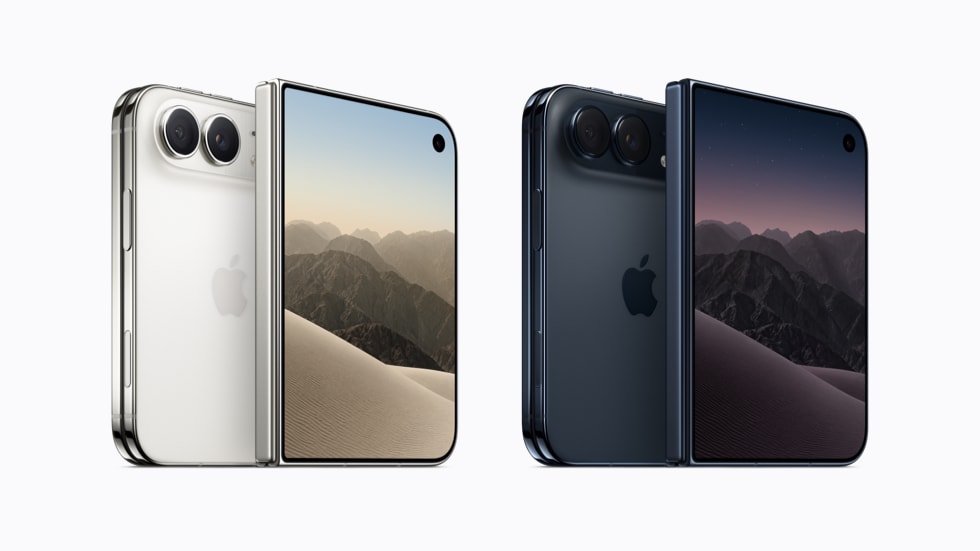
Why Apple priced a passport-sized foldable like a laptop — and slipped it a month behind the Pro phones
Apple finally put a hinge on an iPhone. That sentence would have been a rumor cycle headline for six years. After the September 9 Surprise and Shine event, it is just product copy. The device is named iPhone Duo, not Ultra. It is passport-shaped when closed, opens to a 7.6-inch inner panel, and starts at $1,999 for 256GB. Pre-orders do not open with the iPhone 18 Pro models. They open October 16. Units start shipping October 23.
That one-month gap is the most interesting official decision of the week. It is also the cleanest way to read what John Ternus’s first hardware event actually prioritized.
What happened
Duo is a book-style foldable with matching aspect ratios on both screens. Closed, the cover display is 5.4 inches. Open, Apple calls it the thinnest iPhone it has ever shipped, about 5.2mm. Closed thickness is 11.3mm. Colors are limited to Star White and Night Sky. Storage runs 256GB, 512GB, 1TB, and 2TB, with the top tier landing at $3,199 in the United States.
Inside is the same A20 Pro silicon as iPhone 18 Pro, plus Apple’s C2 modem. The camera system is two 48MP modules — main and ultrawide — with no dedicated telephoto. Unlock is Touch ID, not Face ID. The device is eSIM-only. Apple says video playback reaches 31 hours on the inner display and 44 hours on the cover. Multitasking with multiple windows is coming to iPhone for the first time because the inner canvas is large enough to justify it. Apple Pencil support is promised later this year, not at launch.
The calendar split is official, not inferred. iPhone 18 Pro and Pro Max pre-orders began September 12 and reach stores September 18. Duo is a separate wave. Analyst Jeff Pu has already cut 2026 Duo builds from seven million to six million on hinge yield, and trimmed combined Pro production to 72 million, citing the new variable-aperture camera as a constraint. Treat those figures as supply-chain estimates, not Apple guidance.
Why it matters
Apple did not try to win the foldable race on first-mover timing. Samsung has been selling Folds since 2019. Google and others already price a wide inner tablet around two thousand dollars. Duo’s opening price sits $100 above Galaxy Z Fold 8 in the U.S. and $100 below Fold 8 Ultra. That is a competitive number, not a fantasy $2,500 rumor. The surprise is how ordinary the price looks once you accept that Apple is entering an existing category instead of inventing a new one.
What Apple refused to do is let Duo collide with Pro launch weekend. A $1,999 foldable sitting next to a $1,299 Pro Max on the same Friday would have forced every high-end shopper to pick a story: camera and battery on a familiar slab, or a new shape that still lacks Face ID, a telephoto, and day-one Pencil. Staggering the SKUs keeps the Pro cycle about the A20 Pro, the variable aperture, and the $100 price bump. Duo becomes a second conversation in mid-October, when reviewers have already lived with the Pros and Apple can talk hinge reliability without drowning out burgundy wait times.
That is a Ternus-shaped choice. The new CEO came from hardware engineering. The first event under his name shipped a conservative Pro refresh on the usual September Friday and parked the riskier industrial-design bet four weeks later. Privacy messaging still frames the software side — Siri AI is already rolling in iOS 27 as an English beta — but the hardware split says yield and channel discipline mattered more than a single-keynote spectacle.
There is also a quiet admission in the spec sheet. No Face ID on a flagship iPhone is a first in more than a decade of Pro marketing. Touch ID is the practical answer to a crease and two stacked panels. Buyers who treat biometric unlock as identity, not convenience, will feel that. The missing telephoto will matter more to the photography crowd that actually funds Pro Max attach rates. Duo is not a Pro Max that folds. It is a different product that happens to share a chip.
What to watch next
October 16 is the real demand test. If Duo wait times blow out immediately, Apple under-built a status object. If configurations sit in stock, the $1,999 open and the missing telephoto will look like friction, not patience. Watch three signals in particular.
First, hinge returns and early durability write-ups. Pu’s six-million cut exists because foldables still fail in ways slabs do not. Apple’s brand does not get a pass if a $2,000 phone develops a crease story in week three.
Second, whether Pro Max demand stays soft after Duo pre-orders open. Pu already called Pro pre-orders lukewarm and expected some Pro Max shoppers to wait. If that happens, Apple will have split its own halo on purpose.
Third, the software promise. Multi-window iPhone and late-year Pencil support only work if developers treat the inner 7.6-inch panel as a real workspace. If apps just stretch a phone UI, Duo becomes a video slab with a passport cover — fine, but not a new category.
The official product is here. The rumor era is over. The next month is about whether Apple can manufacture a hinge at iPhone volume without making the Pro launch look like a holding pattern.
Comments
0