
Why Ternus shipped the fold on a delay — and left 18 Pro to carry September
John Ternus did not wait for a second keynote to put a crease on an iPhone. Three days after Apple’s Surprise and Shine event, the story is no longer whether a foldable exists. It is why Apple confirmed the product and then parked it five weeks behind the phones that will actually move this month.
iPhone 18 Pro and Pro Max pre-orders open this morning at 5 a.m. Pacific. They arrive in stores on September 18. iPhone Duo, the first official foldable iPhone, does not take orders until October 16 and does not ship until October 23. That split is the most useful fact from an otherwise familiar September.
What actually shipped on stage
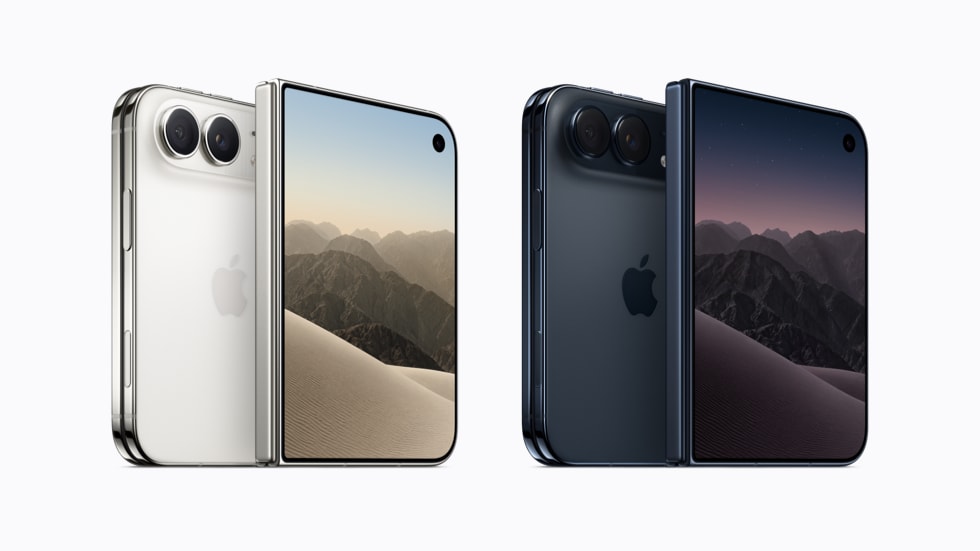
Duo is not the Ultra rumor name that circulated all summer. Apple named it Duo, finished it in star white and night sky, and priced the 256GB model at $1,999. Open, it is a 7.6-inch Super Retina XDR inner display — Apple says that canvas is 50 percent larger than iPhone 18 Pro Max — with a 5.4-inch cover screen that keeps a similar aspect ratio. Folded it is 11.3 mm thick and 254 grams. Unfolded Apple calls it the thinnest iPhone it has ever made, at 5.2 mm.
The hardware choices read like a company that waited until the hinge and glass were boring enough to sell. Grade 5 titanium, IP68, a custom variable-torque hinge, a nano-texture inner panel meant to hide the crease and cut glare. Touch ID sits in the side button so biometric unlock works open or closed. Face ID is not on this device. The A20 Pro chip drives both displays at once. Cameras are a 48MP Fusion main with 2x optical zoom and a 48MP Fusion ultra wide, plus a 12MP Center Stage camera on the cover and an under-display FaceTime camera inside.
That is the official product. The rumor mill had floated a thinner closed body and an iPhone Ultra badge. Those did not survive the event. Label the rest accordingly: Pencil support is promised later this year as a software update, not a day-one feature.
Why the calendar is the real product decision
September still belongs to the slab phones. 18 Pro starts at $1,199 and Pro Max at $1,299, both $100 above last year, both starting at 256GB, both now offering 2TB. The look is last year’s 6.3- and 6.9-inch Pro outline with a smaller Dynamic Island and color-matched back glass in black, silver, glacier, and burgundy. The argument for buying one is the 2-nanometer A20 Pro, a vapor chamber Apple says is three times larger than on 17 Pro, a 48MP Fusion main camera with a six-blade variable aperture from f/1.48 to f/4.0, and battery claims Apple is willing to put on a slide: up to 36 hours of video playback on Pro and 45 on Pro Max, 50 percent charge in 15 minutes wired.
That is volume hardware. Duo is a statement with a supply-constrained build and a $800 gap over 18 Pro. Putting both on the same Saturday pre-order would have forced every Apple Store conversation into a $2,000 comparison before the more expensive phone could even be held. Staggering the fold into mid-October lets Pro absorb the first weekend of demand, lets reviewers live with Duo after the Pro crush, and gives Apple another news cycle when the September devices are already in pockets.
Ternus and Greg Joswiak have already started explaining the timing in post-event interviews: the fold is ready now because the hinge, displays, and software model finally met Apple’s bar, not because the company needed a debut stunt for a new CEO. That is the company line. The calendar still looks like operations talking. A first-generation foldable with two batteries, two panels, and a new iOS layout is the item you do not want short in week one of iPhone season.
Why the fold still matters even if most people buy Pro
Apple spent a decade watching Samsung and Google train a small but loud audience to live on a book-style phone. Duo does not invent that category. It prices into it. $1,999 sits $100 above Galaxy Z Fold 8 and $100 below Fold 8 Ultra in the current street narrative. That is not an accidental number. Apple is not trying to make foldables mainstream in October. It is trying to stop looking late in a segment that already has a price ceiling.
Software is the part that will decide whether Duo is a curiosity or a second computer. Apple is telling developers to treat the inner canvas as a real workspace: split apps, reworked Standby, layouts that survive the fold. If those adaptations are thin in October, Duo becomes a video slab with a hinge. If they are dense, the $700 premium over Pro Max starts to look like an iPad Mini that fits a jacket.
The rest of the event supports the same thesis. Apple Watch Series 12 and Ultra 4 keep last year’s cases and spend the generation on a Health Sensing System that samples heart rate every five seconds and HRV as often as every five minutes. AirPods 5 finally put active noise cancellation on the $129 stem buds. Siri AI, previewed at WWDC, is now attached to the new silicon and the new watches. None of those is the fold. All of them are the installed-base business that pays for the fold.
What to watch next
Today is a Pro checkout test. Watch mix: how many buyers take 512GB and above now that 2TB is on both Pro models, and whether burgundy and glacier repeat last year’s orange-color surge. Watch fulfillment: if Pro Max slips in the first ten days, Apple will have even more reason to keep Duo isolated in October.
For Duo, the next official dates are October 16 and October 23. Between now and then the useful signals are developer notes on two-pane apps, any change to the promised Pencil update, and whether Apple tightens or loosens launch countries after the first Pro weekend. Hands-on reports already circulating from the media room should be treated as first looks, not durability data. A hinge review written in week one is a preview, not a verdict.
The Ternus era did not begin with a cheap phone or a surprise Mac. It began with a confirmed foldable that Apple refused to put on the same loading dock as the phones it needs to sell next Friday. That is not timid. It is a hardware CEO staging inventory. Pre-order the slab if the camera and battery claims are the reason you were waiting. Put a reminder on October 16 if you actually wanted the new shape. Those are now two different products on two different clocks, and Apple was explicit about both.
Comments
0