
Apple Didn’t Ship a Foldable First. It Shipped a Calendar.
Apple did not lead Wednesday’s “Surprise and Shine” keynote with a foldable. It led with a calendar. The iPhone 18 Pro and Pro Max go up for pre-order on September 12 and into stores on September 18. The iPhone Duo — Apple’s first book-style foldable, the product every rumor cycle has been waiting on for years — does not open for pre-order until October 16 and does not ship until October 23. That six-week gap is the most interesting thing John Ternus said without saying it.
This was Ternus’s first product event as CEO. He took the job on September 1. The hardware on stage still looks like the company he ran as SVP of Hardware Engineering, but the sequencing does not. For a decade Apple has treated September as a single crescendo: new iPhones, new Watches, new AirPods, software the following Monday. This year the crescendo is split. The volume products land on the usual fall cadence. The $1,999 experiment arrives after the first weekend of Pro sales has already happened.
What actually shipped on stage
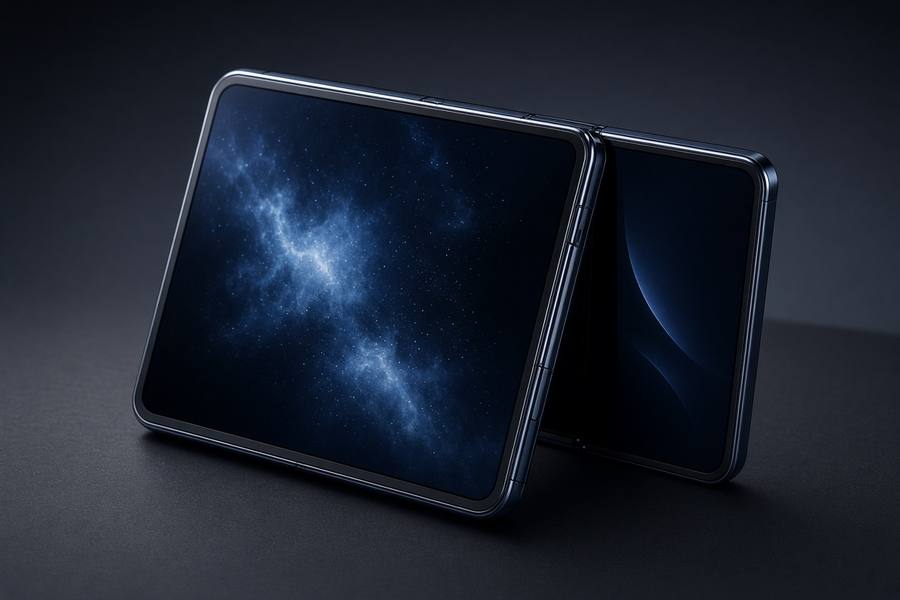
The Duo is official, not rumored. Closed, Apple says it is about the size of a passport and comfortable in one hand. Open, it becomes a 7.6-inch Super Retina XDR sheet — 80 percent larger than the 6.3-inch iPhone 18 Pro display and 50 percent larger than the 6.9-inch Pro Max. The cover screen is 5.4 inches, which Apple claims is 90 percent of the 18 Pro’s screen area, and both panels share the same aspect ratio, ProMotion, Always On, and up to 3,000 nits of peak outdoor brightness. Colors are Night Sky and Star White.
The internals are familiar on purpose. The Duo uses the same A20 Pro silicon as the new Pro phones. Storage starts at 256GB for $1,999 and climbs through 512GB ($2,199) and 1TB ($2,599) to a 2TB ceiling at $3,199 — a capacity Apple is also adding to the slab Pros this year. There are two batteries, one in each half, rated together for up to 31 hours of video on the inner display, 44 hours on the cover screen alone, and 24 hours if you split use evenly. Apple Pencil support is coming to both displays later this year, not on day one. The device is eSIM-only worldwide.
Ternus framed the product the way a hardware lifer would. “Others have created foldables that feel like two phones awkwardly stuck together,” he said. The pitch is continuity: same aspect ratio open and closed, a hinge that is supposed to disappear into a single frame, and software that treats the inner canvas as one display rather than a clamshell of apps. Netflix even got a shout-out for optimizing its app for the open layout. That is not a small tell. Apple is selling the Duo as a media and work surface that still pockets like a phone, not as a Galaxy rival that happens to run iOS.
Why the delay is the strategy
If Apple believed the Duo would clear the same volume as an 18 Pro on week one, it would have shared the September 12 pre-order window. It did not. Separating the SKUs does three useful things at once.
First, it protects the Pro attach rate. The 18 Pro starts at $1,199 and the Pro Max at $1,299, both $100 above last year, both with a variable-aperture 48MP Fusion camera, a 2-nanometer A20 Pro, a vapor chamber, and a smaller Dynamic Island that can hold three Live Activities. Those are the phones Apple needs to sell by the tens of millions before holiday. Putting a $2,000 foldable next to them on the same Saturday morning would have turned every shopping-floor conversation into a comparison Apple is not ready to win on supply or software.
Second, it buys software time. iOS 27 and the broader Siri AI push — Ternus’s “intelligent personal hub,” on-device first, Private Cloud Compute when it has to leave the phone, Siri wired into more than 300,000 apps — still have to land on slab iPhones that already exist. A foldable multiplies the surface area those features have to feel native on. Apple Pencil arriving as a later software update is an honest admission that the inner canvas is not finished.
Third, it is a Ternus-era tell. Cook’s Apple used the September event as a ritual of completeness. Ternus’s Apple used it as a staging area. The Watch Series 12 ($399) and Ultra 4 ($799) and AirPods 5 ($129 with ANC in the base case) still ride with the Pros. The form-factor bet does not. That is how a hardware CEO rations risk: ship the known business on time, give the unknown business its own month and its own inventory plan.
What to watch next
Watch the October 16 pre-order, not the keynote replay. If Duo reservations vanish in minutes in the first wave of 70-plus countries, Apple will look conservative for splitting the calendar. If they linger, the six-week gap will look like foresight — and the missing standard iPhone 18 this year will look like a lineup that is being rebuilt around Pro plus a new shape, with the cheap slab waiting until 2027.
Watch the hinge in the wild, and the crease, and whether 24 hours of mixed-screen battery holds up when people actually leave both panels awake. Watch whether developers treat 7.6 inches as an iPad Mini that fits in a jacket or as a stretched iPhone. And watch whether Ternus’s privacy-first AI story travels to a device whose entire point is that you open it like a book in public.
Apple did not refuse to ship a foldable first. It refused to let a foldable decide the quarter. That is the story under the passport-sized phone, and it is the first clear product decision of the Ternus years.
Comments
0