
The Portable Frontier: Why Apple’s M6 MacBook Pro Marks the Real Shift to Everyday Local AI
On October 27, 2026, Apple quietly refreshed its entry-level 14-inch MacBook Pro with the M6 chip, a 2-nanometer design that pairs a 12-core CPU, a 12-core GPU with Neural Accelerators in every core, and the company’s first Dual 16-core Neural Engine. Pre-orders open the following day and units ship from November 6 at a starting price of $1,999 with 16 GB of unified memory. The announcement is not a theatrical keynote reveal. It is a specification-driven update that places stronger on-device AI capability into a machine millions of students, freelancers, and professionals already carry.
The timing is deliberate. Cloud frontier models continue to grow more expensive to train and serve. Energy constraints, token costs, and latency all favor architectures that can keep useful inference local. Apple’s move does not claim to match the absolute scale of the largest data-center systems. It instead argues that the combination of unified memory, hardware Neural Accelerators, and a dual Neural Engine is now sufficient for many real creative and productivity workloads to stay on the laptop. That claim is worth examining in detail.
What the M6 Actually Delivers
M6 is Apple’s first 2 nm chip. Compared with the M5 that preceded it in the same chassis, the company states the 12-core GPU is up to 30 percent faster in graphics and up to 25 percent faster on AI workloads such as LLM prompt processing. The Dual Neural Engine is rated up to 1.9 times the prior generation and, according to Apple, system frameworks can address both engines simultaneously. Memory bandwidth reaches 170 GB/s, a modest but useful lift over the M5, while unified memory starts at 16 GB and tops out at 32 GB on this base model.
Battery life is listed at up to 24 hours, which Apple calls the longest in any Mac. Wi-Fi 7 and Bluetooth 6 arrive together, and the Media Engine gains hardware ProRes and ProRes RAW support. These are not incidental. Video editors and photographers who already live inside Apple’s creative apps gain both faster local inference for tools such as Super Resolution or intelligent masking and the connectivity to move large files without waiting on a hotel Wi-Fi connection.
Independent verification of the percentage gains will arrive once units are in reviewers’ hands. Apple’s own comparisons against the M1-era 13-inch MacBook Pro show far larger multiples—up to 13 times faster time-to-first-token on certain LLM prompts—because the baseline is older. The more relevant comparison for most buyers is the M5 machine they might already own or the Intel systems still common in corporate fleets. On those axes the gains are incremental yet meaningful once AI features become part of daily use rather than occasional demos.
Why On-Device Capacity Now Matters More Than Peak FLOPs

The industry conversation has spent the last two years focused on the largest training clusters and the capital required to feed them. That focus is not wrong, but it obscures a parallel shift. Once a model is trained, the cost of serving it repeatedly becomes the dominant economic variable. Cloud inference remains essential for the largest models and for multi-user agent systems. For single-user creative work—prompting a local image model, running a speech-to-text pass on interview footage, or letting an on-device assistant summarize a document while the laptop is offline—the economics reverse.
Related coverage of open models engineered specifically for high-end Apple silicon, such as Meta’s Muse Spark Open running on Mac Studios, already demonstrated that frontier-class weights can leave the data center when memory bandwidth and unified address space are sufficient. The M6 MacBook Pro does not reach that absolute scale; 32 GB of unified memory is still a constraint for the very largest open models. It does, however, bring the same architectural advantages into a portable form factor that travels. Developers who previously waited for a desktop or a cloud GPU queue can now iterate on smaller distilled or quantized models while sitting in an airport or a client office.
This is the practical meaning of the Dual Neural Engine and the per-core Neural Accelerators. Matrix operations that once required a discrete accelerator or a remote API call can now stay inside the SoC. Apple’s frameworks—Core ML, the newer Core AI layer, and Metal—are designed to schedule work across CPU, GPU accelerators, and the Neural Engines without the developer manually partitioning tensors. The result is less about raw peak throughput and more about making on-device features feel instantaneous and private.
Implications for Creators and Developers
For video editors the combination of hardware ProRes support and faster AI upscaling is immediately usable. A documentary shooter can apply Super Resolution or intelligent background removal to a rough cut without uploading hours of footage. Photographers working in Affinity or Pixelmator Pro gain the same local acceleration for batch processing. These are not speculative future features; Apple’s performance tables explicitly list Affinity image-processing and Blender ray-traced renders among the measured gains.
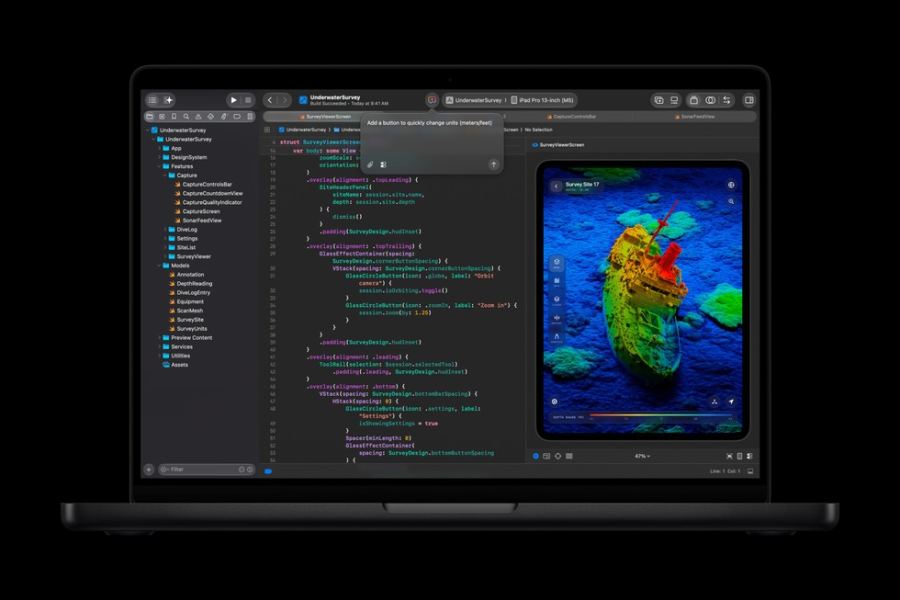
Developers see a different benefit. Xcode build times improve, and the ability to run and fine-tune modest models entirely on device reduces the friction of testing Apple Intelligence-style features or custom App Intents. The same machine that compiles the app can also run the local model that the app will call. That closed loop is difficult to replicate when inference lives only in the cloud. It also aligns with the broader movement toward inspectable, locally runnable stacks, whether those stacks originate from open-weight releases or from vendor-optimized frameworks.
None of this eliminates the need for larger models. Agents that must coordinate across many tools, maintain long-horizon memory, or search external knowledge still favor cloud or high-memory desktop systems. The M6 MacBook Pro simply raises the floor of what can be done privately and offline. For a large class of professional users that floor is now high enough to change default behavior.
What to Watch in the Coming Months
Independent benchmarks will clarify how the Dual Neural Engine behaves under concurrent load and whether thermal limits on the 14-inch chassis constrain sustained AI throughput. Early reports suggest the design prioritizes efficiency, consistent with Apple’s long-standing performance-per-watt emphasis, but real-world battery drain during continuous local inference remains to be measured.
Software adoption matters equally. Apple Intelligence and Siri AI features already ship in macOS 27. The rate at which third-party developers ship Core ML or Core AI models optimized for the dual-engine configuration will determine how widely the hardware advantage is felt. Parallel developments in open-weight models that fit inside 16–32 GB of unified memory will amplify the effect; the tighter the model, the more of the M6’s on-device capacity becomes usable for everyday tasks.
Competition from Windows on Arm and from discrete GPU laptops will also shape the narrative. Those platforms can offer higher peak memory capacities or more raw matrix throughput in certain configurations. Apple’s counter is integration: the same SoC that accelerates the model also drives the display, the media engines, and the continuity features that let an iPhone hand off a task mid-sentence. For users already inside that ecosystem the integration is often decisive.
Conclusion
The M6 MacBook Pro is not the most powerful AI computer Apple will ship this year. Higher-end M5 Pro and M5 Max configurations, and the M5 Ultra Mac Studio, remain the machines for the largest local models. What the 14-inch M6 represents is the moment when dual Neural Engines and per-core accelerators become standard equipment in the laptop that many professionals already buy as their primary machine. Once that threshold is crossed, the default assumption that serious AI work requires a cloud connection or a discrete accelerator begins to weaken.
For the industry the implication is cumulative. Every laptop that can usefully run local models reduces the fraction of inference that must be served from centralized clusters. The absolute volumes remain large, yet the economic and privacy incentives shift at the margin. Apple’s October 27 update is one more data point on that curve, delivered not as a vision of the future but as a shipping product with a price, a battery rating, and a pre-order date.
Related TechMash analysis of local frontier models on Apple silicon appears in The Quiet Migration. Broader open-weight progress is examined in the Kimi K3.1 Pro coverage and inference-cost shifts in DeepSeek’s DeepInfer release. Agent-oriented model design is covered in Meta’s Muse Wonder analysis, while local speech models appear in the discussion of Block’s Dessa.
Official details are available in Apple’s newsroom announcement and contemporary reporting such as Reuters’ summary.
Comments
0